Story code: ST-000274
Part 2: The Room Started Slipping
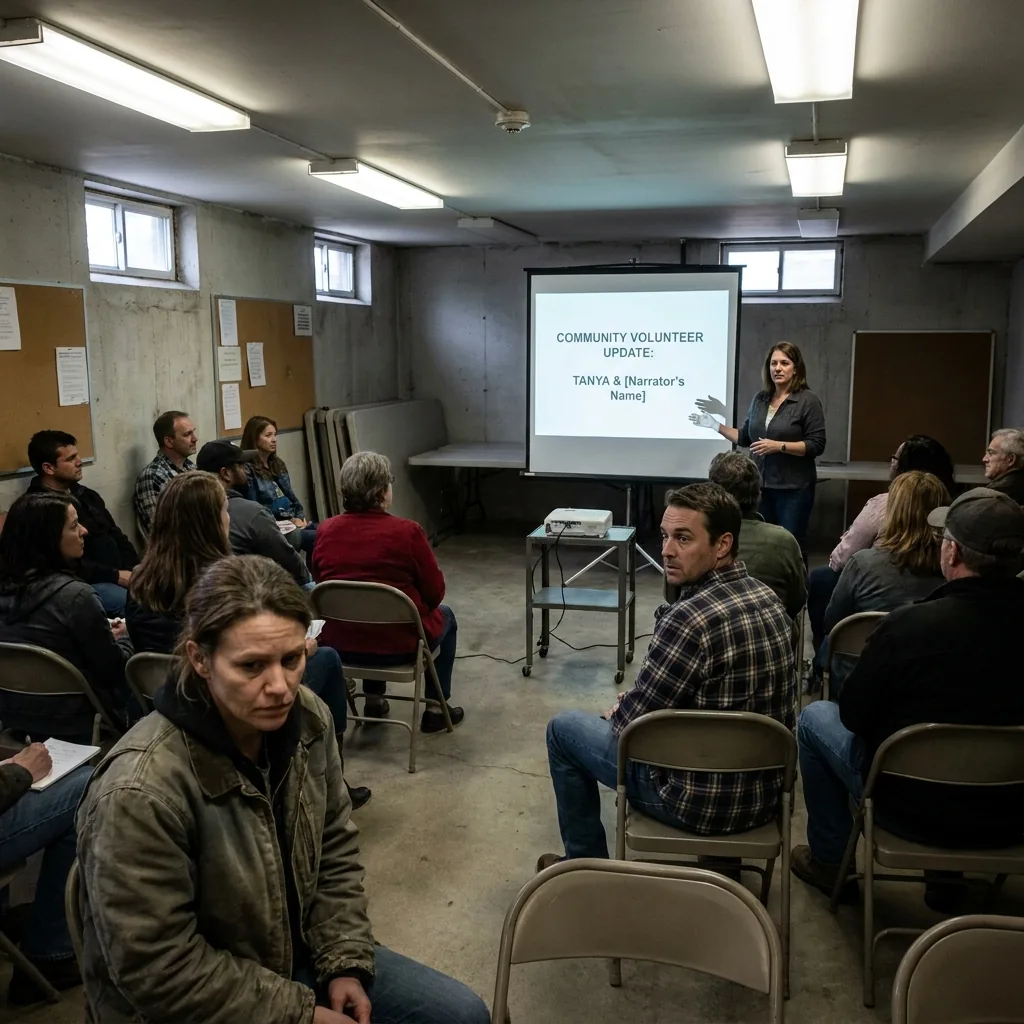
Tanya did not take my name off the announcement screen. She enlarged the slide instead, and the words got bigger over the folded tables and the kids’ room door like she was trying to make them harder to argue with. The projector threw a pale square over her hands, the remote, and the edge of the banner behind her. DeShawn stayed by the chair stack, one hand on the top chair as if he had forgotten what he was doing with it. Linda lowered her paper bag to the floor and kept her eyes on the screen.
“You heard me,” I said.
Tanya gave a short laugh that did not sound like humor. “I heard you. I also heard you forget where you are.” She motioned at the room with the remote. “This is a community center. People show gratitude here. They don’t create scenes because they don’t like being reminded of what they’ve been given.”
That was the second push, sharper than the first. She was tying obedience to gratitude so cleanly that I could feel the room being managed by it. Nobody had to say my name wrong or raise a fist. The screen did the work. The room did the work. She only had to stand there and make my refusal look rude.
I looked back at the slide. There were phrases on it I had not seen the first time because Tanya kept talking over them. “Support the organizer.” “Respect the investment.” “Return what was extended.” The language was polished enough to sound generous until you read it twice. Then it looked like a bill.
“You keep saying what you did,” I said. “Say it plain. What did you sacrifice?”
Tanya’s jaw tightened. She moved one step closer to the screen, putting her shoulder between me and the text. “I’m not doing this with you in front of everybody.” She lifted her chin toward the room. “Not after all the help I made available.”
The first visible harm was sitting right there in the open now: she had turned praise into a leash. People were watching her manage the room with that story. Nobody had to know the whole history to see the shape of it. The problem was not what she claimed. The problem was what she wanted the claim to buy her.
“Then don’t do it,” I said. “Turn it off.”
For the first time, she reached for the remote too fast. Her thumb hit the wrong button. The slide flickered and then stayed on my name, bigger than before because the projector had zoomed on the last click. A couple of people shifted in their seats. DeShawn looked down at the chair in his hand and set it back in the stack.
Tanya’s voice changed. It went flatter, tighter. “You are making this harder than it needs to be.”
“No,” I said. “You are.”
That got a reaction from her. Not a big one. Just enough. Her eyes snapped to mine, then to the screen, then back. For a second she seemed to realize the room was not following the performance the way she wanted. She tried to recover by speaking louder.
“I took responsibility when nobody else would,” she said. “I covered for this place. I covered for people. I kept things moving while other people enjoyed the results.”
The words landed with a strange gap in them. Covering. Moving. Enjoyed. It sounded rehearsed, but not solid. Linda lifted her phone a little, looked at the screen, and lowered it again. DeShawn cleared his throat and said nothing.
I kept my voice even. “If you covered for this place, why is my name on the screen like a debt notice?”
Tanya’s hand tightened around the remote. She tried to answer, but the sentence did not come out clean. She started over. “Because people need to understand what they owe.”
There it was again, stripped bare. Owe. Not thanks. Not teamwork. Owe.
I could hear a few chairs shift farther back in the room. Nobody spoke. Tanya looked from face to face, and I saw her trying to keep control of the frame without giving up the screen. But the room had started to notice the shape of the thing. The louder she got, the less steady it sounded.
I took one step back from the supply table. I did not raise my voice. I did not explain my side to the whole room. I just said, “I’m not carrying your story for you.”
Tanya blinked once, fast. The remote lowered in her hand. Her mouth opened, then shut. For a second the only sound was the projector fan and the scrape of a chair somewhere behind me.
Then she said, “Mara, don’t do this here.”
And that was the strange part. She sounded less like an organizer and more like somebody who had just noticed the burden she was counting on had moved off her side of the scale. She was still standing by the screen, but the room had started to see the strain underneath it. Why was the story so important to her now that she was losing the room by the second?