Story code: ST-001372
Part 3: The Masonry Truth
The fluorescent lights of the municipal council chamber buzzed with a low, sterile hum, a stark contrast to the dark, blood-slicked cobblestones that still haunted Julian’s sleep. Suspended above the zoning board’s curved mahogany desk, a massive projector screen displayed the frozen, high-definition image of Julian’s own terrified face. The viral video had amassed three million views in under a week. In the paused frame, his hands were stained crimson, his knees planted in the street, while the committee chairperson stood over him like a conquering general.
Sitting at the petitioner’s table, Julian stared at his own digital ghost. Beside him, Richard Sterling smelled faintly of scotch and expensive mints. Richard leaned close, his voice a tight, furious whisper.
“The board is ready to vote, Julian. Read the withdrawal statement. Apologize for the staging area’s negligence, beg for the community’s forgiveness, and we salvage the firm’s other three contracts. Do not go off script.”
Julian looked down at the printed apology resting on the fake-wood grain of the table. It was a complete surrender, a meticulously drafted lie designed to appease the heritage coalition.
At the central podium, Eleanor-listed on the official zoning docket by her full legal name, Eleanor Elaine Croft-was finishing her impassioned plea to the council. She wore the same immaculate silver bob and the same expression of theatrical sorrow she had weaponized on the street.
“The video speaks for itself,” Elaine said, her voice echoing through the packed chamber. “The victim, nearly killed by this developer’s reckless heavy machinery, is still in a halo brace. If you do not revoke the housing project’s zoning variances tonight, you are inviting further bloodshed into our historic sanctuary. We rest our case.”
She stepped away from the microphone, returning to her seat in the front row amid a wave of sympathetic murmurs from the gallery. She offered Julian a brief, victorious smile.
The council president adjusted his glasses. “Mr. Vance. You have the floor to enter your firm’s final response into the record before we vote.”
Julian stood. His legs felt heavy, but the paralyzing dread that had anchored him to the cobblestones two weeks ago was completely gone. He picked up his own manila folder, leaving Richard’s prepared apology untouched on the table.
He walked to the podium, the squeak of his shoes cutting through the quiet room. He didn’t look at the council. He turned his head to the AV technician sitting at the control desk in the corner.
“Can you unfreeze the video, please?” Julian asked, his voice steady. “And mute the audio. Play it from the five-second mark.”
Richard half-stood from his chair. “Julian, what are you doing?”
“Just watch,” Julian said.
The screen flickered to life. Without the harrowing, wet rasps of the dying man, the visual evidence became startlingly clinical. The camera panned sharply from the distant, fenced-off construction equipment down to the bleeding man, and finally to Julian’s face.
“Pause it there,” Julian instructed. “Can you zoom in on the victim’s chest? Specifically, his left collar.”
The image magnified, pixelating slightly. The crowd shifted, murmuring in confusion as the man’s frayed, blood-soaked jacket collar filled the screen.
“When I knelt down to stop this man from bleeding to death,” Julian said, looking directly at Elaine, “I saw a detail that didn’t make sense. The night was chaotic, and I was told by everyone holding a camera that our heavy machinery had caused this. But our machines had been locked down for hours. And more importantly, the man bleeding on the street wasn’t a construction worker.”
Julian opened his manila folder. He pulled out a high-resolution, glossy photograph provided by the police evidence file and held it up. It showed the same collar, perfectly clear, illuminated by a flash.
“The victim’s name is Marcus Thorne,” Julian said, his voice rising, bouncing off the acoustic tiles. “He is a structural masonry surveyor. And attached to his collar, as you can clearly see in this evidence photo, is a sheared-off brass carabiner. It’s a safety tether clip used for high-angle historic restoration. And the dust caked into the fraying of his jacket isn’t grey portland cement from our development site. It’s red, century-old mortar dust.”
The council president frowned, leaning over his microphone. “Mr. Vance, what is the relevance of this?”
“The relevance,” Julian said, snapping the folder shut and gripping the edges of the podium, “is that Mr. Thorne wasn’t anywhere near our housing project. He was inspecting the facade of the Montgomery Building. The very same historic building that Ms. Croft’s coalition had enveloped in restoration scaffolding.”
Elaine shifted in her front-row seat. The smug confidence on her face faltered, her posture suddenly rigid. “This is a desperate deflection. The man was in the street-”
“He was in the street because he fell,” Julian interrupted, his tone slicing cleanly through her defense. “I pulled the city surveyor’s log this morning. Thorne was on a ladder, ten feet up, checking the Montgomery masonry. At the exact same time, your coalition was conducting your evening walking tour. Twelve of you, wearing heavy coats, squeezing through a narrow, historic alleyway that had been choked down to three feet of clearance by your own scaffolding.”
“Mr. Vance, you are out of line,” Richard hissed from the table, recognizing the catastrophic shift in the room’s energy.
Julian ignored him, stepping out from behind the podium to close the distance between himself and Elaine.
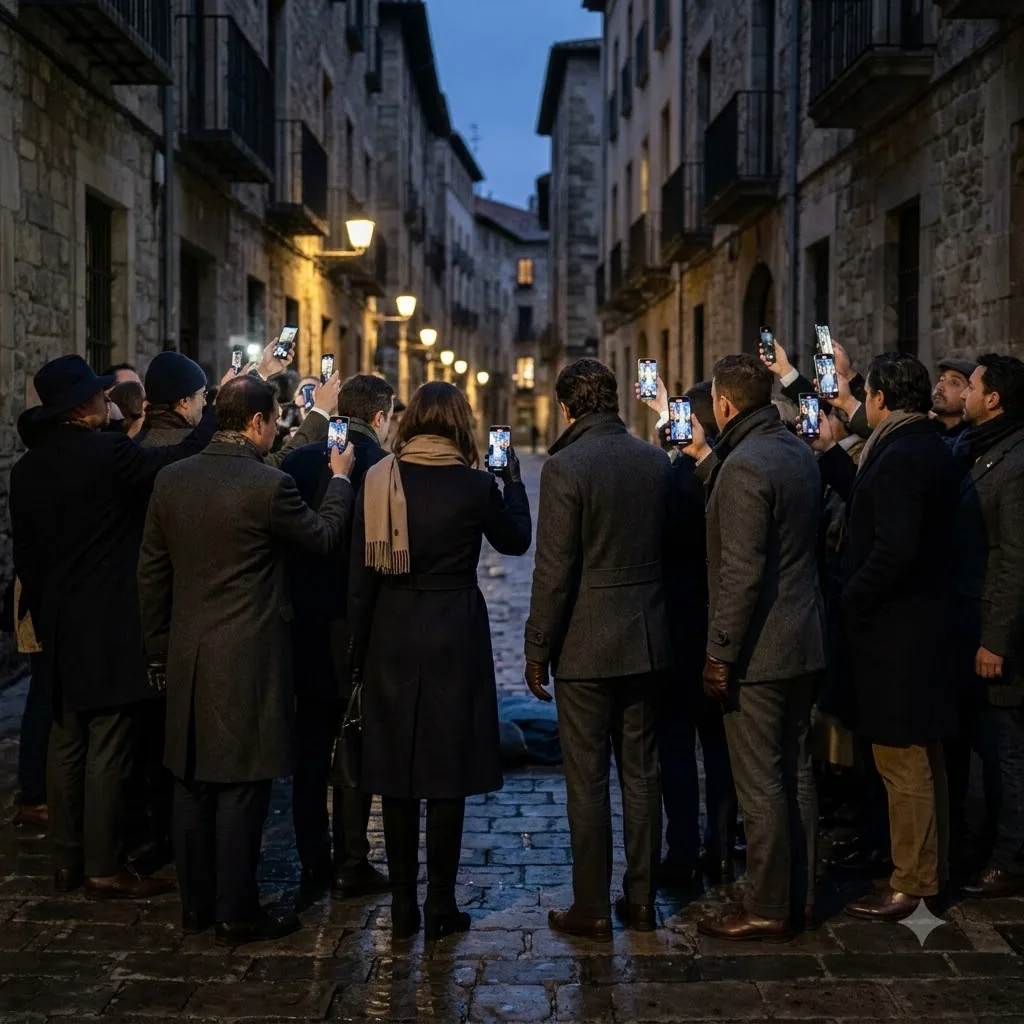
“You claimed in your broadcast that you came running when you heard the crash,” Julian said, pointing up at the frozen, zoomed-in video. “But look at the timestamp. Your recording started less than three seconds after he hit the ground. A dozen of you didn’t sprint down the block and form a perfect, synchronized semi-circle with your phones out in three seconds. You were already standing around him.”
The absolute silence in the chamber was deafening. The council members stared at the screen, then down at Elaine.
“You didn’t witness a tragedy caused by our development, Elaine,” Julian said, his voice dropping to a low, devastating timber. “Your group tried to force your way past the Montgomery scaffolding. You bumped the cross-brace. You knocked a surveyor off his ladder, and while he was bleeding on the cobblestones, you pulled out your phone and decided to frame the housing project to save yourselves.”
Elaine’s mouth opened. She reached blindly toward the small microphone stationed at the edge of the front-row tables. Her hand was visibly trembling. She opened her mouth to speak, to launch the righteous, theatrical indignation that had fueled her viral fame, but as the red active light on the microphone clicked on, not a single word came out.