Story code: ST-001378
Part 2: The True Cost
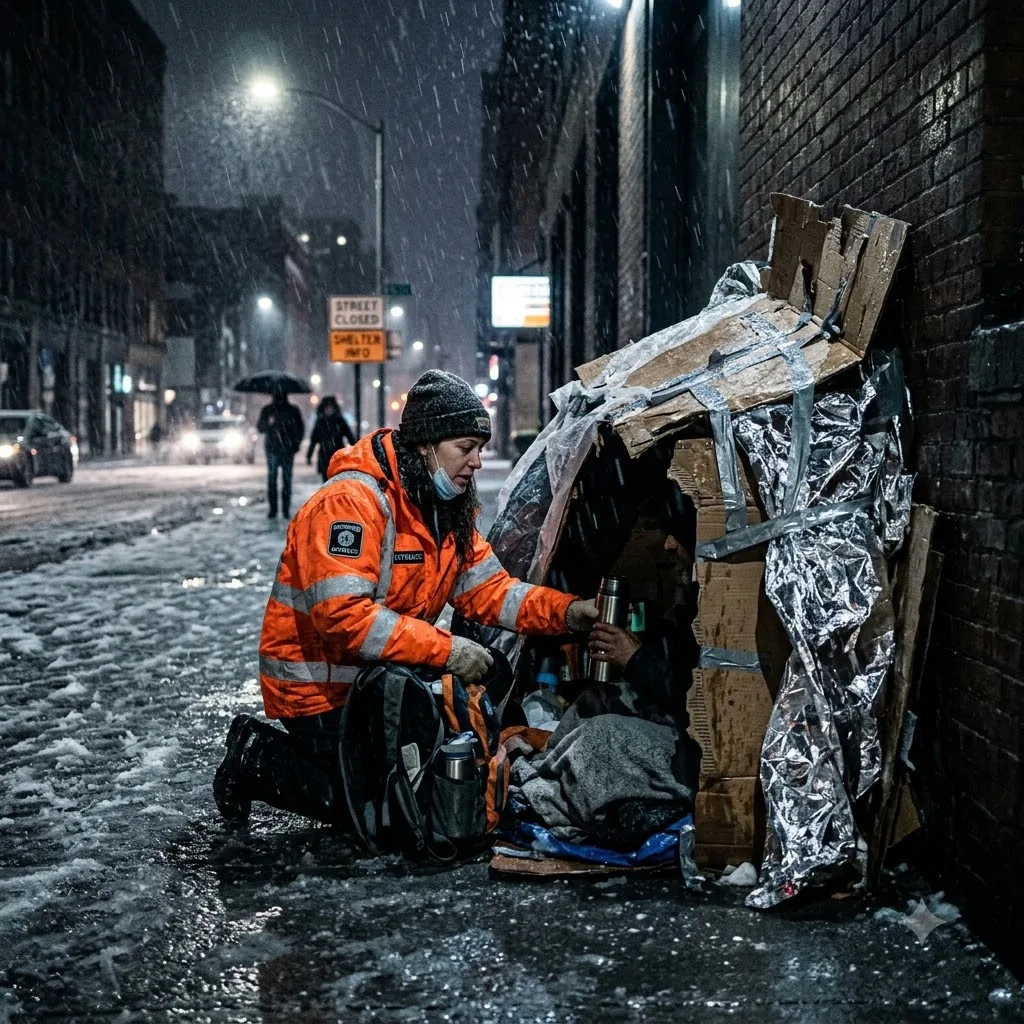
The halogen spotlight hit Marcus with the physical force of a tidal wave, washing the narrow alcove in a blinding, sterile white. The shadows inside the foil-lined barricade vanished in an instant, replaced by a harsh glare that caught every jagged edge of the glass shard pressed against Silas’s throat. The thin bead of dark crimson swelled, breaking its surface tension to trace a hot, wet line down the deep creases of Silas’s weather-beaten neck.
Behind Marcus, the twin diesel engines of the contractor’s heavy loader idled with a rhythmic, bone-rattling chug. The smell of raw exhaust rolled into the makeshift tent, thick and choking, mixing with the scent of unwashed wool and sharp, metallic ozone.
“City worker! Step clear!” a voice boomed through an external PA system, distorted and aggressively loud over the storm. “Zone Five is marked for clearance! We are dropping the plow in sixty seconds!”
Marcus didn’t turn around. He couldn’t. If he broke eye contact with Silas, he knew the old man would pull the mirror shard horizontally out of pure panic. The tension in Silas’s forearm was already piano-wire tight. His bare knuckles were bone-white, trembling violently with the agonizing effort of holding the improvised blade steady against his own pulse.
“Silas,” Marcus said. His voice sounded painfully thin, swallowed instantly by the roaring diesel engine and the relentless drumming of the sleet. He kept his hands raised at shoulder height, palms open and completely empty, freezing rain stinging his skin. “Silas, look at me. Just at me. Ignore the light.”
Silas’s chest heaved. His breath puffed in rapid, misty clouds that immediately froze in the eleven-degree air. “Not going to the Armory,” Silas rasped. The words vibrated against the glass, causing the sharp edge to dig a fraction of a millimeter deeper. “Not going back to the cages. I’ll bleed out right here, Marcus. I swear to God it.”
Marcus felt a sickening drop in his stomach. The Armory was the city’s largest emergency winter shelter. The winter protocol mandated that all displaced individuals be transported there when the temperature dropped below freezing. On paper, it was a triumph of municipal logistics-a thousand warm cots lined up neatly in a retrofitted gymnasium. In reality, Marcus knew exactly what it was: a concrete holding pen. To get one of those warm beds, individuals had to surrender all their personal belongings to an incinerator, endure a chemical lice strip-down, and sleep shoulder-to-shoulder with violent offenders and severe addicts in a locked room with no exit allowed until dawn. For a man like Silas, whose entire survival depended on isolation and strict control of his environment, the Armory was a fate significantly worse than freezing to death.
“You don’t have to go to the Armory,” Marcus lied, though the heavy hesitation in his voice betrayed him completely.
Silas barked a hollow, desperate laugh that sounded like dry leaves scraping over asphalt. “You’re a bad liar for a city man. Protocol says transport to the designated zone. That’s the Armory. You take me, or they crush me.”
Marcus’s shoulder radio crackled to life, the dispatcher’s voice cutting sharply through the static. “Unit Four, be advised, clearance crew is reporting a delay in your sector. Have you extracted the occupant? Code 33 is authorized if he’s resisting.”
Code 33. Police intervention. If Marcus called it in, two cruisers would arrive in less than three minutes. They would see a barricaded man holding a weapon to a hostage-even if the hostage was himself-and they would breach the alcove with tasers drawn, or worse. If they tased Silas right now, the electrical current would cause his arm muscles to instantly spasm, violently jerking the glass shard directly through his carotid artery.
“Move it, City!” a rough voice shouted over the howling wind.
Marcus risked a frantic half-glance over his shoulder. A massive man in a high-visibility yellow jacket was stomping through the icy slush, carrying a four-foot solid steel pry bar. Behind him, the front-end loader raised its hydraulic scoop, the rusted metal teeth gleaming under the amber strobe lights. The contractor wasn’t looking at Silas. He was looking at the wooden shipping pallets holding the structure together, calculating the best angle to shatter the frame. The private crews were paid by the ton. They didn’t care what was inside the cardboard.
“Stop!” Marcus yelled over his shoulder, holding his left hand out toward the contractor while keeping his right hand locked in Silas’s field of vision. “There’s a critical situation in here! Stand down!”
“Not my problem!” the contractor yelled back, freezing rain violently whipping off the bright orange brim of his hardhat. “Curfew hit twenty minutes ago. Supervisor says clear the block. If he doesn’t want to get scooped, drag him out by his boots!”
The contractor stepped right up to the edge of the alcove and swung the heavy steel pry bar into the outermost pallet. The impact sounded like a bomb going off in the confined space. The entire foil structure violently shook, snapping the duct tape and showering Marcus and Silas with a fine dust of dry ice and street dirt.
Silas screamed-a raw, utterly terrified sound-and instinctively pressed the glass inward.
More blood spilled. It soaked into the grimy, frayed collar of Silas’s thermal shirt, running down in thick rivulets. The cut wasn’t deep enough to hit the main artery yet, but it was dangerously close. Another swing of the pry bar, another shockwave of pure panic, and Silas would finish the job without even meaning to.
Marcus’s radio beeped again. “Unit Four, respond. Do you require PD backup to drag the resistant? Acknowledge immediately.”
The entire weight of his job, the unbending protocol, and the city’s brutal bureaucratic efficiency pressed down on Marcus’s frozen shoulders. The mandate was clear: preserve life by forcing the unhoused into the warmth, regardless of their consent, regardless of the trauma. Save the body, ignore the mind.
The contractor raised the pry bar for a second, devastating swing. The diesel loader revved its engine loudly, thick black smoke billowing out into the sleet.
Marcus looked at the dark blood pooling on Silas’s neck, then at the sheer, unadulterated terror in the old man’s eyes. The true cost of the city’s “warm beds” was staring right at him, preparing to bleed out in a frozen bank alcove.
Marcus finally made his choice.
He unclipped the heavy two-way radio from his shoulder harness, switched the power off, and dropped it into the freezing slush at his feet. Then, instead of dragging Silas out into the blinding spotlight, Marcus ducked his head, stepped fully inside the cramped, freezing cardboard shell, and reached out to pull the ruined foil flap completely shut behind him, sealing them both in the dark just as the hydraulic loader surged forward.