Story code: ST-001385
Part 2: The Dead Ignition
The heavy silence in the stifling, cedar-scented room pressed against Maya’s chest, making it impossible to draw a full breath. She stared at the crisp rectangle of paper trapped beneath Arthur’s manicured index finger. Two thousand, four hundred dollars. The exact sum required to stop the eviction, restore her negative bank balance, and buy her the four weeks she needed to secure her salaried position. All of it rested right there, inches from her trembling hand.
“No,” Maya whispered. The word felt like sandpaper in her dry throat. “No, I am staying with them. If they come here, I come here.”
Arthur did not blink. He did not shift his weight. The blue light from the silent nature documentary flickered across his face, casting long, shifting shadows that deepened the hard lines around his mouth. “That was not the offer, Maya.”
“They are seven years old,” she said, her voice gaining a desperate, fractured edge. “They do not know you. They have not been in this house since they were toddlers. I am not leaving them here alone with you.”
“You are leaving them on the street,” Arthur corrected, his tone as smooth and indifferent as glass. “You are choosing to drag them out into the freezing cold because of your stubbornness. I am offering them a warm bed. A safe house. A sprawling backyard. And I am offering you the means to keep a roof over their heads during the week.”
“Safe,” Maya repeated, the word tasting like ash. Her eyes darted to the heavy crystal tumbler of scotch sitting on the mahogany desk, then back to his perfectly combed silver hair. She remembered the shattered plates. She remembered the booming, unpredictable rage that used to rattle the windows of this very room, the sudden explosions over a misplaced television remote or a shoe left in the hallway. “They aren’t safe here without me.”
Arthur slowly lifted his finger from the check. For a second, Maya’s lungs expanded, thinking he was yielding. Instead, he picked up the slip of paper, folded it precisely in half, and then in half again.
“I have early meetings tomorrow,” Arthur said, ignoring her accusation entirely. He opened the top drawer of the mahogany desk and dropped the folded check inside. The heavy wood slid shut with a definitive, hollow thud. “I will be awake by seven. The banks open at eight. You have until seven-thirty to knock on that front door with the twins. If you arrive at seven thirty-one, I will not answer.”
Maya stared at the closed drawer. Her hands shook so violently she had to clench them into fists and press them against her thighs. “Please,” she choked out, hating the tears of humiliation burning hot in the corners of her eyes. “Arthur, please. It is just a loan. I will pay it back with interest the second my salary clears. Do not do this to them.”
“Seven-thirty,” he repeated. He turned his back to her, picking up the television remote and raising the volume a single notch. The narrator’s voice droned into the room, discussing the migration patterns of apex predators. The conversation was over.
Maya stood rooted to the Persian rug for ten agonizing seconds. The cedar and scotch were making her nauseous. The crushing weight of the eviction notice sitting in her car slammed back into her reality. She turned on her heel and practically ran out of the living room, her boots echoing sharply against the hardwood floor of the foyer. She threw open the heavy oak door and stepped out into the biting winter wind.
The cold hit her like a physical blow, instantly freezing the moisture on her eyelashes. She pulled her thin wool coat tighter around her chest and hurried down the pristine concrete driveway. The wind howled through the barren branches of the oak trees lining the affluent street, cutting straight through her worn denim jeans.
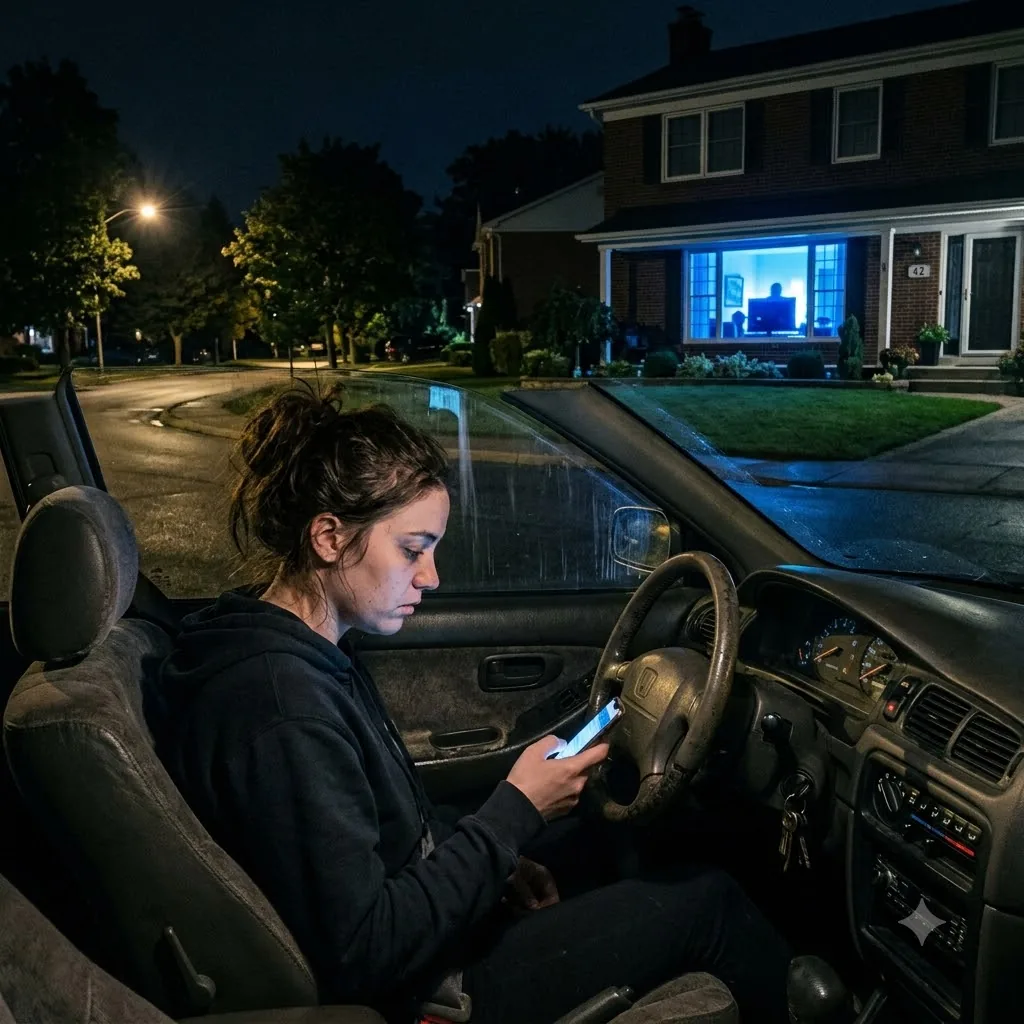
She yanked open the door of her ten-year-old sedan and collapsed into the driver’s seat. She slammed the door shut, locking it instantly, as if Arthur might follow her out. But the porch remained empty. The house stood silent and dark, save for the rhythmic blue pulse in the wide front window.
Maya buried her face in her freezing, numb hands and let out a single, ragged sob. The yellow eviction notice sat on the passenger seat, mocking her. The empty juice boxes reminded her of the two small children currently sleeping on an air mattress in a drafty apartment, oblivious to the fact that their mother had just failed them.
She had chosen the street over the house. She had chosen financial ruin to protect them. But as the adrenaline began to fade, the sheer, logistical terror of that choice took hold. She had no money. She had no family to call. She had no credit left to leverage. In less than forty-eight hours, the sheriff would physically remove their belongings and lock the apartment door.
She reached out with a trembling hand and slid the key into the ignition. She needed to get back to them. She needed to pack whatever she could fit into the trunk and figure out which homeless shelter had open beds on a Tuesday night.
She turned the key.
The engine clicked. Once. Twice. A rapid, hollow stutter.
Maya froze. She held her breath, waiting a few seconds, and tried again.
Click-click-click-click.
The dashboard lights flared weakly, then died. The battery, already strained by the freezing temperatures and the short, infrequent trips around town, had given out entirely.
“No,” Maya whispered, frantically pumping the gas pedal as if it would make a difference. She turned the key again, twisting it violently. “No, no, no, please.”
Nothing. Absolute silence, save for the howling wind battering the thin glass of the windshield.
Maya dropped her head against the freezing plastic of the steering wheel. She was trapped. She was parked illegally on the street of a gated community she didn’t belong in, miles away from her apartment, with a dead car she couldn’t afford to tow. The temperature in the cabin was already dropping rapidly, her breath pluming in thick white clouds in the darkness.
She slowly lifted her head and looked through the frost-rimmed glass of her windshield. Across the street, the massive, imposing house sat perfectly still. The blue glow of the television pulsed steadily through the living room window. Inside that warm, safe house was a folded piece of paper in a mahogany drawer that could fix everything.
She checked her phone. The battery was at seven percent. The bright red negative balance of her banking app was still the last thing open on the cracked screen.
Then, a new text message notification dropped down at the top of the glass. It was from Sarah, the neighbor who was watching the twins.
Maya, I am so sorry, but the property manager is here. He says you violated the lease by being three months behind, and he is changing the locks right now. He told me to get the kids out.
The yellow eviction notice hadn’t been a forty-eight-hour warning. It had been a formality. They were already homeless.
Maya stared at the blue light pulsing from Arthur’s window. It was no longer a question of if she could survive the debt by the weekend. It was a question of whether her children could survive the night.