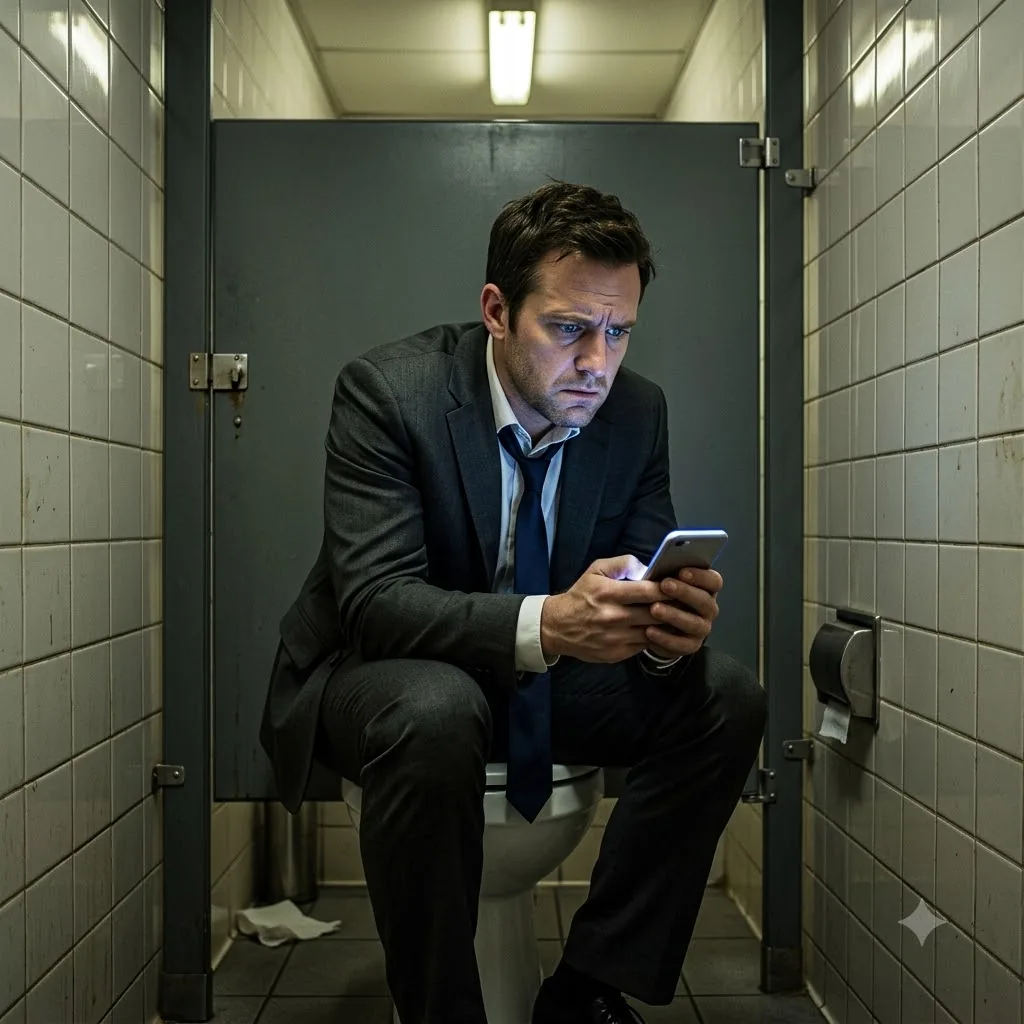
Story code: ST-001404
Part 4: The Digital Vacuum
The heavy hydraulic hinge of the main washroom door groaned, followed by a definitive metallic click. The silence that rushed into the executive bathroom was absolute, heavy, and suffocating.
Greg remained pressed against the cold aluminum of the stall door. His hands were completely numb, locked in a white-knuckled grip around the deadbolt mechanism. He waited for David’s rubber soles to squeak back across the tile, for someone to tell him it was a misunderstanding, but the only sound was the indifferent hum of the overhead ventilation fan.
It took him three tries to slide the deadbolt back. His damp fingers slipped repeatedly against the metal. When the door finally swung open, the harsh fluorescent light above the sinks stung his eyes. He stepped out on trembling legs, his scuffed leather shoes leaving faint, sweaty prints on the pristine ceramic tile. He caught his reflection in the mirror above the motion-sensor faucets. His tie was skewed, his collar soaked in a cold sweat, his face pale and slack. The ruthless, untouchable executive who had walked into this washroom twenty minutes ago was gone.
Greg pushed through the main door and stumbled out into the fourth-floor corridor. He braced himself for the stares, for the whispers of the staff, but as he rounded the corner toward the open-plan sales pit, he froze.
The floor was entirely deserted.
The sea of outstretched arms and lifted smartphones had vanished. The towering standing desks were abandoned in various states of adjustment. Half-empty iced coffees sweated onto mousepads. A single desk fan oscillated back and forth, blowing a stack of quarterly projection reports onto the commercial carpet. The entire division had been evacuated.
At the far end of the room, near the glass-walled server enclosure, Mark from IT sat hunched over a terminal. Greg swallowed hard, his throat like sandpaper, and walked slowly down the central aisle.
“Mark?” Greg croaked.
Mark flinched but didn’t turn around. His wire-rimmed glasses reflected the rapid scrolling of a command-line interface. “David sent everyone home, Greg. Paid administrative leave for the rest of the week.”
“Where is Julian?” Greg asked, his voice barely a whisper.
“Gone,” Mark said flatly, his fingers flying across the mechanical keyboard. “He formally resigned. HR rushed the paperwork downstairs. Maya had them sign a settlement before the paramedics even loaded him into the ambulance.”
Greg stared at the empty space on the carpet where Julian had collapsed. The indentation of a heavy boot-a paramedic’s, maybe-was pressed into the nylon fibers. “He resigned? But I terminated him. The PIP…”
“There is no PIP,” Mark interrupted, his tone devoid of the usual deference he showed management. He hit the enter key with a sharp clack. “Legal reclassified his exit. It’s a voluntary resignation with full severance and medical continuation. In exchange, the company retains the rights to the security footage.”
Greg’s phone buzzed in his pocket. He pulled it out, staring at the cracked screen. The Slack app icon, usually glowing with dozens of red notification badges, was completely blank. He tapped it. The general channels, the sales-floor discussions, the direct message threads-they were all locked out. An error message claimed his credentials had been revoked.
“What are you doing, Mark?” Greg asked, a sickening realization taking root in his stomach.
“Scrubbing the servers,” Mark said. He finally stopped typing, though he still refused to look at Greg. “David’s orders. Wiping the cloud backups, deleting the local caches, purging the intranet. The company is eliminating the liability. By tomorrow morning, digitally speaking, Julian’s collapse never happened here.”
Greg looked around the massive, echoing room. He had fought relentlessly for this space. He had clawed his way up the corporate ladder, sacrificed his personal life, and ruthlessly optimized his team to earn this exact view. He had built an empire of efficiency, populated by people he controlled through fear and metrics. Now, the desks were empty, the screens were dark, and the corporate machine was quietly erasing the mess, preparing to discard the single remaining liability: him.
Mark shut down the terminal, grabbed his backpack, and walked briskly toward the elevators, leaving Greg entirely alone.
The silence in the open-plan office was deafening. Greg walked heavily toward his corner office, his legs feeling like lead. He didn’t sit in his ergonomic executive chair. Instead, he sank down onto the floor, his back resting against the cold glass wall overlooking the empty pit.
IT had scrubbed the servers, wiped the Slack channels, and purged the company devices. The viral nightmare had been digitally vaporized by the HR machine. But they couldn’t remotely wipe his local, personal storage.
His thumb hovered over the cracked glass. He opened the photos app. There it was. He was staring at the deleted video on his own phone-the raw, unedited version he had recorded himself.
Greg pressed play.
There was no digital barricade of coworkers to hide behind in this angle. There was no distance. The screen filled with Julian, collapsed on the commercial carpet, his hands desperately clutching his ears, his chest heaving as he drowned in a sensory nightmare. The audio played softly into the empty office. Greg heard Julian’s high, keening gasp, followed by his own voice, cold and clinical, manufacturing a lie for a file that didn’t exist.
Then came the push. The vicious, unnecessary shove of a leather shoe against a terrified man’s chest.
The video looped. Julian fell, over and over again, trapped forever in the cracked glass of Greg’s phone. Greg didn’t swipe away. He didn’t lock the screen. He sat on the floor of the echoing, empty office he had fought so hard to fill, staring at the absolute truth of what he had done, drowning in inescapable guilt.