Story code: ST-001411
Part 4: The Weight of Tomorrow
Marcus didn’t move. He kept his breathing steady, watching the older man through the glass. The silence on the shaded porch stretched, broken only by the distant, rhythmic idle of the tow truck’s diesel engine down the street.
Arthur’s gaze remained locked on the greasy, blood-smeared fingerprint Marcus had left on the pristine pane. The retired HOA president’s throat worked, swallowing hard. His hand, still gripping the tablet, slowly lowered to his side.
A sharp click echoed in the foyer. Arthur turned the deadbolt on the storm door and pushed it open. The conditioned, cool air of the house washed over Marcus’s sweat-soaked coveralls.
Arthur didn’t say a word. He didn’t offer an apology, and he didn’t look Marcus in the eye. He simply stepped past him onto the porch and began walking down the paver walkway.
Marcus turned and followed, his heavy boots dragging on the concrete. The adrenaline that had propelled him up the street was evaporating, leaving behind a profound, hollow exhaustion and the sharp, throbbing agony of his burned palm.
They reached the driveway. The tow truck driver was leaning against the flatbed’s control panel, checking his phone. He looked up as Arthur approached.
“You the one who called it in?” the driver asked.
Arthur reached into his pocket and pulled out a leather money clip. He peeled off two crisp hundred-dollar bills and held them out. “Drop the truck. The call was a mistake.”
The driver eyed the cash, then looked at Marcus’s battered face and soot-stained chest. He didn’t ask questions. He snatched the bills, shoved them into his high-vis vest, and pulled the hydraulic lever.
The winch hissed loudly. The heavy steel cable went slack, and the rear suspension of Marcus’s welding rig settled back into place with a metallic groan. The driver walked to the back, kicked the J-hook loose from the leaf spring, and dragged the heavy chain back onto the flatbed. A minute later, the reverse alarm blared briefly, and the large diesel truck lumbered out of the neighborhood, leaving behind a cloud of exhaust.
Marcus stood in his driveway, the silence of the suburb rushing back in to fill the void.
Arthur stood a few feet away, staring down at the crushed, melted remains of his drone fused to the truck’s undercarriage. He slowly raised his tablet.
Marcus tensed, his injured hand curling into a protective fist, but Arthur didn’t open the camera. Marcus watched the glowing screen as Arthur navigated to the property management portal. With a few deliberate taps, Arthur opened the violation log. He swiped across the pending $150 fine and hit the red ‘Delete’ icon. He opened the video repository. Another tap. Another deletion.
Arthur turned the tablet around. The screen displayed a blank resident ledger. The balance was zero.
“I’ll log the drone as a pilot error,” Arthur said. His voice was thin, stripped entirely of its former bureaucratic authority. “A total loss due to user negligence.”
“Yeah,” Marcus rasped.
Arthur lowered the device. He looked at Marcus’s burned hand, then at the grease-stained medical envelope still clutched in Marcus’s other fist. Arthur opened his mouth, perhaps to offer a platitude, but seemed to realize there were no words that could bridge the gap between a retired man’s hobby and a father’s survival. He turned and walked back toward his house, his shoulders slumped, leaving Marcus alone in the driveway.
The sun finally dropped behind the rooflines of Oak Creek Estates. The oppressive humidity broke, and the evening air turned rapidly cold, chilling the sweat that soaked Marcus’s shirt.
He had six hours until he needed to be at the municipal water treatment plant.
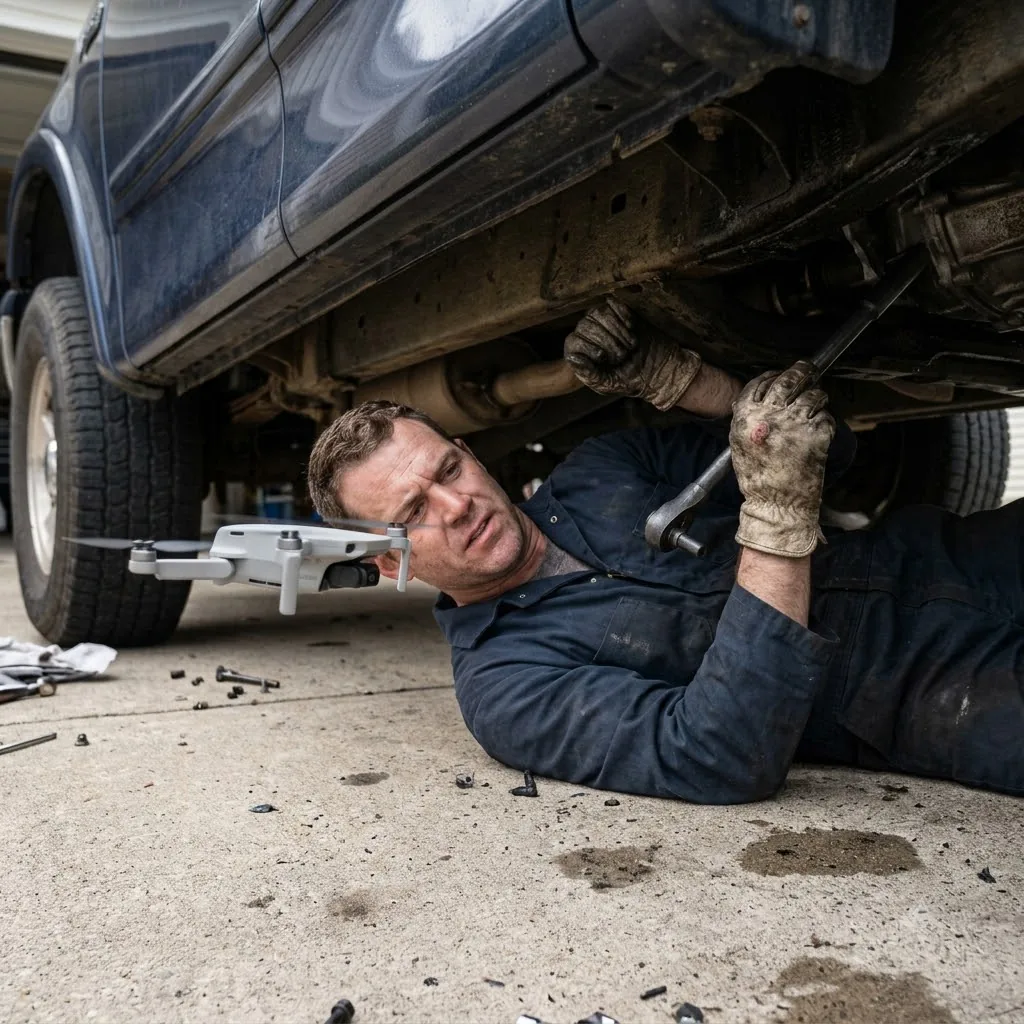
Marcus walked to his toolbox and pulled out a cold steel chisel and a heavy ball-peen hammer. He laid on the freezing concrete and slid back into the narrow, fourteen-inch clearance beneath the truck. The sharp smell of burnt lithium still stung his nostrils. He positioned the chisel against the hardened, melted plastic fused to the U-joint.
He swung the hammer. The impact sent a vicious shockwave into his blistered palm. Marcus gritted his teeth, squeezed his eyes shut against the pain, and swung again.
It took him an hour of agonizing work in the fading light to chip the ruined plastic away from the hex nut. It took another two hours to finally break the rusted bolt free, swap the damaged driveshaft component, and torque everything back to spec.
When he finally dragged himself out from under the chassis, the neighborhood was pitch black, illuminated only by the soft, warm glow of decorative gas lamps.
Marcus stood up, his joints popping in the cold air. He tossed the tools into the truck bed and climbed into the cab. He turned the key. The heavy diesel engine roared to life on the first crank, vibrating steadily, ready for the night’s labor.
He reached across the dashboard and picked up the crumpled medical denial letter.
He had his truck back. He had the job. Tomorrow morning, he would hand the hospital a cashier’s check for twelve thousand, four hundred dollars. His daughter would get her first round of immunosuppressive therapy. He had won the day.
But as Marcus stared at the corporate logo on the envelope, the victory felt impossibly heavy. The county contract would drain his account back down to double digits by tomorrow afternoon. This wasn’t a cure; it was just a down payment on a reprieve. The brutal, unfeeling machinery of the medical system was still waiting for him tomorrow, and the next day, and the day after that.
Marcus shifted the heavy rig into gear, his burned hand gripping the steering wheel tight, and rolled out into the dark.