Story code: ST-001475
Part 2: The Hum of the Hive
The rehearsed speech about boundaries and municipal zoning died instantly in Eleanor’s throat. The man sitting on the milk crate did not look like the entitled, parasitic thief she had built up in her head over the last twenty minutes. He looked small, hollowed out by the damp cold, wrapped in a faded sleeping bag that was heavily patched with silver duct tape. His hands, hovering over the pathetic, smokeless fire, were trembling worse than hers did on her bad days.
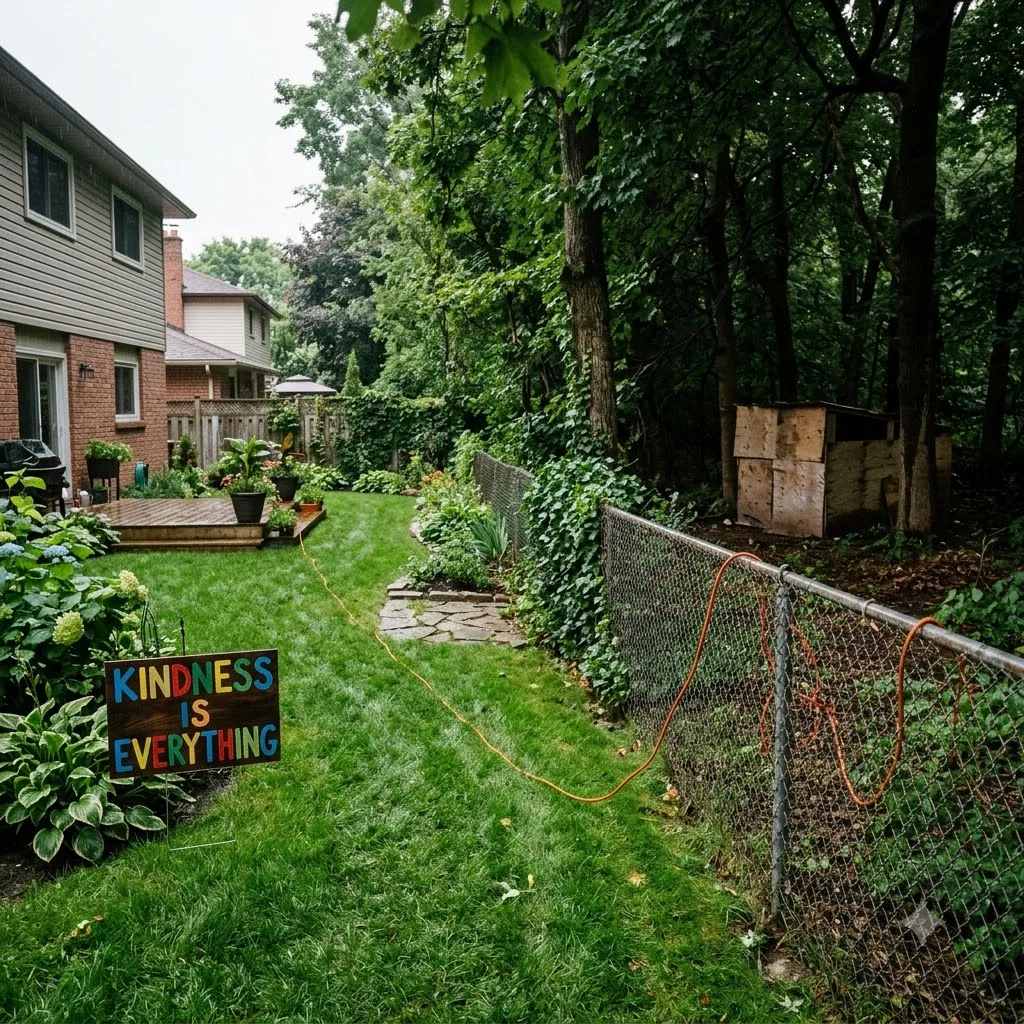
Eleanor swallowed hard, her grip on the thick orange rubber cord slipping slightly as the dew mixed with the nervous sweat on her palms. She had expected defiance. She had wanted a fight to justify the simmering rage that had been keeping her warm. Instead, the man slowly lowered his hands and stared at the bright orange line connecting them, a look of profound, terrified resignation washing over his weathered face.
“I know,” the man rasped, his voice barely rising above the rustle of the dead leaves. “I know it’s yours. I’m sorry.”
Eleanor’s jaw tightened. An apology was not the forty dollars she needed to balance her spreadsheet. It did not erase the violation of her property line, and it certainly did not fix the terrifying numbers waiting for her in the regional neurology portal. “You’re stealing from me,” she said, her voice sounding unnervingly shrill in the quiet woods. “You bypassed my fence and plugged into my house. What could you possibly be running out here that gives you the right to run up my utility bill?”
Before he could answer, a sudden, sharp spasm shot up Eleanor’s left arm, originating from her wrist and exploding into her shoulder. The cord jerked in her hand. It was the same neurological misfire she had been trying to ignore for six months, the one the specialists said would only get worse without immediate, aggressive intervention. She clamped her right hand over her left wrist, forcing the tremor down, masking her physical vulnerability behind a wall of pure, unadulterated hostility.
“Show me,” Eleanor demanded, stepping closer to the faded green tent. “Show me what you are running on my electricity.”
“Please, lady,” the man pleaded, half-rising from his plastic crate. “It’s just a small draw. Barely anything. I can try to get you some money by the end of the week. Just don’t pull the plug. If you pull it, everything goes bad.”
“Forty dollars,” Eleanor snapped, the financial injustice overriding her fear. “That is not ‘barely anything’ when I am keeping my house at freezing temperatures to survive. Move.”
She didn’t wait for him to step aside. Driven by a volatile mix of panic and the desperate need to exert control over something in her failing life, Eleanor pushed past him. The man shrank back, too weak or too afraid to physically stop her. She grabbed the half-open zipper of the tent flap and yanked it upward.
The interior of the tent smelled heavily of mildew and old wool, but it was surprisingly organized. There was a thin sleeping pad, a neatly folded stack of clothes, and in the far corner, the source of the mechanical hum. It was not a space heater. It was not a luxury television or a hot plate.
Sitting on a piece of rigid foam board was a small, pristine white portable medical refrigerator.
Eleanor stepped into the tent, her boots sinking into the soft ground beneath the nylon floor. The bright orange extension cord snaked straight into the back of the pristine unit. A digital temperature display glowed a harsh, clinical blue on the front panel, reading exactly 38.5 degrees Fahrenheit. It was the only clean, modern object in a radius of garbage and decay.
She crouched down, her knees popping loudly in the confined space, and peered through the condensation-streaked glass door of the cooler. Inside, sitting neatly on two wire racks, were three identical, highly specialized cardboard cartons.
Eleanor stopped breathing. The cold dread that usually lived in her stomach rushed violently into her chest.
She knew that specific logo. She knew the sterile, minimalist font. It was the exact branding from the glossy brochures the neurologist had handed her last month. It was the biologic injection therapy-the highly volatile, temperature-sensitive medication that could halt the progression of her nerve degradation. It was also the medication her insurance had flatly refused to cover, leaving her with a monthly out-of-pocket cost that equaled the remaining principal on her mortgage.
The man appeared in the tent flap behind her, blocking out the gray morning light. “It has to stay between thirty-six and forty-six degrees,” he whispered, his voice cracking. “The clinic gave it to me through a compassionate use grant. But I lost my room at the boarding house two weeks ago. If it gets warm, the proteins break down. It’s ruined.”
Eleanor’s eyes remained locked on the boxes. A compassionate use grant. A charity program she had been told had a three-year waitlist. This man, living in a damp tent, shivering over an aluminum can, had a three-month supply of the exact chemical compound required to save her motor functions. And he was keeping it alive using her electricity.
Her left hand spasmed again, harder this time, her knuckles knocking against the glass door of the cooler. The digital display blinked, the internal compressor humming steadily, drawing another fraction of a cent from her grid.
“If it gets warm, it’s ruined,” Eleanor repeated slowly, the words feeling foreign and heavy on her tongue.
“Yes,” the man said, taking a hesitant step into the tent. “I know I stole from you. But if you pull that cord, I won’t be able to walk by December. Please. I have nowhere else to plug it in.”
Eleanor slowly stood up, her head nearly brushing the damp nylon ceiling. She looked down at the orange cord still clutched tightly in her right hand. She could unplug it right now. She would have her forty dollars back. She would have her boundaries restored. And the priceless, life-saving medication sitting in the dirt would turn to useless water by lunchtime.
She looked back at the man, a new, terrifying calculation taking shape in her mind as the sharp, shooting pain in her arm flared once again.