Story code: ST-001487
Part 2: Three Minutes Late
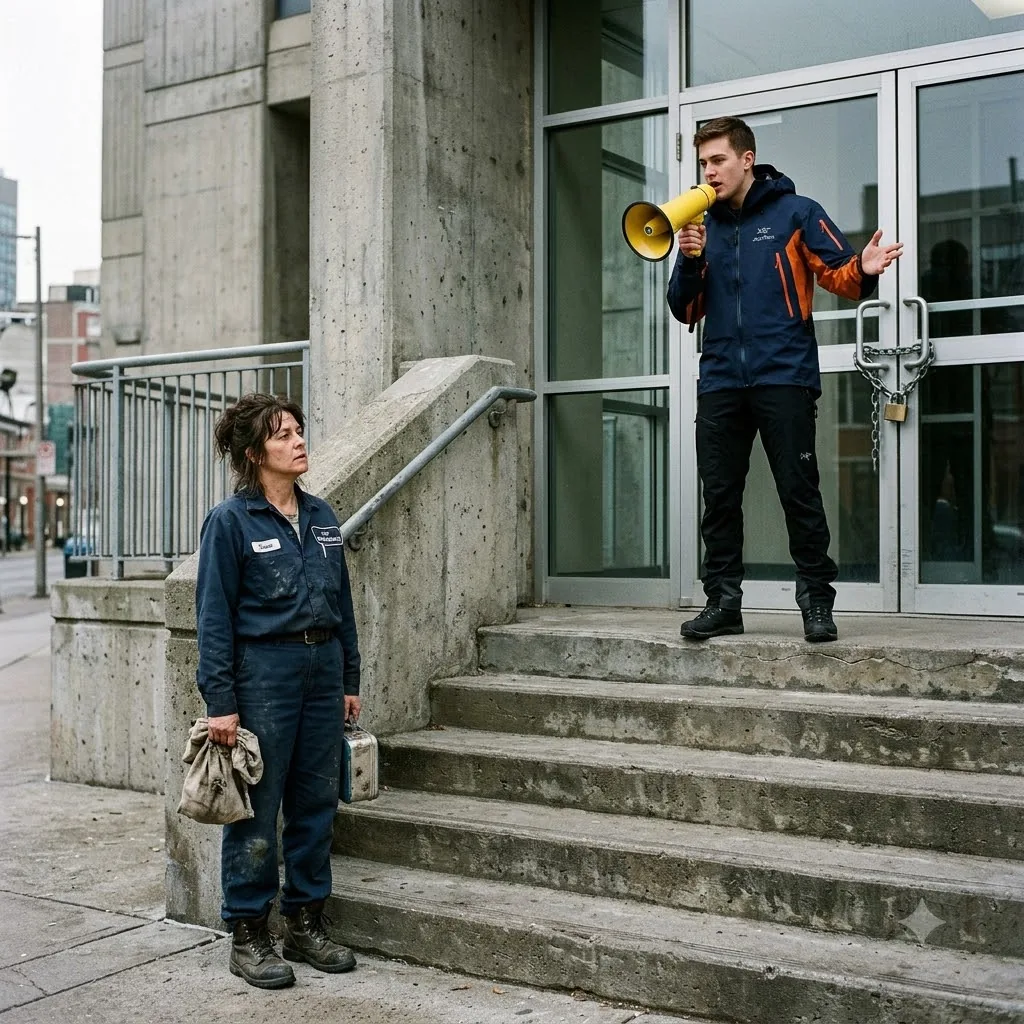
Sarah felt the sudden, shocking heat of his palm against her freezing skin. His grip was remarkably tight for someone who had just spent ten minutes preaching about non-violence. His knuckles went white, and the heavy, custom silver signet ring on his index finger dug sharply into the fragile tendons of her wrist. He did not let go. Instead, he leaned in closer, the scent of organic peppermint and expensive, earthy sandalwood cologne washing over her face.
“Hey, whoa, let’s not get violent,” he said. His voice was completely devoid of panic, dripping instead with a performative, theatrical calm. He wasn’t speaking just to her; he was projecting to the half-dozen camera lenses that had suddenly swiveled in their direction.
Sarah stared at his long, manicured fingers wrapped securely around her forearm. She did not instinctively yank her arm back. She knew exactly how that would look on the inevitable social media clips that would be uploaded before noon. If she pulled away, the sudden, jerky movement would be framed as a struggle, an attack. She simply kept her right hand firmly clamped on the freezing steel of the Master Lock, refusing to cede the one inch of ground she had taken.
“Let go of me,” she said. Her voice remained dead flat, barely carrying over the renewed, energized chanting of the crowd.
“You’re trying to break the barricade,” the young man said, shaking his head in mock disappointment. He looked back over his shoulder at his audience, playing directly to the cheap seats. “We are maintaining a peaceful blockade! We cannot let the administration’s pawns dismantle our vital work!”
A girl with a silver septum piercing and a bulky, hand-knit scarf shoved her phone mere inches from Sarah’s face. The screen showed the red recording dot blinking steadily, capturing every microscopic detail of Sarah’s tired eyes and frayed coat collar. “We have a hostile campus employee attempting to use physical force against a peaceful sit-in,” the girl narrated to her live feed, her voice shrill and urgent. “Why are you supporting a predatory institution? Why are you using violence against us?”
Violence. Sarah’s jaw throbbed from how hard she was clenching her teeth. She weighed a hundred and ten pounds in her heavy wool coat, and this protest leader, who had at least six inches and eighty pounds on her, was physically restraining her against her will. Yet, in the glowing screens of the twenty-odd smartphones surrounding her, she was the violent oppressor.
Her left hand remained buried deep in her coat pocket. Her blunt fingernails dug viciously into the stiff, thick paper hidden in the lining. She traced the harsh, permanent crease right down the center of the page, pressing until she felt the cheap paper fibers begin to yield and tear under the pressure. The document was a ticking countdown clock. It was the entire, pathetic reason she was standing in the biting morning air, fighting for the right to sit behind a fluorescent-lit desk and get yelled at by undergraduates about late registration fees. If she did not punch into the time clock software, the paper in her pocket became a reality she could no longer hold off.
Deep inside her opposite pocket, her phone buzzed. It was a long, continuous vibration. Then a pause. Then another. It was the automated human resources software pushing a notification. Three minutes late.
Movement behind the thick, double glass doors caught her eye. A figure emerged from the inner hallway into the shadows of the lobby. It was Mr. Abernathy, the bursar’s office manager. He wore his usual immaculate gray cardigan and carried a steaming ceramic mug of coffee. Sarah’s chest hitched with a brief, desperate spike of adrenaline. She tapped her knuckles hard against the glass to get his attention.
Mr. Abernathy stopped dead in the middle of the empty lobby. He looked through the glass at the sea of brightly colored winter gear, the glittery cardboard signs, and the heavy chain wrapped around the door handles. Finally, his wide eyes landed on Sarah. He looked at her, trapped against the glass, and then glanced nervously at the clock mounted on the lobby wall.
Sarah mouthed the words, *Let me in.* She pointed aggressively to the side entrance, a heavy steel fire door just twenty feet away that required a staff keycard to open from the inside.
Mr. Abernathy frowned. He looked at the angry, chanting students, then down at his own mug. He visibly paled at the sight of the phone cameras pressed against the glass. Slowly, he shook his head. He tapped his wrist, pointing to his watch, and held up three fingers. Three minutes late. He took a deliberate step backward, turned around, and walked briskly back down the hallway, disappearing into the warm, secure depths of the administration building.
He was not going to open the side door. He was not going to risk going viral by confronting a student mob. He was simply going to write her up for failing to appear on time.
The young man with the megaphone chuckled softly, finally releasing her wrist. He stepped back, raising his hands in a gesture of exaggerated surrender, though he carefully positioned his broad shoulders directly between Sarah and the glass door.
“See?” he said, his sympathetic smile returning, bright and completely devoid of empathy. “Even your boss knows the building is closed today. Go home, sister. Take a mental health day. Stand in solidarity with us.”
The girl recording the video moved even closer, the cold edge of her phone case nearly brushing Sarah’s nose. “Say something to the camera,” she urged. “Tell the administration you refuse to be their scab.”
Sarah looked blindly at the girl’s phone lens. She looked at the heavy Master Lock, then at the empty lobby where her manager had just abandoned her. The buzzer in her pocket vibrated a third time. Five minutes late.
That was it. The automatic half-day dock in pay had just been triggered by the system. The money she needed for the week-the exact amount required to stop the catastrophic consequences of the crumpled paper in her pocket-was officially gone. There was no way to earn it back.
A strange, terrifying calm washed over her. The suffocating, silent rage evaporated, replaced instantly by a cold, singular focus. She slowly pulled her left hand out of her pocket, leaving the torn, creased document behind in the dark lining. She reached into the open main compartment of her canvas tote bag. Her fingers bypassed her cheap vinyl wallet, her spare uniform shirt, and her plastic lunch container.
At the very bottom of the bag, her hand found the heavy, solid steel cylinder of the industrial flashlight she carried for her dangerous walk home from the bus stop at night. It weighed nearly three pounds, wrapped in knurled, unforgiving metal.
“I’m not your sister,” Sarah said, her voice dropping to a terrifyingly quiet whisper, as her fingers wrapped tight around the grip and she began to pull it from the bag.