Story code: ST-001491
Part 4: The Hazard Line
The smoke rising from the valley floor didn’t smell like winter pine or damp earth. It smelled of ignited phosphorus, burning diesel, and the sharp, chemical death of the Carver syndicate’s meth labs.
Harlan sat in the passenger seat of Richard Sterling’s idling corporate SUV, parked on a high logging road that overlooked the holler. Through the tinted, bulletproof glass, he watched the eradication unfold. There was no chaotic shootout, no prolonged standoff. Blackwood Coal’s private security contractors moved with terrifying, synchronized precision. Tactical vehicles blocked the only dirt road out. Suppressed rifle fire echoed like a string of muffled firecrackers against the limestone ridge. Within twenty minutes, Silas Carver and his brothers were permanently removed from the ecosystem.
The billion-dollar energy company was cleaning its house, and they were far more ruthless than any local gang.
“They are sweeping the property now,” Sterling said, his voice completely devoid of emotion as he checked a message on his phone. The corporate lawyer sat in the driver’s seat, adjusting the cuffs of his tailored wool suit. “The ledgers and the product are being incinerated. Silas Carver will not be collecting any debts.”
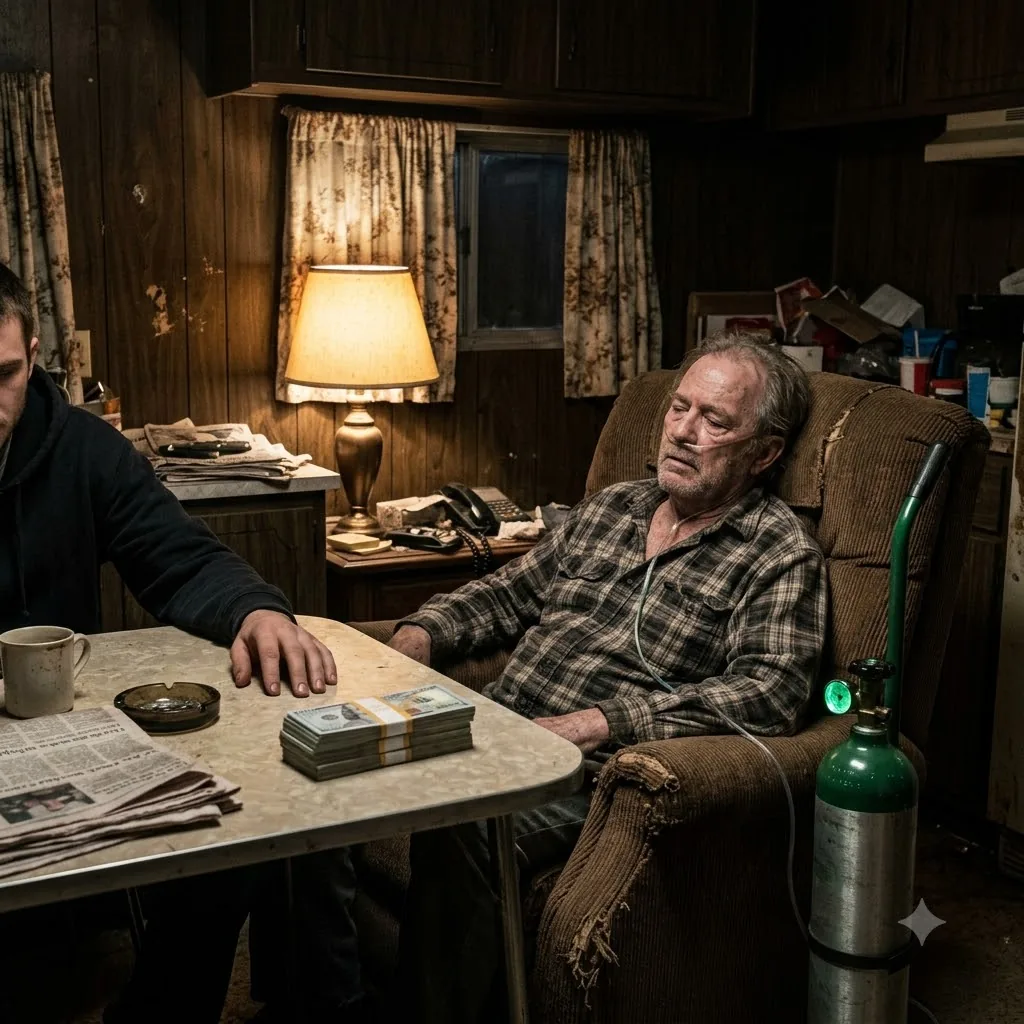
Harlan didn’t reply. He stared down at the green D-cylinder strapped to the floorboard between his muddy boots. The analog needle was hovering just above the red line. The hissing flow of oxygen through his plastic cannula felt thin, barely scratching the deep, agonizing itch in his scarred lungs.
Sterling reached into his leather briefcase on the center console and produced a thick manila folder. He laid it open on the armrest. Inside were two documents, neatly typed on heavy, watermarked paper. He clicked an expensive silver pen and held it out.
“Pest control comes with a price, Mr. Miller,” Sterling said smoothly. “Our contractors will vanish into the woods before the county sheriff arrives. When the police do get here, they need a clean narrative. A local tragedy. An old man, grieving the loss of his burned-down home, returned to the valley with a sawed-off shotgun to exact vigilante justice.”
Harlan looked from the burning compound up to the lawyer’s manicured hand.
“You will take the fall for the violence,” Sterling continued, tapping the first document. “Our men have already placed your shotgun near Silas’s body. You confess to the murders. In exchange, your grandson’s name is kept entirely out of the police report, and Blackwood’s private army doesn’t hunt him down next.”
Harlan’s chest seized, a hollow ache that had nothing to do with his failing lungs. He took the silver pen. Its heavy, polished metal felt foreign in his calloused, grease-stained fingers.
“And the second paper?” Harlan rasped, his voice a dry scrape.
“A full and immediate withdrawal of your black-lung lawsuit against Blackwood Coal,” Sterling replied. “Signed with prejudice. You relinquish any claim to a settlement, and you absolve the company of all medical liability. You won’t need the money in state prison anyway, Harlan.”
It was a total erasure of his life’s remaining value. He was giving away his freedom, his vindication, and his only chance at a comfortable death. Harlan didn’t hesitate. He pressed the pen to the paper and signed his name on both lines, the jagged script sealing his fate. He dropped the pen onto the center console.
“Pleasure doing business,” Sterling murmured, closing the folder. “Your truck is parked at the bottom of the logging road. The sheriff will be dispatched to this location in exactly ten minutes.”
Harlan opened the heavy door of the SUV. The cold mountain air hit him like a physical blow, instantly choking him. He grabbed the rusted handle of his portable oxygen cart and hauled it out onto the gravel, dragging it behind him as he began the slow, agonizing descent down the incline.
The old Ford was idling in the shadows of the pines. Ty was sitting behind the wheel, his pale face illuminated by the faint green glow of the dashboard. When he saw Harlan emerge from the tree line, the boy scrambled out, leaving the driver’s door open.
“Papaw?” Ty whispered, his eyes wide as he looked past Harlan toward the rising black smoke in the valley. “What did you do? Where are we going?”
“You’re going west,” Harlan forced the words out, leaning heavily against the rusted quarter panel of the truck. His legs were shaking uncontrollably. “Desert air. Like you said.”
“I’m not leaving without you,” Ty said, his voice cracking, his blood-stained hands grabbing Harlan’s canvas jacket. The fresh Carver ink on his skin was a permanent reminder of the debt that had just been paid in blood and corporate ink.
“The Carvers are dead,” Harlan wheezed, staring intensely into his grandson’s eyes. “The debt is gone. But the police are coming. If you are here when they arrive, they will take you down with me. You get in this truck. You drive to Knoxville, you get on the interstate, and you do not stop until you hit sand.”
“Papaw, please-”
“Go!” Harlan barked, the sudden exertion sending him into a violent, rattling coughing fit. He waved the boy away, refusing to let Ty see the sheer terror in his fading body. “Live clean, Ty. Go.”
Tears cut tracks through the soot on Ty’s face. He stepped back, realizing the finality in the old man’s stance. He climbed back into the cab, pulled the door shut, and put the truck in gear. Harlan stood in the freezing mud and watched the taillights fade into the deep mountain darkness, taking everything he had left to love out of the holler forever.
When the truck was completely gone from sight, Harlan’s legs finally gave out. He sat down heavily on a damp, moss-covered log beside the gravel road.
Down in the valley, the first distant wail of a police siren cut through the bitter wind.
Harlan looked down at the tank between his boots. The analog needle touched the absolute bottom of the red hazard line. The rhythmic, life-sustaining hiss through the plastic tubing sputtered, grew faint, and finally fell silent. Harlan closed his eyes, took a shallow, agonizing breath of the cold mountain air, and waited in the dark.