Story code: ST-001492
Part 2: The Overload Light
The machine roared to life just as a heavy hand slammed down on the woman’s shoulder from behind.
“Ma’am, you need to lower your voice immediately,” a deep, authoritative voice commanded over the chaotic din of the lobby.
It was Marcus, the building’s exhausted head of security, flanked by Mr. Chambers, the immaculate and tightly wound floor supervisor. The woman gasped, her diamond bracelets clattering as she spun around, her camera jerking wildly to capture the interruption.
Beneath the desk, the commercial shredder was locked in a violent, mechanical struggle. The cardstock was incredibly thick-government-grade, tamper-proof paper designed to survive decades in a filing cabinet, not the steel teeth of an office appliance. The blades ground against the stiff material with a horrific, rhythmic *clack-clack-clack*, the motor whining in loud, desperate bursts.
Mateo’s heart lodged in his throat. He kept his right hand frozen on the mouse, his eyes wide and vacant, perfectly playing the part of the paralyzed, incompetent clerk. But his left hand remained entirely out of sight, his fingers perilously close to the intake slot, trying to force the rigid paper down faster.
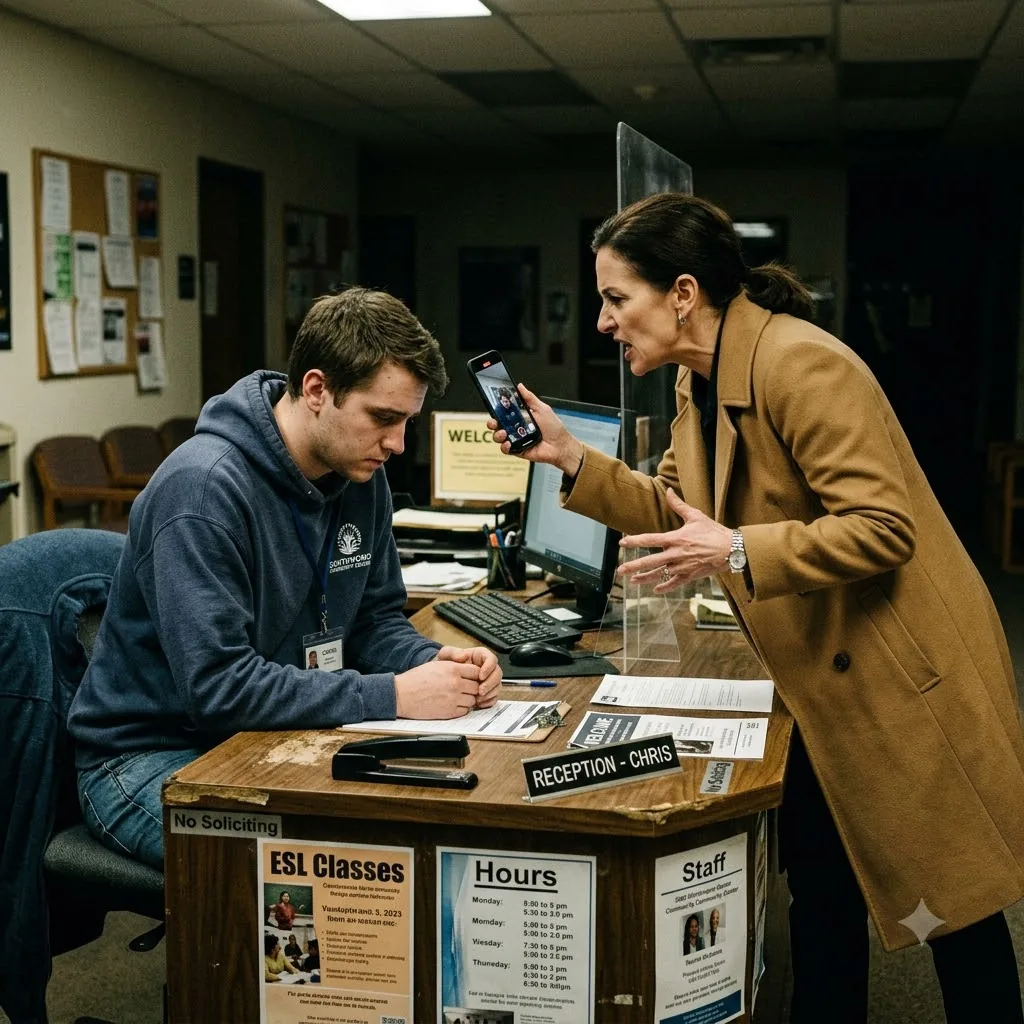
“Remove your hand from me this instant!” the woman shrieked at Marcus, her phone now capturing the security guard’s impassive face. “I am documenting a grossly negligent city employee who is refusing to process my Article 4 injunction! I’ve been standing here for twenty minutes while he stares at a frozen screen!”
“There is no recording allowed inside a federal intake facility,” Mr. Chambers said, stepping forward. He was a severe man who cared only about metrics, queue times, and avoiding liability. “Turn the camera off, or Marcus will physically escort you off the premises.”
“I will do no such thing! This man is-” The woman cut off mid-sentence.
The shredder beneath Mateo’s desk gave a loud, agonizing *crr-runch*. The heavy vibration traveled up through the laminate floor, rattling the cheap plastic pens in Mateo’s desk organizer.
The woman’s meticulously threaded eyebrows furrowed. Her gaze snapped from the supervisor back to Mateo. Then, her eyes darted to the glass surface of the document scanner on Mateo’s desk. It was empty. The plastic intake tray meant to hold pending priority items was also completely empty.
“What is that noise?” she demanded, her voice losing its performative outrage and dropping into a sharp, genuine panic.
“Just the cooling fan on the CPU, ma’am,” Mateo stammered, his voice trembling perfectly. “The system is overheating from the… the buffering.”
“Don’t lie to me!” she snapped, leaning so far over the velvet rope that her camel coat brushed the glass partition. “Where is my injunction? Where is the docket I handed you?”
Mateo swallowed hard, keeping his shoulders hunched. “It’s inside the machine. Processing.”
“That is a shredder!” she screamed, the realization hitting her with the force of a physical blow. She slammed both hands against the glass partition. “Chambers! He’s destroying it! He is shredding my federal docket!”
Mateo kept his face a mask of terrified confusion, but beneath the desk, his pulse hammered a frantic, terrified rhythm. She was exactly right. The document she had slammed onto his counter ten minutes ago-an expedited federal property seizure that would have legally authorized the immediate eviction and detention of the migrant family currently cowering in the back of the waiting room-was being chewed to ribbons. The family had surrendered their own meager intake slip to him, desperate for help, and this woman had stormed in demanding to fast-track the very docket that would ruin them.
Mateo knew he couldn’t delete a scanned docket once it hit the federal database. The system was airtight. The only way to stop the automated raid was to destroy the original physical document before its barcode was ever registered.
“Mateo, step back from the workstation,” Mr. Chambers ordered, his voice suddenly sharp with alarm. Destroying a sealed federal document was a massive felony. If the clerk was intentionally destroying court records, the entire branch could face a federal audit and immediate shutdown.
“I’m just trying to reset the scanner, Mr. Chambers!” Mateo cried, frantically clicking the mouse. Under the desk, the motor gave a sickly, high-pitched whine. The paper was too thick. The glue from the embossed seal was catching on the cross-cut teeth. It was jamming.
“Open the modesty panel!” the woman shrieked to her livestream, pointing her camera through the glass at Mateo’s lower half. “Get around there and pull him out! My signature is on that docket! It costs five thousand dollars to file!”
Chambers didn’t hesitate. He bypassed the velvet ropes and keyed his access card into the secure swinging door that led behind the counter. The magnetic lock clicked loudly.
Mateo shoved the remaining edge of the docket with all his strength, but the machine choked. The red ‘OVERLOAD’ light flashed on the shredder’s control panel. The motor clicked, hissed, and died in total silence.
Three inches of the thick cardstock remained jutting out of the plastic throat. The harsh blue barcode and the embossed gold seal of the woman’s injunction were perfectly visible against the black plastic housing.
The secure door swung open. Chambers was exactly three steps away, marching down the narrow aisle behind the counter, his eyes locked on Mateo.
“Stand up, Mateo,” Chambers commanded, pointing a stiff finger at the floor. “Take your hands off the keyboard and move them where I can see them.”
Mateo remained seated. If he moved his leg even an inch, Chambers would see the blue barcode instantly. He had exactly two seconds before the supervisor reached his chair, and the blinking red light on the shredder meant the blades were completely, hopelessly locked.