Story code: ST-001523
Part 2: The Black Orchid
The second ring cut off with a sharp, hollow click. Background noise filtered through the tiny, degraded speaker-the clatter of heavy ceramic plates, the hiss of a commercial steam wand, and the low, overlapping murmur of a midday diner crowd.
“We don’t take to-go orders after two,” a gravelly voice answered.
“I need a confirmation,” Marcus said. His voice sounded foreign to his own ears, rougher and stripped entirely of the gentle, patient tone he had cultivated for the locals over the last half-decade. “Apex Equities. Is it Kastner?”
Silence stretched over the line, thick and suffocating. The ambient diner sounds on the other end seemed to suddenly mute, as if a heavy hand had been clamped over the receiver.
“Marcus,” the voice said, dropping the customer-service facade. It was Tommy. They hadn’t spoken since a freezing night by the lake seven years ago. “You shouldn’t have this number. You shouldn’t be breathing my air.”
“Is Kastner using Apex?” Marcus repeated, his eyes tracking a single dust mote dancing in the dim, slanted light of his office.
“Kastner got his federal appeal pushed through last month. You didn’t hear?” Tommy asked, his tone dropping to a harsh, strained whisper.
“I bake bread, Tommy.”
“Not anymore you don’t. The feds lost track of his offshore assets during the transition. He’s liquidating old grudges, Marcus. If you’re looking at his paper, you are already in the crosshairs. Where are you?”
“It doesn’t matter.”
“It matters because Kastner doesn’t use civil courts to win money. He uses them to pin people in place. A federal discrimination suit freezes your business assets. It red-flags your name. It keeps you local and panicking while you hire a defense attorney. By the time the judge gavels in, you’ll be buried under the foundation of your own building. You need to run.”
“I’m not running,” Marcus said, his grip tightening on the plastic phone. “I built this place. It’s clean.”
“You built a sandcastle on a landmine, you stubborn bastard. Kastner knows exactly where you are. Think about it. Whatever got you sued? It was a setup. They needed a public incident to drag you into the legal system and lock you down.”
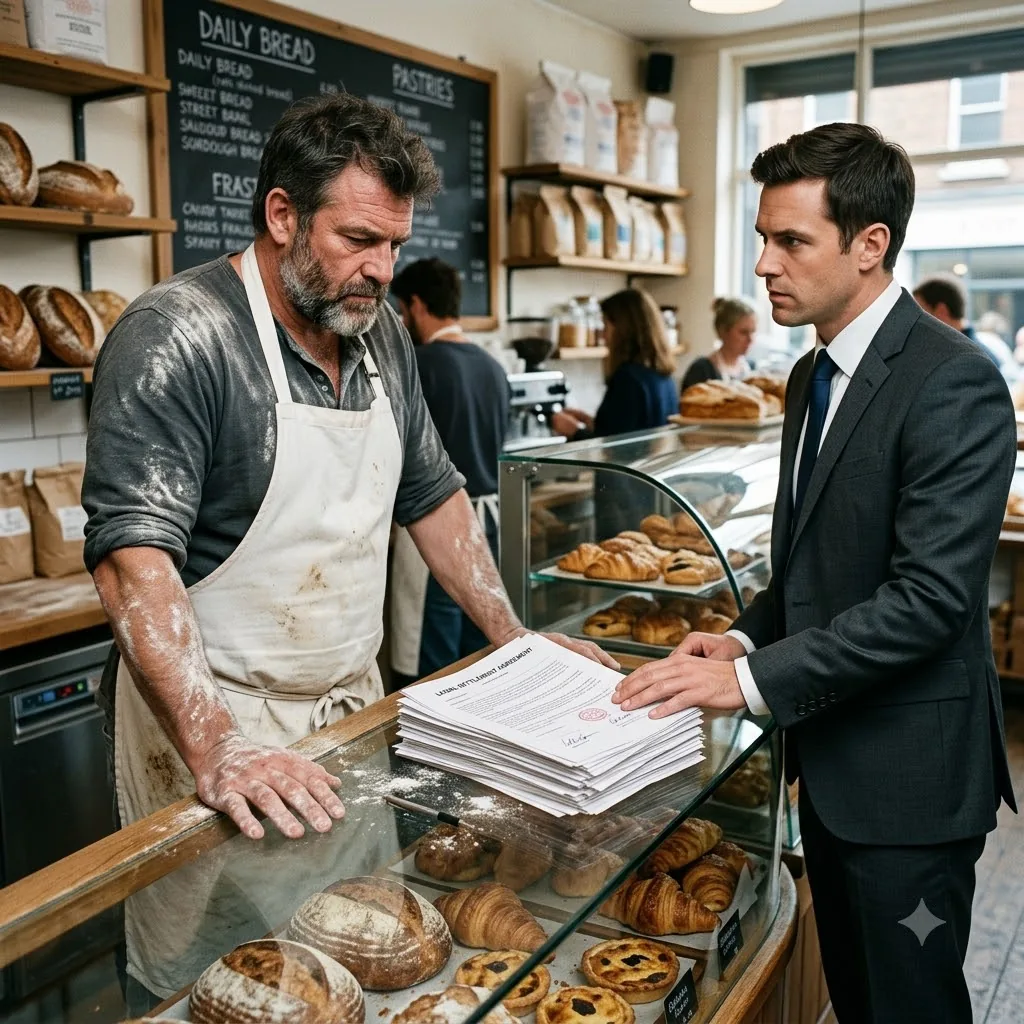
Marcus closed his eyes. Tuesday afternoon. The couple had come in right before closing. They hadn’t just asked for a custom cake. They had specifically requested a design incorporating a stylized black orchid cascading down the white fondant. It was the exact emblem Kastner’s crew used to paint on the doors of businesses that didn’t pay protection in the old neighborhood. When Marcus had frozen, recognized the message, and firmly told them to leave, they had instantly pivoted. The tears, the screaming about discrimination, the phones whipped out to record his refusal-it hadn’t been an unfortunate misunderstanding. It had been a surgical strike.
“They staged it,” Marcus muttered, the interlocking pieces snapping together with terrifying precision.
“Of course they staged it,” Tommy said. “He wants to dismantle you legally before he does it physically. Make it hurt. Make you watch it burn. If I were you, I’d empty the register and walk out the back door. Don’t pack. Don’t look back.”
“Who is he sending?”
“The lawyer was probably Elias Thorne, right?” Tommy guessed, the name sending a fresh spike of cold adrenaline through Marcus’s veins. “Thorne is the spotter. He serves the papers, confirms you’re panicked, confirms you’re staying to fight. Once Thorne reports back, Kastner sends the cleaners. Tonight, Marcus. They won’t wait for the ink to dry.”
The line went dead. No goodbye. Just a dial tone buzzing like an angry hornet against Marcus’s ear.
He lowered the phone. The cramped office suddenly felt like a concrete cell. He looked at the framed health department certificate on the wall, the polaroid photos of his first batch of sourdough pinned to a corkboard, the modest ribbons from the county fair. Five years of flour, sugar, early mornings, and peace. All of it weaponized against him.
He stood up, his knees popping in the quiet room. He walked out of the office and back into the main kitchen. The stainless steel prep tables gleamed in the ambient light bleeding through the edges of the drawn front blinds. The comforting smell of yeast and vanilla now made his stomach turn, a stark reminder of his extreme vulnerability.
He moved silently to the front window. Peering through a tiny, half-inch gap between the heavy linen blind and the wooden window frame, he scanned the street. The afternoon sun cast long, dark shadows across the pavement. Elias Thorne’s luxury sedan was gone. But parked diagonally across the street, idling in the loading zone of the closed antique shop, was a matte-black SUV. Its windows were tinted far past the legal limit, and a steady plume of exhaust pulsed into the crisp autumn air.
A watcher. Thorne had spotted the target, and now the dogs were holding the perimeter.
Marcus let the blind drop back into place. His mind worked with brutal, calculating speed. If he tried to drive out of town in his delivery van, they would follow him and run him off the desolate, unlit county highway. If he called the local police, Chief Halloway-a decent man who thought Marcus was just a quiet, dough-kneading bachelor-would end up catching a bullet meant for a Chicago enforcer.
He was completely isolated. Kastner had engineered it perfectly. The lawsuit kept Marcus anchored to the property, the viral incident destroyed his public reputation so the town would distance itself, and the watcher ensured he couldn’t slip away in the dark.
Marcus turned his back to the front door. He walked slowly toward the massive, sixty-quart Hobart stand mixer bolted to the floor in the center of the kitchen. Next to it were stacked fifty-pound bags of unbleached bread flour on heavy wooden pallets.
He hadn’t touched the hidden compartment beneath the pallets since the day he bought the building. He had prayed the dampness of the basement below hadn’t ruined what was wrapped in the heavy oilcloth.
He gripped the top bag of flour and hurled it to the side. It hit the floor with a heavy thud, sending a thick plume of white dust into the air. He grabbed the next one, his muscles remembering the violent, effortless efficiency of his past. With every bag he moved, the peaceful baker eroded, leaving only the hardened man who used to keep Kastner’s rivals awake at night.
He cleared the pallet and hauled the heavy wood aside. The concrete floor beneath was seamed with a faint square outline.
Before he could wedge his fingers into the seam to pry the loose slab up, a sharp, metallic sound echoed through the empty bakery.
It wasn’t coming from the street.
It was the unmistakable, grinding scrape of a heavy crowbar wedging into the steel frame of the rear alley exit. They weren’t waiting for nightfall.