Story code: ST-001541
Part 4: The Return Address
Arthur did not reach down to help Maya off the floor. He knew better than to touch her. He stepped over the scattered yellow intake forms, his legs feeling like they were made of lead, and walked into the kitchen. He picked up the heavy plastic handset from the wall cradle. The dial tone hummed in his ear, flat and unforgiving. He punched in the ten-digit number for the Department of Family Services, followed by the supervisor’s emergency extension listed on the paperwork.
He stood in the doorway, the phone pressed hard against his ear, watching his daughter. Maya remained on her knees in the entryway, her arms wrapped protectively over the thick medical gauze hidden beneath her shirt. She was barely breathing.
When the emergency dispatcher answered, Arthur did not ask for Agent Miller. He spoke directly into the receiver, his gravelly voice stripped of all its previous self-righteous authority.
“My name is Arthur Pendelton,” he said, staring at the floorboards. “I am calling to formally retract a tip made to your agency on Tuesday regarding case number eight-four-two. I fabricated the report.”
The dispatcher’s typing stopped instantly. “Sir, you are on a recorded line. Are you stating you filed a false claim of child endangerment?”
“I made it all up,” Arthur said, the words tasting like ash in his mouth. “There was no endangerment. I lied because I was angry with my daughter. She is currently under a travel hold, and she has a newborn baby dying in an out-of-state hospital. You need to lift the restriction right now. Call the hospital. Call the border. Do whatever you have to do to let her cross the state line. I will accept whatever criminal charges apply.”
He stayed on the line for forty-five agonizing minutes. He was transferred to a regional director, forced to repeat his confession three separate times. He listened to stern warnings about misdemeanor charges, heavy fines, and court appearances. He agreed to all of it. Finally, the director confirmed that the hold was temporarily suspended pending a judge’s signature, and that they would notify the out-of-state hospital that the mother was legally cleared to arrive and sign the surgical consent forms.
Arthur hung up the phone. He looked at Maya.
She didn’t wait for him to speak. She didn’t scream, and she didn’t cry. The burning rage that had brought her to his doorstep had completely burned out, leaving nothing but cold, hardened ash. She gathered her crumpled papers from the carpet, stood up, and walked out the front door. She didn’t look back. The heavy oak door clicked shut.
Arthur walked to the window and pushed down a single blind slat with his trembling index finger. He watched the rusted blue cargo van back out of his driveway, its tires crunching over the gravel, before speeding away down the quiet suburban street.
Four months passed.
Autumn bled the color out of Arthur’s overgrown lawn, turning the grass brittle and brown. The legal consequences of his false report had been swift and bureaucratic. He had pleaded guilty to a misdemeanor, paid a heavy two-thousand-dollar fine that ate into his meager retirement savings, and completed sixty hours of community service sorting cans at a local food bank. The court had permanently flagged his name in the state’s welfare system.
But the legal penalty was nothing compared to the silence in the house.
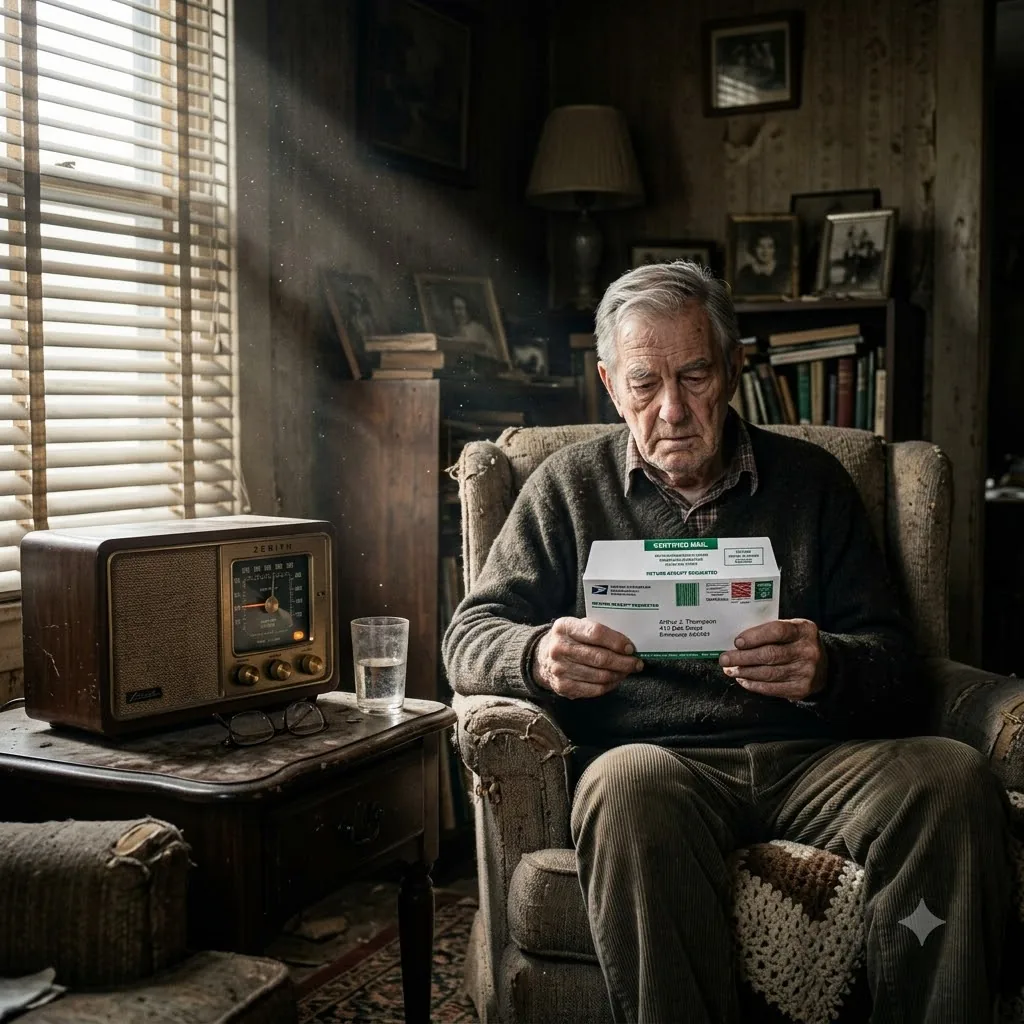
Arthur sat in his faded recliner. On the kitchen counter, the conservative talk radio host droned on about the decay of family values and the necessity of tough love. Arthur used to nod along to those broadcasts. He used to feel a deep, comforting solidarity with the angry voice coming through the speaker. Now, it just sounded like noise. Empty, hollow noise from a man who didn’t understand the catastrophic price of being right.
The heavy knock on the front door startled him.
Arthur pushed himself up from the upholstery, his joints popping. He walked to the entryway and opened the door. There was no mail carrier this time. Just the regular afternoon post stacked inside his wall-mounted metal box.
He pulled out a handful of grocery circulars and a single, standard white envelope. He paused in the entryway, staring at it. There was no bold, blue government lettering. There was a canceled stamp, but the postmark was blurred over. Most importantly, the top left corner-the return address-was completely blank.
Arthur set the circulars down on the side table. He retrieved his brass letter opener and carefully sliced the top of the envelope.
He reached inside and pulled out a single, glossy square of heavy photo paper. A Polaroid.
He held it up to the pale afternoon light filtering through the drawn blinds. The picture showed Leo, looking a little older, his hair a little longer, sitting on a worn plaid couch. In Leo’s arms was a tiny, fragile baby girl wrapped in a pink hospital receiving blanket. The infant had a thin, clear oxygen tube taped beneath her nose, but her eyes were open. She was alive.
There was no note. There was no letter folded in the envelope to explain how the surgery had gone, where they were living, or how Leo was doing in school. There was no phone number to call. Maya had sent him exactly what he needed to see to know that he had a granddaughter, and exactly what he needed to know that he would never, ever meet her.
Arthur walked slowly into the living room. He stopped at the mantle. He placed the Polaroid carefully on the wood, resting it against the frame of Maya’s dusty high school graduation photo.
He backed away, sinking slowly into his recliner. He stared at the two photographs, separated by a decade of time and a chasm of his own making. In the kitchen, the radio host shouted into the void, keeping Arthur company in a house that would never hear the sound of his grandchildren.