Story code: ST-001547
Part 4: Ceasefire
The hostile cleared the granite barrier with the desperate, flailing agility of a cornered insurgent. Her heavy leather boots slammed down onto the anti-fatigue mats directly inside our primary espresso trench. The physical impact sent a violent tremor through the floorboards. Her trailing heel caught the edge of a freshly poured steaming pitcher of whole milk on the hand-off plane. A viscous white tidal wave erupted across the operational theater, coating the espresso hoppers, the vanilla powder, and Maya’s impeccably knotted apron in a thick layer of collateral damage.
I tightened my grip on the stainless steel pitcher, muscles coiled to deliver a debilitating blunt-force strike to the hostile’s exposed tibia. We had crossed the Rubicon. The rules of engagement had shifted from psychological containment to unrestricted, close-quarters kinetic warfare. I locked my eyes onto her center of mass, waiting for her to lunge.
Then, the flashing amber lights of a patrol vehicle illuminated the front windows.
The heavy glass double doors of the main entrance swung open. Two operatives from the mall’s private security contractor ambled into the active combat zone. They were completely unarmored, wearing cheap poly-blend blazers and clip-on ties, armed with nothing but Motorola walkie-talkies and an offensive lack of situational awareness. I classified them immediately: an incompetent peacekeeping force, woefully unprepared for the domestic terrorism unfolding behind my counter. They didn’t fan out. They didn’t establish a tactical perimeter or draw weapons. They just strolled through the shattered ceramics and scattered sugar packets like they were walking through a gentle autumn breeze.
“Whoa, hey, let’s bring the volume down a notch in here, folks,” the lead guard drawled, resting his thumbs casually in his utility belt as if he were breaking up a mild disagreement at a neighborhood barbecue, not interrupting a lethal siege.
The hostile’s transformation was instantaneous, absolute, and utterly terrifying.
The guttural rage vanished from her face in a microsecond, replaced by the rapid deployment of weaponized victimhood. She stumbled backward into the pastry display case, clutching her collarbone as if she had just taken shrapnel.
“They locked me down!” she wailed, her voice trembling with perfectly calibrated theatrical terror. Tears-actual, physical saline droplets-spilled over her eyelashes and ran down her flushed cheeks. “I just wanted my macchiato remade! I paid seven dollars! And that woman-” she pointed a shaking, manicured finger directly at Maya “-called me a terrorist! She told me not to reach for my bag! I thought she was going to attack me! I had to jump over the counter just to escape her!”
She was rewriting the battlefield history in real-time, painting the defending forces as the aggressors.
The security guards nodded sympathetically, completely falling for the enemy propaganda. They didn’t see a hostile combatant who had violently breached a secure perimeter. They saw a distressed civilian who had been poorly treated by the working class. The lead guard pulled out a small leather-bound notepad, clicking his ballpoint pen with agonizing, bureaucratic slowness.
“Alright, ma’am, you’re safe now. Why don’t you come with us out to the concourse? We’ll get you a bottle of water and you can tell us everything that happened,” the guard said, gently placing a hand on the hostile’s shoulder to guide her back through the swinging door. He paused at the threshold, looking at Maya with profound, patronizing disappointment. “You guys really need to work on your customer service skills. Seriously. Just give them the refund next time. It’s not worth all this drama.”
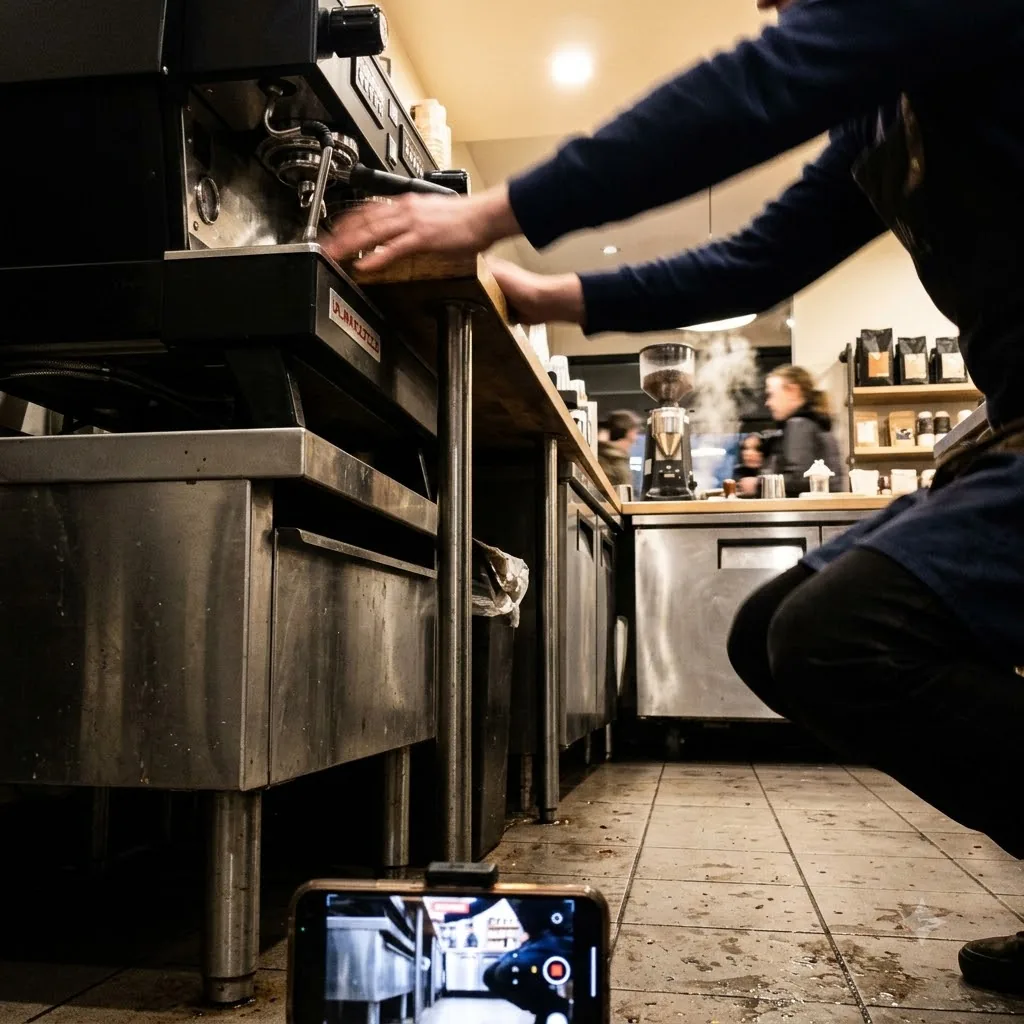
I stayed locked in my tactical crouch behind the La Marzocco machine, my lungs burning as I processed the sheer, blinding absurdity of the civilian worldview. A hostile had breached the wire, assaulted our position, and nearly forced a lethal physical altercation, and the local authorities were treating it like a missed discount coupon. They escorted the hostile out through the main doors, casually promising her a complimentary mall parking voucher as compensation.
The heavy glass doors clicked shut, sealing us back inside.
The store fell into a deafening, hollow silence, broken only by the quiet, rhythmic sobbing of Kyle, who was still curled tightly under the secondary syrup rack, entirely broken by the engagement. He would need a medical discharge. He was never going to steam milk the same way again.
I slowly stood up, my knees popping in the quiet room. I kept my hand locked around the heavy steel pitcher. I didn’t holster my weapon. I couldn’t. I looked over at my commanding officer.
Maya hadn’t moved a single muscle since the hostile vaulted the barrier. She was standing exactly where she had planted herself during her soft-lockdown protocol. A pool of spilled whole milk was slowly creeping across the linoleum, seeping into the black rubber treads of her non-slip work shoes. Droplets of white dairy dripped from the edge of the granite counter, rhythmically plinking into the puddle at her feet.
She was completely unharmed. No bruises, no lacerations, no visible physical trauma. But as I stared at her blank, unblinking eyes, I recognized the profound, permanent alteration in her posture. Her shoulders were still locked into a rigid, defensive frame. Her hands were still hovering slightly above her waist, twitching with residual, unspent adrenaline.
The enemy had been evacuated, the perimeter was quiet, and the official corporate incident report would classify this as a simple customer dispute. But the war hadn’t ended. The civilian illusion was completely shattered. Maya just stood quietly amidst the ruins, staring blankly at the swinging door, her breathing shallow and calculated, waiting for the next ambush. And as I gripped my steel pitcher, scanning the empty, fluorescent-lit lobby for invisible threats, I realized my own threat-radar was permanently jammed in the red zone. We were going to spend the rest of our shifts, and maybe the rest of our lives, inside the wire.