Story code: ST-001564
Part 4: Fourteen Seconds
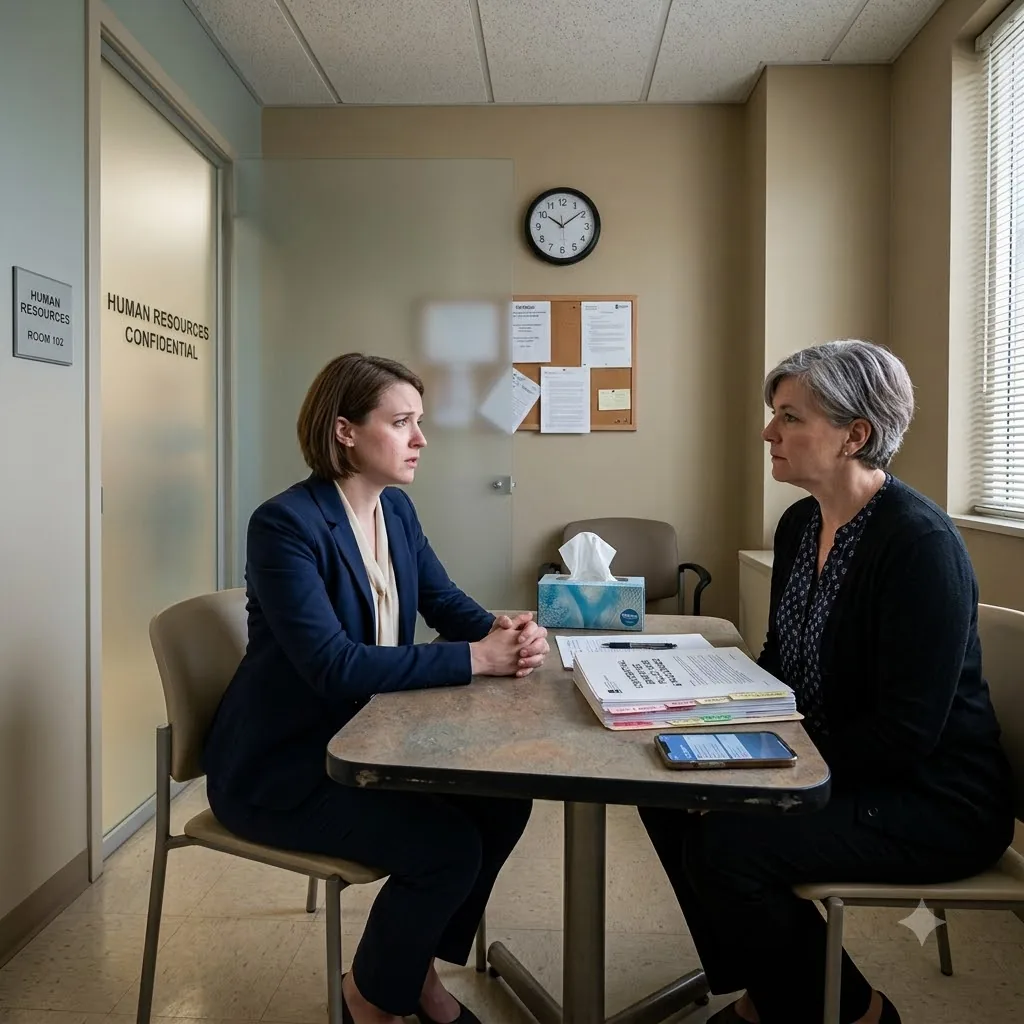
Dana pressed the heavy metal handle of the consultation room door. It opened with a loud, final click, spilling her out into the bright fluorescence of the HR hallway. Elise did not follow her. She just stood by the veneer table, her professional mask lying in pieces around her.
Dana answered her phone on the third ring. “This is Dana.”
“Dana, this is Martin with Corporate Compliance,” the voice said. It was not the urgent, conspiratorial tone she had hoped for. It sounded like a man reading from a script. “We are requesting you surrender your personal device to IT security pending an active investigation into a HIPAA breach.”
They were all in on it. The institution was simply shifting its massive weight, preparing to crush the nearest liability.
“I’m leaving,” Dana said, and hung up.
Her termination hit her personal email before she even reached her car in the employee garage. The language was sterile and bulletproof: *Immediate dismissal for violation of electronic device policy, breach of patient privacy, and failure to meet the behavioral standards outlined in Tuesday’s Performance Improvement Plan.* Elise had moved fast, sealing the trap they had set before the emergency ever existed.
Sitting in the driver’s seat, listening to her engine idle, Dana opened the cloud drive on her phone. She bypassed Compliance. She bypassed HR. She sent the uncropped video, the timestamp logs, and the names of the staff present directly to the *River County Watch* tip line, copying the health department’s state oversight board.
Then she drove home and waited for the blast.
It took less than twenty-four hours for the hospital’s clean narrative to collapse.
By Friday evening, the full footage was playing on a loop across every local channel. The sound of Marcus Vance barking at nurses to protect the lobby visibility metrics echoed out of Dana’s television. The hospital’s polished facade cracked wide open. State regulators announced an unannounced audit. The staff who had stood by and watched the man die-the triage nurses, the security guards, the volunteers-were suddenly caught in a brutal spotlight, looking at each other with suspicion and fear, wondering who would be thrown under the bus next.
But there was no swift justice, no cinematic victory.
Marcus Vance did not resign; he was placed on paid administrative leave while the board formed a committee. And Elise did not fall. Instead, she was dragged in front of the cameras. Dana watched her on the evening news, standing at a podium in the hospital courtyard. Elise looked exhausted, the skin around her eyes tight and gray, as she read a statement about “recommitting to a culture of care” and “cooperating fully with the independent review.” She had tried to control the story, and now she was shackled to it, forced to be the public face of the very disaster she had tried to bury.
Dana turned off the television. The silence in her apartment was heavy, pressing against her eardrums.
She had broken the machine, but she was still outside of it. Her badge was dead. Her career in River County was over. The regional healthcare network was small; being fired for a patient privacy violation, even a contested one, was a permanent stain.
The final cost arrived on Monday.
It was a direct message on her social media, slipping past her privacy filters. The profile belonged to a young woman with a tight, exhausted smile in her photo. The last name matched the man who had died on the polished lobby tiles.
Dana opened the message. Her chest felt hollow. She realized she had been bracing for gratitude, for shared anger, for the absolution she desperately needed to prove she was not the villain Elise wanted her to be.
*The reporter told me you were the one who leaked the tape,* the message read. *I guess I’m supposed to thank you for exposing that administrator. But I watched the whole video. I heard him give the order. And I saw the bottom corner of the screen. I saw you filming.*
Dana stopped breathing.
*You knew it was wrong,* the daughter wrote. *But you still just stood there holding a phone while my dad choked to death. You didn’t drop it. You didn’t push past them. You watched him die for fourteen seconds before you even flinched. Do not ever reach out to my family.*
Dana stared at the glowing screen until the words blurred.
She wanted to type back. She wanted to explain the shock, the bystander effect, the confusing authority of a senior vice president shouting orders. She wanted to explain that she was just a person, caught in a broken system, doing the best she could in a terrible moment.
But her fingers hovered over the keyboard, trembling, and typed nothing.
Because the daughter was right.
Dana set the phone face down on her kitchen counter. Outside her window, the city kept moving. The hospital would pay its fines, Elise would drown in litigation paperwork, and Vance would eventually negotiate a quiet severance. But none of that changed the footage playing on a loop in Dana’s head.
She closed her eyes, and there it was. The shiny floor. The dying man. And her own hand, perfectly still, holding the camera steady in the long, frozen seconds before she remembered how to be human.