Story code: ST-001573
Part 3: Threshold Notes
The new face belonged to a man who looked as if he had been assembled from the company handbook.
Neat collar. Calm mouth. A background so blank it might have been real or might have been generated for people who did not want to reveal where they were. His name appeared in the lower corner a beat after his face did.
Jared Flint, Review Coordination Lead.
“Good morning, Owen,” he said.
It was not morning anymore, but Owen understood at once that time inside these rooms belonged to whoever named it.
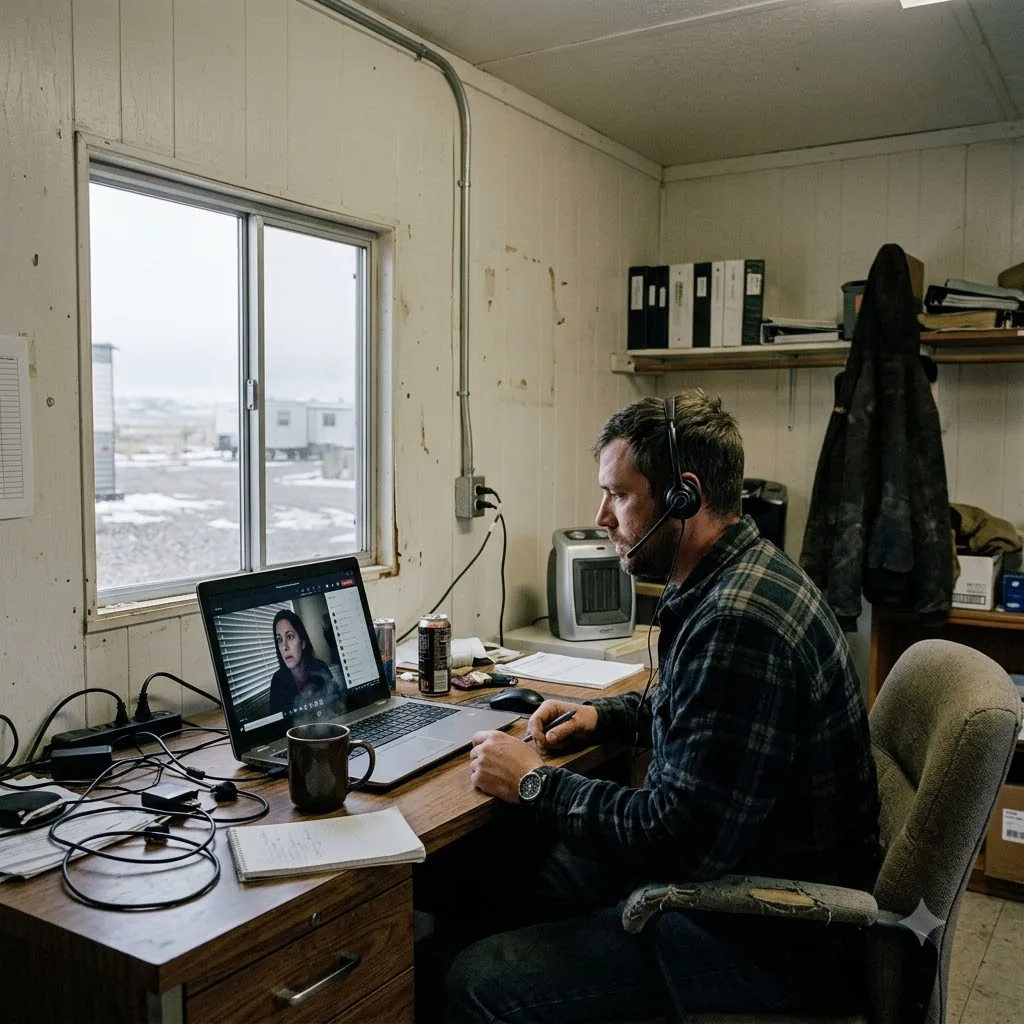
He stayed where he was at the table. The old sugar packet still sat beside his mug, damp now at one corner. On his screen, Jared glanced down and to the side, not at Owen but at whatever panel held the notes.
“Before we begin,” Jared said, “I need to confirm that you are alone, indoors, and prepared to participate in an enhanced support review.”
“You opened this by yourself,” Owen said.
Jared gave a patient expression that did not quite become a smile. “The room auto-launches to support attendance. Are you alone?”
“Yes.”
“Are you indoors?”
Owen looked around the trailer as if the sink and narrow bed might object on his behalf. “Yes.”
“Thank you. Today is a care-focused conversation intended to help us understand recent distress markers and ensure continuity after a staffing change.”
Staffing change.
The phrase sat there, polished and useless.
Owen looked at the bottom of the screen where the dashboard panel still showed the unfinished item from before.
Supplemental media uploaded from facilitator endpoint.
It remained visible for half a second, then vanished as the review interface expanded. Jared must have noticed his eyes move, because he said, smoothly, “I know transitions can be unsettling. Let us stay with the present moment.”
“Where is Mara Vance?”
Jared folded his hands. “Your assigned facilitator is no longer attached to your case.”
“That is not what I asked.”
A soft notification sounded on Jared’s side. His eyes flicked left. “We are here to discuss your current support needs. We have identified several statements from prior sessions that suggest social destabilization, distrust in service channels, and fixation behaviors.”
Fixation behaviors.
Owen almost laughed, but the sound would have come out wrong.
Jared continued, reading now. “Repeated references to unresolved maintenance. Reframing ordinary inconvenience as neglect. Retention of grievance materials. Escalatory curiosity regarding internal staffing events.”
“You mean I asked if she was all right.”
“I mean,” Jared said, still mild, “that this pattern does not exist in isolation.”
He touched something offscreen. A panel opened beside him, and the excerpts Owen had already seen appeared one by one in clean company type. NOBODY CAME TO LOOK AT IT. THERE WAS NOBODY THERE TO EVEN LAUGH AT IT. I KEEP MOST THINGS.
Each line had a colored tag beside it. Isolation indicator. Service distrust. Retention posture.
Jared watched Owen while the labels settled into place, as if waiting to see whether they worked.
“This is from wellness,” Owen said quietly.
“From your care record, yes.”
“I talked about a cabinet door.”
“Language is often most revealing when people believe they are speaking casually.”
The room seemed to pull tighter around that sentence. Owen could hear the little fan inside his laptop. He remembered Mara saying, Keep talking if there is a delay, all right. The software flags silence.
Not because silence was unhealthy.
Because speech was useful.
Jared moved to another panel. “We also have machine-assisted observations from your final interrupted session. Elevated pause rate at the beginning. Vocal tension increase when prompted toward unscripted material. Stress response spike at mention of documentation.”
Owen stared at him. “Mention of documentation?”
For the first time, Jared’s rhythm broke. Only slightly. His eyes went left again.
Then he said, “Your facilitator asked whether you retained screenshots and confirmations related to prior complaints. Your biometric and linguistic response indicated heightened attachment to those materials.”
Owen saw the room behind Mara as sharply as if the call had opened again. The bare wall. The overstuffed tote. Her hand flattening the folder. Good, she had said too fast. That is good record keeping.
Not therapist talk. Warning talk.
“Why would that be in my care record?” he asked.
“Any material relevant to wellbeing, compliance, or environmental stressors may be incorporated into a total-support model.” Jared’s voice had steadied again. He was back on the rails. “That is disclosed in your participation agreement.”
“Disclosed where.”
“In the wellness consent packet.”
Owen thought of the packet he had signed on a loading dock terminal during onboarding, six forms stacked one after another while a supervisor told everyone to keep the line moving.
Jared was still speaking. “The system does not judge. It identifies patterns so interventions can occur before instability affects work, housing, or safety.”
“The system already affected work and housing.”
“Preventive review is not punishment.”
“Then why does missing it threaten my residence?”
Jared paused.
It was a small pause, but after all the careful smoothness, it sounded almost loud.
“Attendance requirements exist,” he said, “because disengagement correlates strongly with adverse outcomes.”
“For me,” Owen said, “or for the company.”
No answer. Not a real one.
Jared shifted to the next item too quickly. “There is also supplemental context from the facilitator endpoint that may clarify why this review was accelerated.”
There it was. Not gone after all. Just waiting for the right use.
Owen leaned forward before he knew he was doing it. “Show me.”
“Access is tiered.”
“You just said you have it.”
“I said there is supplemental context.”
“Uploaded from her end.” He heard his own voice sharpen. “Those were the words on my screen.”
Jared’s expression changed by less than an inch, but it changed. “That language is system-generated.”
“So is all of this.”
He gestured at the labels, the excerpts, the score now sitting in the corner beside his employee number like a verdict pretending to be weather.
Jared tried another route. “Owen, it would help if we returned to your emotional state during the interrupted call. Did Mara’s abrupt disconnect trigger abandonment concerns?”
The question landed so neatly it might have worked on someone else. On someone more tired, or more eager to survive by agreeing. But Owen was still looking at the contradiction hanging open between them.
Support review. Staffing change. Care record. Facilitator endpoint.
He remembered, suddenly, one of the tiny notices at the bottom of the dashboard, the kind he usually read because he checked things. Session recordings may be reviewed for quality assurance and continuity of care.
Quality assurance.
Not compliance notes. Not stress markers. Not sentiment tags.
His pulse kicked once, hard.
“Open my file,” he said.
“That is not how this meeting works.”
“Open the session record.”
“Portions are restricted.”
“Because it is care, or because it is evidence?”
Jared’s jaw tightened. The first visible thing that belonged to a human being instead of a script.
Owen clicked back with his own mouse, searching for the hidden panel under the review window. Jared said his name sharply, the first sharp sound yet, but Owen had already caught it: a collapsed sidebar flickering at the screen edge where the room overlay had not fully covered the portal.
For a second only, before Jared’s side tried to force focus back to the call, Owen saw a list under his case ID.
Transcript fragments.
Sentiment tags.
Stress markers.
Compliance notes.
Final session escalation.
Not wellness language. Not therapy language. Report language.
His throat went dry.
“You said this was support.”
Jared did not answer.
Owen could hear his own breathing in the cheap speakers now. “You said the system does not judge. You said preventive review. You said continuity of care. But somebody took notes on compliance during my call with her. During the last session. Before I was flagged.”
Jared’s face held, but only by effort. “Those classifications are internal processing categories.”
“For what?”
“For appropriate response.”
“Response to what? Me talking? Her asking if I kept screenshots?”
Jared looked left again, and this time he did not manage to hide it before he answered. “Response to identified risk at the facilitator level and participant level.”
Facilitator level.
Participant level.
Two tracks. Already linked.
Owen felt the pieces meet with a cold, precise click. Mara in the wrong room. Mara telling him to keep talking. Mara asking about records. The knock at the door. The full name. And inside the same system now calling itself care, a category already waiting called Final session escalation.
“Someone acted on it,” he said.
Jared stayed still.
“Before this review opened,” Owen said. “Before you started telling me about support. Somebody read whatever that session captured and did something with it. To her. Maybe to me too.”
Jared’s mouth parted, closed, then parted again as if he had expected resistance, anger, denial, anything except the exact shape of it.
On the screen between them, the labels still glowed beside Owen’s harmless sentences.
For once, Jared did not seem to have the next line ready.