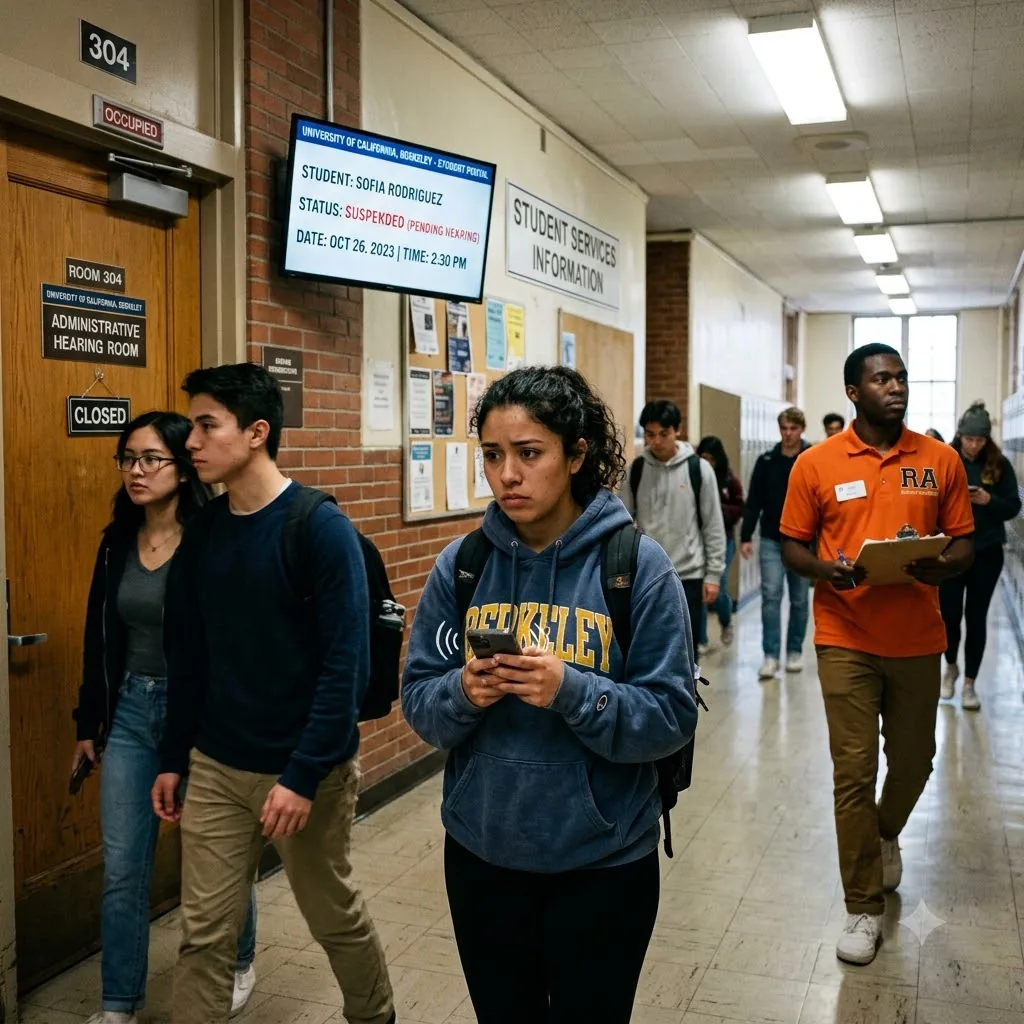
Story code: ST-001575
Part 4: Where the System Ends
The man with the silver-framed glasses opened his mouth.
And for the first time that morning, nothing clean came out.
What finally emerged was smaller than all the language he had been using before.
“Ms. Reyes,” he said, “I think it would be best if we paused all nonessential actions until this review can be clarified.”
Paused.
Not reversed. Not apologized for. Just paused, as if the damage had only been motion and not impact.
Marisol stood very still. “My room key.”
He glanced toward the RA, which was answer enough. The RA fumbled for her radio, then seemed to think better of using it in front of everyone. “I can call the hall desk,” she said. “They can put you on temporary manual access pending instruction.”
Pending instruction. Another rope made of words.
But it was not nothing.
The students in the hall had stopped pretending now. A boy by the vending machine was openly staring. One of the girls from the honors wing had her phone down at her side but not away, thumb hovering over the dark screen like she was deciding whether what she had just seen belonged to gossip or evidence. Dana from financial aid looked as if she might be sick.
The cardigan administrator took a breath and tried to gather the scene back into something manageable. “Everyone not directly involved needs to clear the hallway.”
Nobody moved for a second. Then, slowly, the crowd loosened. Not because they had been dismissed, Marisol thought, but because they had already gotten what they came for: the sound a sealed story made when it cracked.
The legal-pad woman stepped fully into the doorway. Up close, the university badge at her waist read A. VELASQUEZ, REGISTRAR COMPLIANCE. Her expression had tightened into something that wanted to be neutral and could not quite make it. “Your immediate residential access will be restored in an interim capacity,” she said. “Your registration and disbursement hold will remain while records verification is completed.”
There it was. Home, maybe. Money, no. School, not really.
“How long?” Marisol asked.
“We cannot provide a definite timeline today.”
“Today,” Marisol repeated.
Velasquez did not answer.
The man with the glasses had shifted from authority into damage control so completely Marisol could almost see the mechanism. “You will be given a temporary stay in housing,” he said. “No one is removing you from your room this morning.”
This morning.
Again that careful ceiling. He would save her from the version of the harm already visible and leave all the others standing.
“And my scholarship?” Marisol asked.
Dana looked up before anyone else did. Just a flicker. Enough.
The man answered without looking at her. “Aid eligibility remains under review.”
Which meant frozen. Which meant bills still due, charges still real, systems still able to treat uncertainty as guilt. Marisol thought of the balance on her account, the lab fee, the meal plan, the tiny exact arithmetic her life kept requiring. Temporary housing did not buy books. It did not unplace a hold. It did not fix the red banner on the screen.
The RA had reached someone at the hall desk now. Her voice was too soft for Marisol to catch all of it, but she heard enough: manual check-in, temporary exception, do not deny entry. Each phrase landed with a dull, bitter weight. Not impossible, then. Never impossible.
When the RA ended the call, she would not meet Marisol’s eyes. “They’ll let you in if the app doesn’t refresh within fifteen minutes. You just need your student ID.”
“My physical ID is in my room,” Marisol said.
The RA closed her eyes for half a second.
Dana made a small sound, almost a laugh and almost despair. Nobody acknowledged it.
Velasquez wrote something on the top sheet of her pad, tore it off, and held it out. “Take this to the desk if needed.”
Marisol took the note. It was a name, a timestamp, and three initials written hard enough to emboss the paper beneath. A human permission slip for a problem they had insisted was just the system.
The hallway had thinned, but not emptied. People were leaving in clusters now, whispering. Marisol caught fragments as they passed.
They locked her out-
No, they said they could override it-
Wasn’t Theo’s name-
Shh.
Theo. Even here he remained a warning label on other people’s mouths.
That was one of the consequences too, Marisol realized. Something had shifted around him without him needing to be present. The soft shield his name carried had thinned. Not broken. Not even close. But thinned enough that other students were saying it out loud in a corridor instead of only in private.
The man with the glasses turned his body toward the room again, signaling an ending he wanted to control. “You will receive follow-up communication by email.”
Marisol looked at the locked hearing room, the half-lowered blind, the table inside where they had been willing to discuss her life without her body in the chair. She understood suddenly that nothing said next would become justice just because it was spoken in a calmer voice. They had been forced to stop one kind of harm because too many people had seen it. That did not mean they would stop protecting themselves.
“You’ll send me language,” she said. “Not answers.”
He did not deny that either.
She started walking before anyone dismissed her. Her legs felt strange, not weak exactly, but distant, as if the rest of her had moved ahead and left them to catch up. The elevator took too long, so she went to the stairs. On the landing between floors she stopped and looked at her phone.
The housing app still showed ACCESS DENIED.
Her university email showed three new messages. One was the interim notice she had already read. One was a generic account alert repeating that administrative restrictions might affect registration and disbursement. The newest one had the subject line TEMPORARY HOUSING ACCOMMODATION and no body text yet, just the university logo and a time stamp.
A promise to explain later what had already happened.
By the time she reached West Hall, the desk worker had been warned. He did not ask questions. He looked at the note from Velasquez, looked at Marisol, then reached under the desk for the metal ring of backup cards reserved for outages and lock failures and all the moments the digital certainty of campus broke down into ordinary plastic.
“One-time access,” he said quietly.
He slid the card across.
Marisol took it and went upstairs. Her room opened on the first try.
Inside, everything was exactly where she had left it: blanket half off the bed, notebook open on the desk, charger plugged into the wall, one shoe tipped on its side by the closet. The sight of it hit her harder than the hallway had. Not because she was safe. Because she had almost been made absent from this room while all her things were still here, as if a person could be administratively erased before the shape of her life caught up.
She shut the door behind her and leaned against it, backup card still in her hand.
The app on her phone had not changed. The hold on her account had not changed. The red scholarship banner had not changed. Outside, somewhere down the hall, she could hear a door open and voices rise and fall, ordinary campus noise continuing around the edges of what had happened.
The system had not failed her by mistake. That was the part that would stay.
It had given everyone involved a clean place to stand while they decided how much of her life they were willing to risk, and only when she forced their choices into public view had the machinery suddenly rediscovered a human hand.