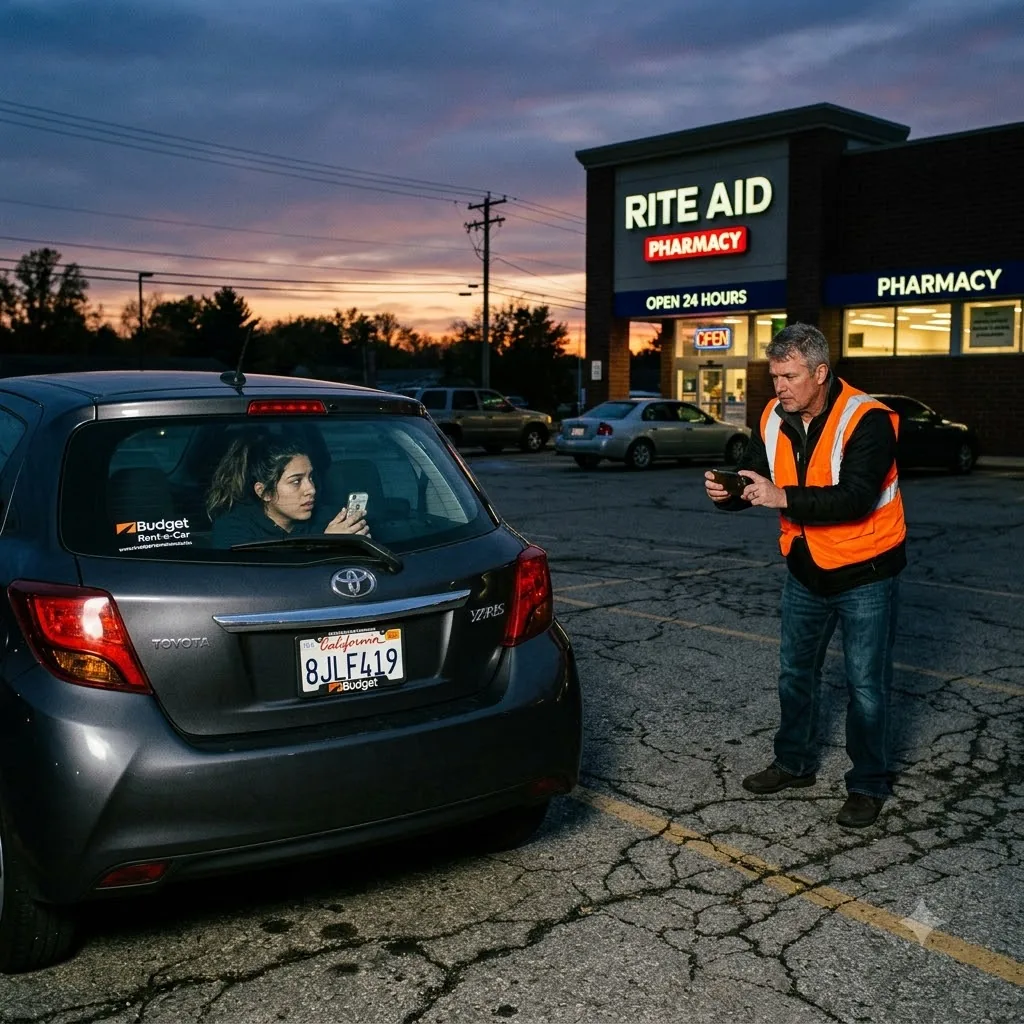
Story code: ST-001600
Part 2: Counter Three
The knuckles came again, gentler this time, as if politeness made the sound less frightening.
Maya jerked so hard the charger slipped. Her screen went black for a second, then lit again on low battery. The calm voice in her ear was still there, small and far away now. “Hello? If this is not a safe time, you can say you have the wrong number.”
Maya put the phone face down on her thigh and turned her head.
The man in the vest stood just beyond the glass, one hand braced on the roof of the rental, the other lifted in a patient little wave. Up close he looked older than she had first thought, the skin around his eyes cut deep by sun and squinting. He smiled without showing teeth and pointed toward the pharmacy doors, then toward her phone, as if he were helping her remember an errand.
She cracked the window less than an inch because not opening it at all felt like a kind of confession.
“Can I help you?” she asked.
“Just checking if you’re all right in there.” His voice had the soft public tone people used in front of strangers when they wanted to sound reasonable. “You’ve been sitting a while. Folks noticed.”
Folks. As if the whole parking lot had convened around her without her seeing it.
“I’m fine,” Maya said.
He leaned a fraction closer, not enough to look aggressive, exactly enough to make her wish she had not opened the window at all. “Your plate came back to a rental. Different county. We had some break-ins last month, so I take down numbers when something looks off. Volunteer watch.” He tapped the peeling letters on his vest with two fingers. “Nothing personal.”
On her thigh, the phone made a tiny sound. The voice from the clinic, still connected. Maya pressed the speaker hole hard against her jeans to muffle it.
“Okay,” she said.
“You waiting on somebody?”
“No.”
“Then why not go on in?”
Because the name inside was wrong. Because if she said it out loud at the counter in front of him, or in front of anyone he could ask later, it would stop being a private paperwork problem and become a story. Because every minute mattered and she had already lost too many. Because she could feel him arranging her into a shape he understood and would not let go of.
She said, “I’m making a call.”
His eyes dipped to the phone she was half hiding. “You local?”
“No.”
“Uh-huh.” He rocked back on his heels. The smile stayed, but it thinned. “Well, manager asked me to make sure everything was okay. People get nervous when someone sits in a car with the engine off and keeps ducking down. You understand.”
Maya looked past him to the doors. Inside, the cashier who had been leaning over the counter was now looking out through the glass. When she saw Maya looking back, she did not wave. She only kept watching.
The clinic voice came again, muffled but distinct enough to make the man’s gaze drop.
“You on with roadside or something?” he asked.
“A doctor’s office.”
That should have ended it. Instead it seemed to interest him. He took another small look at the pharmacy doors, then back at Maya. “You sick?”
The question was so direct, so entitled, that for a second she could not answer.
“I’m late,” she said finally.
“For the pharmacy?”
“For an appointment.”
The voice on the phone said, a little louder now, “If you can hear me, you can answer yes or no. Are you in immediate danger?”
The man’s forehead changed almost imperceptibly. Not a frown. Attention sharpening.
Maya snatched the phone up. “Yes,” she said into it, too quickly, then realized what she had done and felt all the blood leave her face.
“Yes what?” the man said.
On the line, the calm voice answered at once. “Okay. If you can, go inside the nearest public building and stay on the phone with me. Do not drive if someone is blocking your vehicle. Is anyone with you right now?”
Maya couldn’t speak. The man straightened from the window. His reasonable expression held for one more second, then settled into something cooler and more official, though he had no authority she could see.
“Ma’am,” he said, louder now, “is there a problem?”
The cashier had stepped away from her register. Another woman near the photo kiosk turned her head. The automatic doors opened for a customer leaving with a case of soda, and the man’s next words carried neatly through the gap.
“Do we need to call somebody for you?”
Maya heard the trap in that do we. If she said no, she sounded unstable. If she said yes, she gave him the right to decide who somebody was.
“No,” she said. “Please move away from my car.”
He lifted both hands, open-palmed, for the benefit of the people now capable of seeing him. “I’m not doing anything to you.” Then, with the same mildness: “I asked if you’re okay.”
Inside the pharmacy, the cashier pushed through the doors and came a few steps into the lot, not close enough to help, only close enough to witness. She was a broad woman in pink scrubs with a badge flipped backward on its clip.
“Miss?” she called to Maya. “Are you the one for counter three?”
The name hung there unspoken and dangerous.
Maya gripped the phone. “Can you bring it out?”
Pink scrubs looked from Maya to the man in the vest. “I can’t release medication without verifying.” Her tone had changed since the call, less hurried now, more careful in a way that created distance instead of safety. “If you come in, we can sort it out.”
“She can walk ten feet,” the man said, still in that calm voice. “Unless there’s some reason she can’t.”
The clinic worker said, “Maya? Stay with me. Can you tell me whether the person near you is law enforcement?”
The man heard the name. Maybe not clearly, but enough. His eyes returned to her face with a tiny flicker of recognition that was not recognition at all, only the thrill of finding a loose thread.
“Maya?” he repeated.
Pink scrubs frowned. “I thought you said-”
Maya ended the call by mistake trying to pull the phone against her chest. The screen flashed, then dropped to one percent. She stared at it in disbelief, as if will alone could reverse the number.
The charger cable had come loose again.
“Damn it,” she whispered.
The man had heard enough to stop pretending this was routine. He bent a little, trying to see past her shoulder into the back seat. “Whose car is this?”
“Mine right now.”
“Registration says otherwise.” He nodded toward the dashboard. “And the pharmacy’s asking for somebody else.”
Pink scrubs did not move closer. She folded her arms instead, defensive now, as if Maya had become an inconvenience with edges. “If the pickup name doesn’t match, I need ID.”
Maya’s stomach dropped so fast it felt like missing a stair. Her license still carried the old marker, the old photograph, the old arrangement of facts that made every counter a gamble. She had known she might need it. She had not let herself think beyond that.
A car pulled into the row behind her and stopped, blocked by the angle of the man’s body and the open pharmacy lane. The driver, a woman with two children in the back, waited a beat and then tapped her horn once. Heads turned. The sound was not loud, but it widened everything.
“Can you move along, Ron?” the driver called through her cracked window, irritated rather than concerned.
So now Maya had his name.
Ron ignored her. He took out his phone again, not even sneaking it anymore, and aimed it through Maya’s windshield. At her. At the dashboard. At whatever he thought would matter later.
“Stop,” Maya said.
“Documentation,” he said.
Pink scrubs looked uneasy but did not tell him to stop. She only said, “Miss, if this is your prescription, come inside with your ID. If not, I’m going back in.”
On Maya’s phone, the battery symbol turned red and began to blink.
Then the clinic called back.
The screen lit with the number she had not saved, bright as an alarm in her hand. Ron saw it. Pink scrubs saw it. And from somewhere inside the store, over the automatic doors opening again, a voice called out across the counter area, clear enough to carry into the parking lot:
“Can someone check whether Daniel Reese is here or not?”