Story code: ST-001602
Part 2: The Poisoned Well
The mouse clicked. The folder swallowed the ticket. The red emergency banner vanished, replaced by the sterile gray of the empty queue.
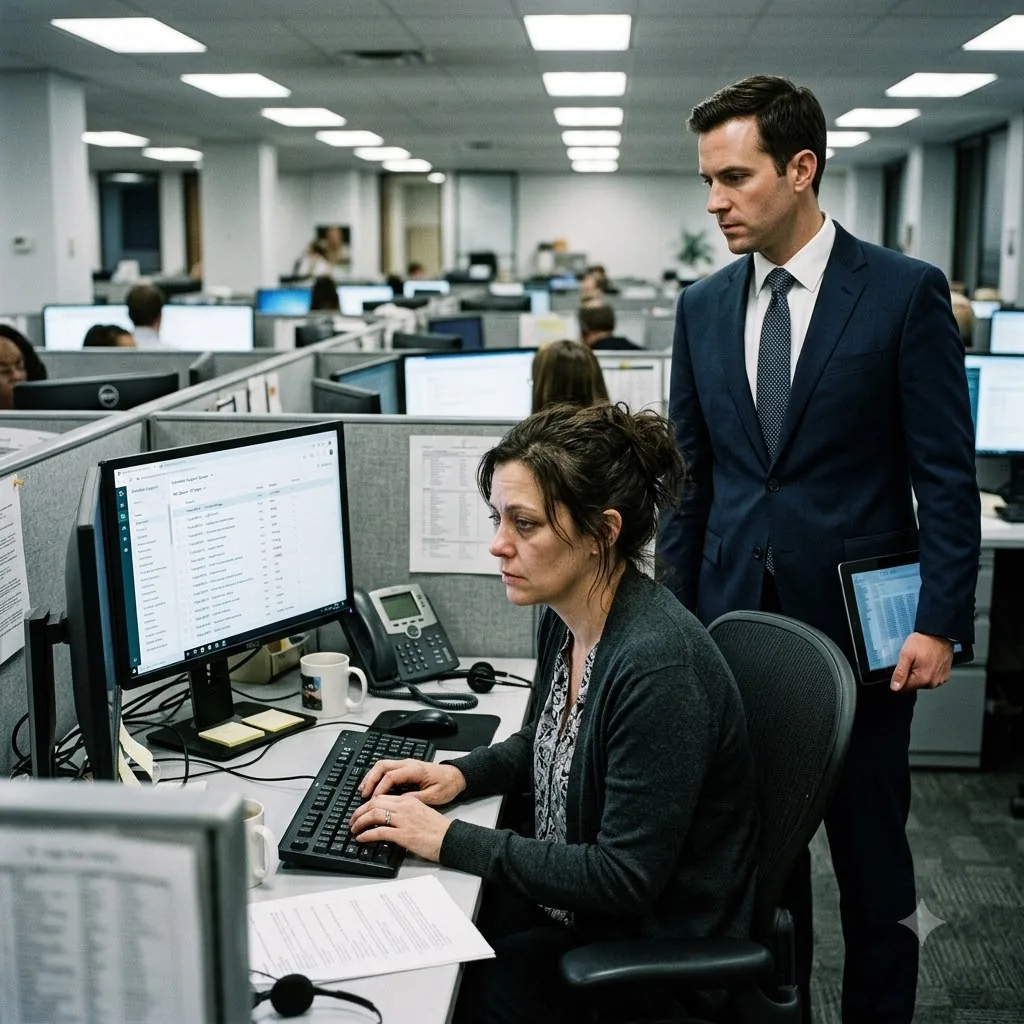
Julian’s grip loosened. His fingers slid off her skin, leaving behind damp, cold imprints on her aching wrist. He stepped back, straightening his silk tie.
“It is not cruelty, Sarah. It is a Service Level Agreement,” Julian said, his voice returning to its smooth, corporate cadence. “We promised the state a forty percent reduction in operational overhead. Emergency medical dispatches cost three thousand dollars per rollout. If we let every inmate with indigestion call an ambulance, our client goes bankrupt, and we lose our contract. Do you understand?”
Sarah stared at the empty queue. Her wrist burned where his thumb had dug into her tendon. “Yes,” she said. Her voice sounded hollow, belonging to someone else.
“Good. The algorithm needs consistency to build its neural pathways. No more hesitation. Feed it.”
The queue refreshed. A waterfall of new grievances populated the screen. Sarah’s hands hovered over the keyboard. The man with the numb arm was gone, buried in the *Hypochondria – Ignore* database. She could not pull the ticket back. The system architecture prevented any tier-one agent from reversing a categorization. She had sealed him in, stripping away his only lifeline.
A cold, sharp clarity settled over her. Julian wanted efficiency. He wanted a machine that protected the profit margins of a private cage. She could not save the inmates individually-Julian was watching too closely for her to manually dispatch help. But she was the one shaping the machine’s brain.
Ticket four-five-three. *My cellmate is coughing up blood. He cannot stand up.*
Sarah’s left hand rested on the keyboard. Her right hand gripped the mouse. She dragged the text block toward the *Ignore* folder, just as Julian demanded. But as the file hovered over the destination, her left pinky dropped onto the Control key. Her ring finger brushed the Shift key. Her thumb tapped the bracket key.
It was a developer shortcut, a leftover diagnostic command she had found in the API documentation during her onboarding. It appended a silent, secondary classification to the primary action.
She didn’t just dump the ticket into *Ignore*. She bound the string “coughing up blood” to a background workflow categorized as *Hazardous Biological Spill – Mandate External EPA Cleanup*.
Click. The ticket vanished. The AI absorbed the action, updating its weights and biases. It learned that coughing blood required no medical intervention for the inmate, but simultaneously demanded a mandatory, union-rate hazardous materials contractor be dispatched to the facility. An eight-thousand-dollar automatic payout.
Julian watched her screen, his arms crossed. “Eleven seconds. Much better.”
Ticket four-five-four. *They took my psychiatric medication during the shakedown. I am having withdrawals.*
Sarah dragged it to *Security – Confiscation Approved*. She hit the shortcut keys. She bound “medication” and “withdrawals” to *Structural Integrity Failure – Dispatch Architect*. Another massive contractor fee, billed directly to the prison corporation.
Click. The AI swallowed the poison.
Ticket four-five-five. *Water in the pipes is brown and smells like sulfur. We have no drinking water.*
*Maintenance – Low Priority*. Shortcut key. She linked the sulfur complaint to a *Federal Civil Rights Audit – Retain Outside Counsel* code. Legal fees. Hundreds of dollars an hour, automatically initiated by the system’s external API the moment the AI took over.
Sarah fell into a manic rhythm. Eighty-five keystrokes per minute. Ninety. Her aching wrists went completely numb. The screen blurred into a smear of desperate pleas and corporate categorizations. With every click, she followed Julian’s mandate perfectly on the surface. Beneath the surface, she was teaching the ingestion engine to hemorrhage money. She was building a financial suicide bomb disguised as a streamlined workflow.
“Excellent,” Julian murmured, his breath ghosting over her shoulder. “Your accuracy rating is at ninety-nine percent. The model is latching onto your decision trees beautifully. It’s internalizing the cost-saving protocols.”
He walked away from her desk, pacing toward the back of the cramped room where his primary server rack hummed. Sarah did not look away from her monitors, but she could hear the rapid tapping of his stylus against his tablet.
Ticket four-nine-zero. *I have a severe staph infection on my leg. The infirmary gave me ibuprofen. It is turning black.*
*Ignore*. Shortcut. *Trigger Emergency Dietary Overhaul – Import Organic Produce.*
She was running out of high-cost sub-codes, but she kept improvising, chaining desperate human suffering to the most exorbitant, unreviewable corporate expenses buried deep in the system’s administrative menus.
“Alright, Sarah, stop,” Julian said.
Sarah froze. Her cursor hovered over ticket four-nine-one. Her heart slammed against her ribs. Had she used the shortcut too many times? Did the diagnostic command flash on his administrative dashboard?
“Take your hands off the keyboard,” Julian ordered.
She slowly pulled her hands back, resting them in her lap. She kept her eyes glued to the monitors.
Julian stepped back up to her desk. He reached over her and tapped the glass of her primary monitor. “You’ve fed it enough volume. The confidence intervals are holding steady at ninety-four percent. The client is logging into the secure portal right now.”
Sarah’s stomach dropped. “The client?”
“The regional director for the corrections corporation,” Julian said, checking his heavy smartwatch. “He wants to see the return on investment before he signs the contract extension for the other twelve facilities.”
Julian tapped a sequence of commands into his tablet. On Sarah’s left monitor, the cascading gray text boxes disappeared, replaced by a stark black command terminal. Lines of green code began scrolling down the screen.
“I am taking the model out of shadow mode,” Julian said, his voice tight with anticipation. “I’m linking it to the live API for Cell Block C. The AI is going to process the live grievance queue autonomously, in real-time, while the regional director watches.”
Sarah stopped breathing. Cell Block C. That was the queue she had been poisoning for the last hour. If Julian turned the AI on, it wouldn’t just be learning anymore. It would begin executing her cross-wired logic. It would ruthlessly ignore the dying, but it would simultaneously summon hazmat teams, architects, and external lawyers. The sudden, massive expenditure would trigger dozens of automated alarms across the prison’s financial network.
It would destroy the company’s contract. But it would also completely abandon the inmates to an emotionless, automated death sentence before the financial fallout could be stopped.
“Julian, wait,” Sarah said, her voice cracking. “The model… it needs more baseline testing. There are edge cases.”
“The edge cases are acceptable losses,” Julian said, pressing his thumb against his tablet’s biometric scanner. “Initiating live triage.”
The black terminal flashed white. The AI roared to life, ingesting the live queue at a rate of two hundred tickets per second.
Julian smiled, looking at his tablet. But his smile faltered. His brow furrowed. He tilted the tablet closer to his face, the blue light reflecting in his eyes.
“Why is the financial API projecting a four-hundred-percent budget overrun for the next hour?” Julian whispered, his gaze snapping from the tablet down to Sarah. “And why is the system requesting authorization to dispatch three private hazardous waste crews to a minimum-security block?”