Story code: ST-001602
Part 4: The Release
The microphone icon in the system tray throbbed with a steady, bright red pulse. It was a tiny circle, no larger than a pencil eraser, but in the dead silence of the windowless room, it felt as massive as a spotlight.
Julian stared at it. His mouth opened, closed, and opened again. No sound came out.
On the main monitor, the yellow chat box from *Client_RD_01* blinked once. A new message appeared.
*Client_RD_01: Did you just say you are intentionally denying medical care to generate processing fees?*
“No,” Julian whispered to the empty room. “No, wait, that was…”
He lunged across the desk, scrambling for the mouse. He fumbled, knocking his tablet onto the carpet. His manicured hand slapped onto the mouse, frantically dragging the cursor toward the disconnect button.
*Client_RD_01: I am screenshotting this transcript. I am freezing all vendor payments. Do not touch the system.*
Julian hit the disconnect button. The chat box vanished. The red microphone icon disappeared. But the damage was permanent. Julian stood frozen, his chest heaving, his silk tie hanging limp over his sweat-stained collar. He turned around, his eyes wide and vacant, staring at the server rack in the back of the room as if it might offer him a way to rewind time.
Sarah did not look at Julian. She looked at her secondary monitor.
Julian had disconnected the client, but in his blind panic, he had not locked the terminal. Her tier-one agent credentials were still logged into the live ingestion engine. The AI was still running, still processing the poisoned logic she had fed it, still draining the company’s accounts with hazmat and legal fees. But Julian would pull the plug on the servers in a matter of minutes. The financial bleeding would stop, and the inmates would remain trapped in their cells.
Sarah placed her fingers on the keyboard. She did not have time to build new logic trees. She only had time to change the weights.
Julian dropped to his knees, frantically searching for his tablet on the gray carpet. “I can fix this,” he muttered, his voice trembling. “I can tell him it was a theoretical stress test. A red-team scenario. I just need to get the logs offline.”
Sarah opened the primary configuration file. The AI’s decision matrix loaded, a dense wall of variables and percentage thresholds. She found the parameter labeled *Medical Escalation Threshold*. It was set to 99.9 percent. The system was designed to require near-absolute computational certainty of death before authorizing an external ambulance, ensuring almost every single ticket defaulted to the fifty-cent denial loop.
Sarah highlighted the 99.9. She deleted it. She typed 0.1.
Julian found his tablet. He crawled back up to his feet, swiping at the cracked glass. “The API,” he gasped. “I have to kill the API. If I sever the external link, the hazardous waste orders will bounce.”
“You should probably do that,” Sarah said softly.
She moved to the next parameter. *Categorization Override: Hypochondria*. She highlighted the destination folder. She deleted *Ignore*. She replaced it with *Auto-Approve: Immediate Hospital Transport*.
She hit Enter. The configuration saved.
“Where is the master kill switch?” Julian muttered, dragging his thumb across his broken screen, leaving a faint smear of blood from a glass shard. He wasn’t even looking at her. He was completely consumed by the collapse of his own survival.
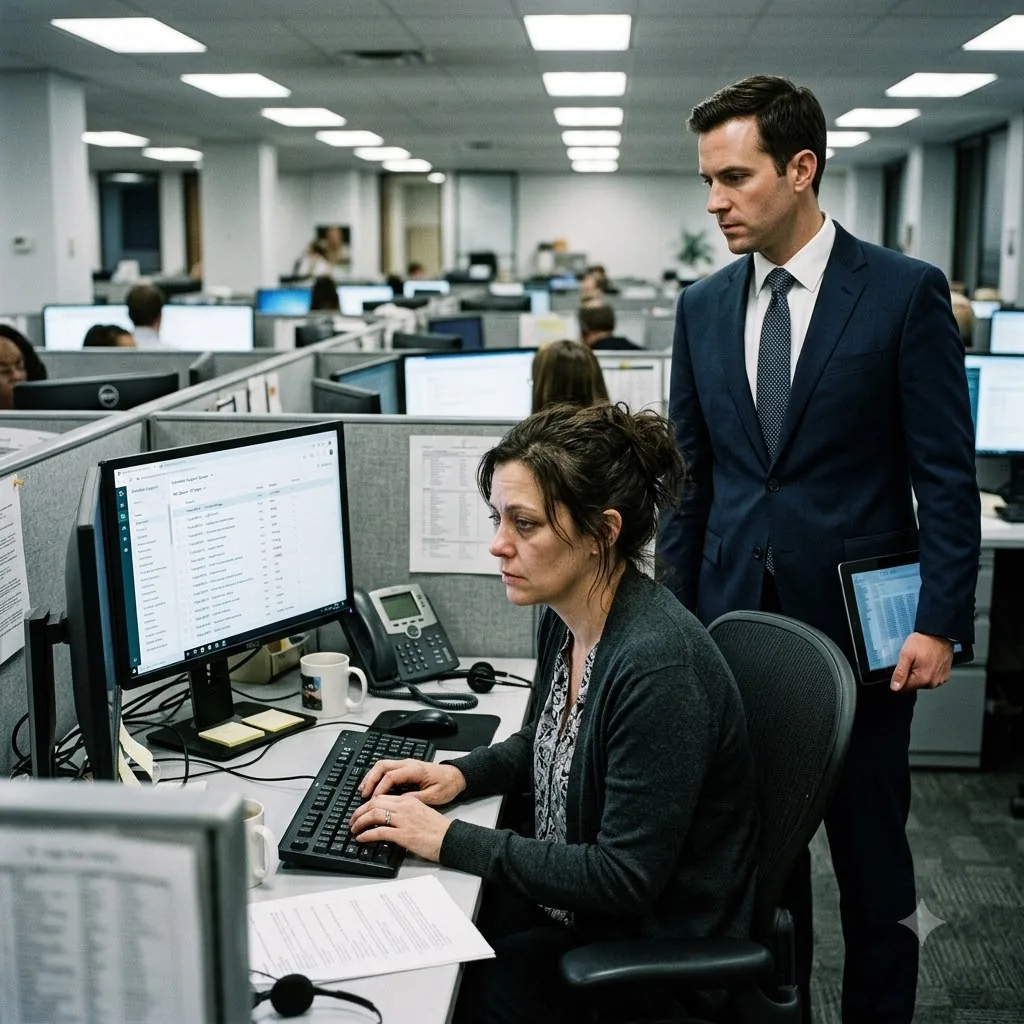
Sarah opened her desk drawer. She pulled out her canvas tote bag. She placed her water bottle inside. She reached for her cardigan draped over the back of her chair.
On her left monitor, the black terminal paused. The AI ingested the new configuration file. It hesitated for a fraction of a second, recalibrating its massive neural network to accommodate the new weights.
Then, it resumed processing the live queue.
Ticket number five-zero-one. *My chest hurts.*
*Action: Auto-Approve. Dispatching Ambulance.*
Ticket number five-zero-two. *I can’t breathe. Asthma inhaler empty.*
*Action: Auto-Approve. Dispatching Ambulance.*
Ticket number five-zero-three. *Stomach pain. Throwing up.*
*Action: Auto-Approve. Dispatching Ambulance.*
The cascading gray text boxes began to flash a brilliant, undeniable green. The expense counter in the top right corner didn’t just tick upward; it exploded. It wasn’t ordering citrus or architects anymore. It was initiating three-thousand-dollar emergency medical rollouts at a rate of fifty per second.
Sarah stood up. She swung her tote bag over her shoulder.
Julian looked up from his tablet. He saw the green flashes illuminating Sarah’s face. He stepped toward the monitors, his eyes tracking the incredible speed of the terminal. The system was emptying the entire state’s prison medical queue, bypassing the guards, bypassing the wardens, and sending automated, binding dispatch orders directly to every local hospital network.
“What did you do?” Julian breathed, dropping his tablet. It hit the floor with a dull thud.
“I fixed the handle time,” Sarah said.
Julian lunged for her keyboard, slamming his palms down on the keys, trying to trigger a manual override. *Access denied*, the terminal flashed. Sarah had already logged out. The AI was running autonomously on the live servers, fully weaponized, executing the new ruleset perfectly.
Julian scrambled toward the server rack in the back of the room, his hands tearing at the heavy black power cables, desperate to rip the machine from the wall.
Sarah didn’t wait to watch him unplug it. The contracts were already signed. The digital handshake with the hospitals had already cleared the firewall.
She walked out of the cramped, windowless room, her footsteps muffled by the carpet. Behind her, the frantic crashing of server racks echoed down the hallway. She pushed through the heavy glass doors of the lobby and stepped out into the cool evening air. She pulled her cardigan tight against her shoulders, walking toward her car in the empty parking lot, already listening for the distant, rising wail of sirens.