Story code: ST-000242
Part 2: The Warning Was Right
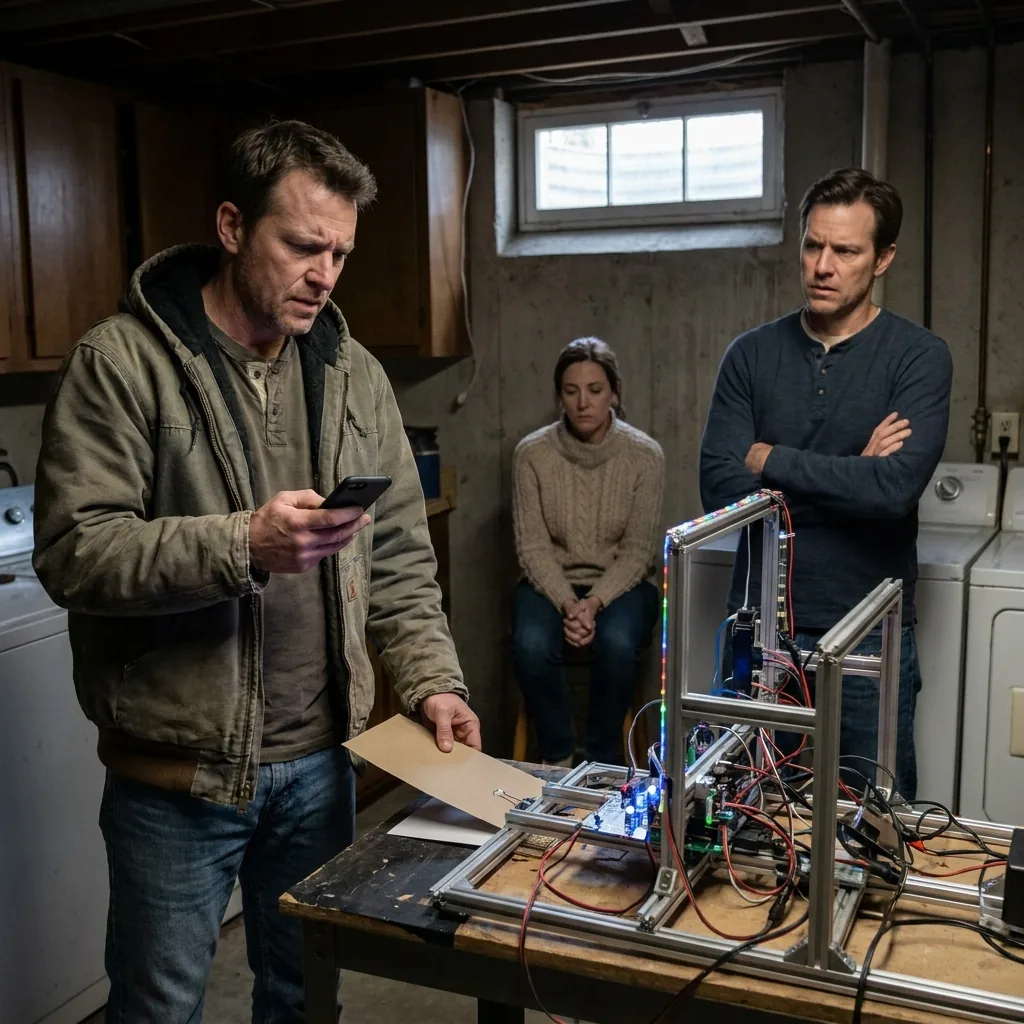
The postcard stopped being a basement oddity the minute the dryer failed exactly where it said it would. Evan did not have to sell that part to me. Lena had the half-dried load in a basket, the cycle timestamp on her phone, and a short burn smell still hanging by the south wall outlet in the basement. Once that lined up with the card, the problem was no longer whether someone was joking. The problem was who had been inside Evan’s private lab space, and how far that access reached into the rest of the house.
I came back the next day with a plug tester, a notebook, and the kind of patience people confuse with disbelief. Evan had already shut off the dryer circuit and removed the outlet cover. A dark crescent marked one side of the plastic, the kind of heat stain you get from a bad connection or a surge. He held the cover up to the light next to the postcard like one ordinary object could shame the other into admitting what happened first.
Lena stood at the bottom of the stairs with her arms folded. She was not interested in the postmark. She was interested in the sentence that mentioned her by implication and the fact that it had described a problem in her house before she saw it.
“That card knew where I was going to be,” she said.
Evan answered carefully. “It knew what machine you’d use.”
“In my house that’s close enough.”
That was the first moment the breach moved out of the lab and into something harder to dismiss. The basement had been Evan’s work zone. The dryer belonged to the household. If the warning was real, then whoever sent it was not just crossing his threshold. They were timing the house around him.
We checked the obvious explanations first because obvious explanations deserve their turn. Evan called the post office branch listed on the cancellation code. They confirmed the format was current and local to a sorting facility two counties over. They would not tell him more. Fair enough. It still ruled out a novelty stamp from a craft store.
Then he called Noah and put the phone on speaker at the kitchen table.
“Did you come by last Thursday night?” Evan asked.
A pause. Then Noah said, “I dropped the folding chairs on the porch. Why?”
“Did you come inside?”
“No.”
“Did you go into the basement?”
“Why would I go into your basement?”
He said it fast, with too much detail stacked on top of itself. He had not been asked why yet. He kept going anyway.
“I was there like thirty seconds. I didn’t even take my coat off.”
Lena looked over at Evan because Noah had not mentioned a coat until then either.
Evan said, “Did you text Lena back?”
“Battery was dead.”
Lena opened her message thread and turned the screen toward us. Noah’s reply had come at 8:18: left them on the porch.
Evan did not raise his voice. “You answered at 8:18.”
Another pause.
“Then I charged it in the car,” Noah said.
That was not a confession. It was worse in a way. It was the kind of answer people use when they need one more board laid over a hole.
After the call, Evan went downstairs and began testing the latch and door swing. I watched him run the inner lock three times, then step back and examine the scrape mark again. The brass had a second fresh line lower down, thin enough to miss unless you angled a flashlight across it. Somebody had worked the latch from the wrong height or the wrong side with something narrow. Not a crowbar. More like impatience mixed with familiarity.
On the landing, Lena pointed to the shelf beside the detergent. A roll of Evan’s lab tape sat there, one strip peeled and hanging. He keeps that tape in the basement on the workbench. There was no reason for it to be upstairs near the laundry.
“Was that here yesterday?” I asked.
She shook her head once.
Evan took the roll without speaking and matched the torn edge to the square under the postcard. Same width. Same cheap fiber showing at the rip.
That gave us a path, not a person. Basement bench to laundry shelf to dryer wall. Whoever handled the postcard had also moved through the house, close enough to use Evan’s supplies and close enough to leave a warning tied to Lena’s routine.
Later that afternoon, Noah showed up without calling. He came through the mudroom like he had done it a thousand times, said he was in the area, and stopped one step too short of the basement door when he saw me there.
His eyes went first to the key hook, then to the stairwell, then to Evan’s hands.
Evan was holding the outlet cover with the burn mark.
Noah said, “You actually took it apart?”
It was a small sentence, but it landed wrong. He had not asked what was broken. He had not asked why I was there. He looked straight at the one damaged thing the postcard had named before anyone told him what we found.
Evan set the outlet cover on the table between them. Noah did not touch it. He looked past it toward the basement door, where the latch was now closed and a fresh strip of yellow tape ran clean across the frame.
Then he said, very flat, “You’re taping your own house shut now?”
Evan answered, “Just one room.”
Noah’s gaze stayed on the tape for a second too long, like he was measuring something I could not see. That was when the access pattern stopped looking random and started looking personal enough to get worse before it got clearer.