Story code: ST-000242
Part 3: The Window In The Rig
I did not come back to the Mercer house to referee family denials. I came back because Evan finally had enough clean anomalies to justify a technical review, and once we started measuring instead of arguing, the room got narrower around Noah.
Evan had left the yellow tape across the basement door overnight. When I arrived the next morning, the strip was broken in one place near the latch and pressed back together by hand. Not neatly. The torn fibers were mashed flat where somebody had tried to make the damage look smaller than it was.
Lena saw me looking at it and said, “I didn’t touch it.”
Evan held up his phone. He had taken a picture of the seal before bed. The rip was new.
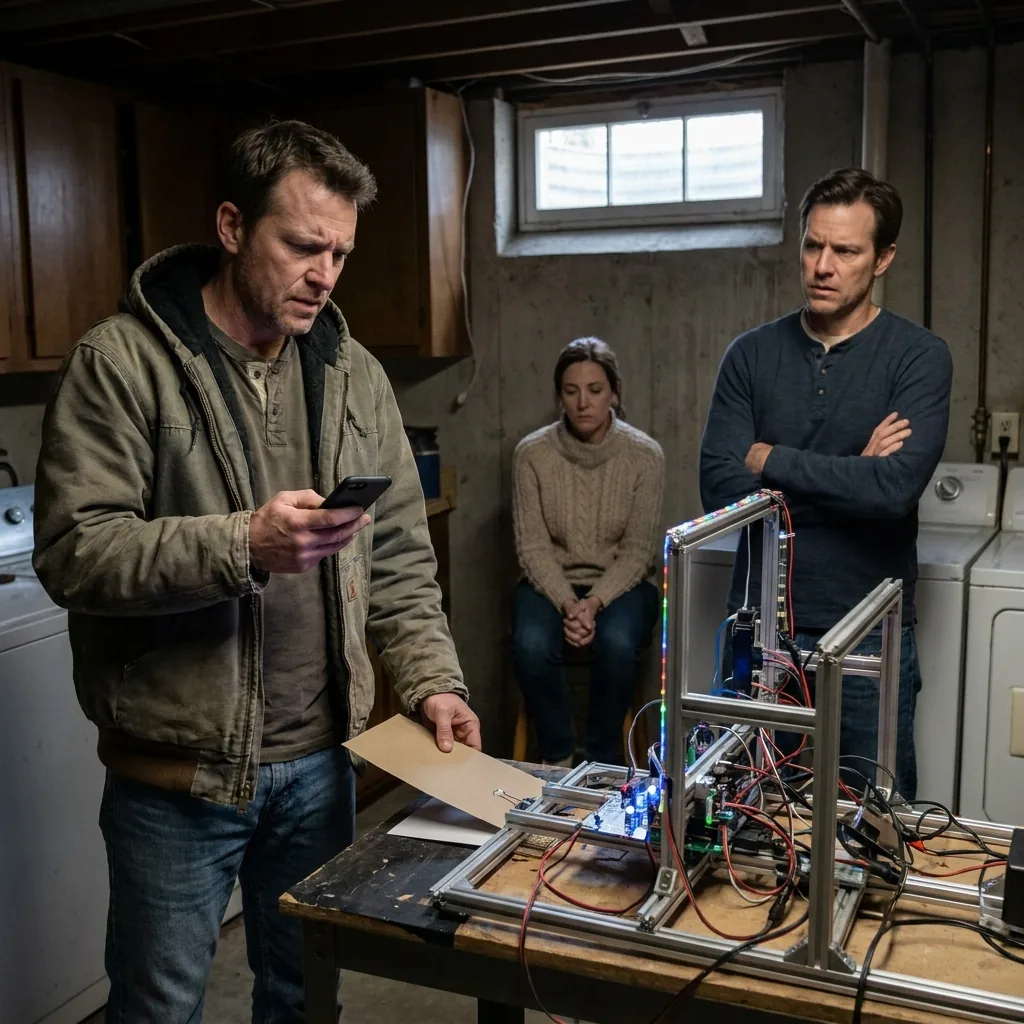
He did not call Noah yet. He went downstairs, opened the maintenance log notebook, and set the postcard beside it again. The basement looked as precise as ever except for the parts that no longer fit: the fresh scrape on the latch plate, the scuffed floor tape by the timing rig, the burn-marked outlet cover on the bench, and now the broken seal on the stair door.
I asked for the rig logs. Evan gave me a printout from the controller and the handwritten notebook together, which was what I needed. The controller tracked power draw in half-second bursts. The notebook tracked whatever he noticed with his own eyes and ears. A lot of people trust one record and not the other. In a room like that, you need both.
The spike at 8:14 lasted less than three seconds. Under ordinary conditions it could have been ugly wiring and a relay hiccup. It was the shielding trace that changed the picture. At the same instant as the south outlet surge, the shielded test chamber registered a drop and recovery pattern Evan had marked twice before during small displacement attempts. He pulled those old pages for me without a word.
I laid all three entries side by side.
“These match,” I said.
Evan nodded once. “Not perfectly. Same shape.”
That was enough. The postcard had arrived as an ordinary object, but not by ordinary handling. Something had lined up in the rig’s narrow window when the outlet sparked. Not a movie effect. Not a glowing portal. Just a brief event recorded in two systems at once and attached to an object that should not have existed in the room yet.
Lena stayed on the landing through most of this, listening. She asked the question that mattered most in a house and least in a lab.
“So that thing came through because of your machine?”
Evan looked at the printout before he answered. “Because of the rig, the outlet problem, and bad shielding. That’s what the record supports.”
She did not come farther down the stairs after that.
We tested the physical path next. Evan showed me exactly where the postcard had been found, then where a person standing at the workbench could have set it before it slid under the lip. He measured the scuff by the taped floor mark with a ruler and compared it to the heel width on three pairs of his own shoes. None matched. Noah’s did not have to be present for the room to start pointing at him; it was enough that the movement belonged to somebody who knew where to stand without walking into the chamber frame.
At noon Noah called instead of the other way around. Evan put him on speaker.
“Why is Lena asking if I was in the basement?” Noah said.
Evan answered, “Because someone broke the tape on the basement door last night.”
Silence long enough to hear the dryer hum upstairs.
Then Noah said, “You taped the door?”
He had said the same thing the day before in person, but this time it came too quickly. He was reacting to the detail, not learning it.
Evan asked, very evenly, “How did you know it was tape on the door before I said where it was?”
Noah’s response came back sharp. “Because you told me yesterday you were taping rooms off like a lunatic.”
That was close enough to plausible that nobody spoke over him. He kept going.
“Uncle Evan, if this is about that postcard, throw it away. You’re making everybody crazy.”
Throw it away. Not what postcard. Not what are you talking about. Just throw it away.
After the call, Evan opened a shallow drawer under the workbench and took out a folded printout I had not seen yet. It was an old calibration sheet with Noah’s handwriting on the margin from six months earlier: relay delay 0.8 sec? ask Evan. A harmless note by itself. Except Noah had always told Lena and everyone else that he did not understand the equipment and never went near it.
Evan laid the sheet beside the postcard and the logs. Same blue-ink pressure, same cramped question mark, same habit of dropping the tail on the y.
“He was down here longer than he admits,” I said.
“Yes,” Evan said.
Lena came down two more steps and stopped. Her eyes went from the calibration note to the broken tape and then to the stair door. She did not ask for a theory this time.
She said, “Change the mudroom code. Today.”
That was the first household decision made as if the breach were real. It was also the moment the proof stopped being just Evan’s burden. The rig had made the window. Noah knew enough about the room and the timing to use it or wait for it. And if Lena was changing the code, then Part 4 was no longer going to be about whether Noah had crossed the threshold. It was going to be about what they were willing to lose by admitting how.