Story code: ST-001639
Part 2: The Purge Protocol
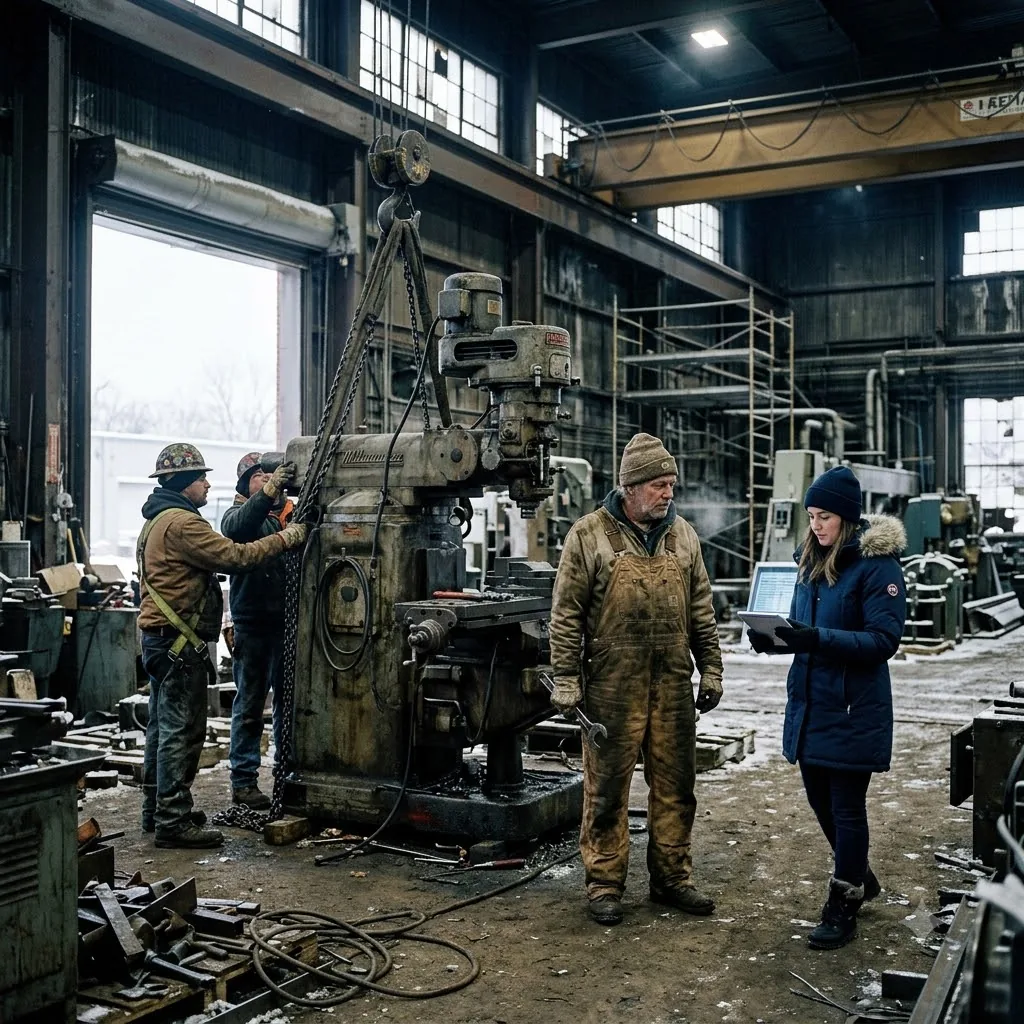
Arthur did not look at Chloe’s raised, trembling hands. He kept his eyes fixed on the massive, chained bulk of the Mark VII hydraulic press. He walked right past her, the frozen air parting around his broad shoulders.
“The ledger says zero,” Arthur said, his voice flat, carrying through the cavernous space without an echo. “Thirty-five years, and your algorithm zeroed out my pension for ‘accelerated depreciation’.”
Chloe lowered her hands slightly, her breath catching in the frigid air. “Mr. Vance, you need to step back behind the line. The financial assessment is final and automated. I don’t control the output.”
“The output is a lie,” Arthur said, not breaking his stride.
He gripped the tablet in his left hand, the cold rubber case biting into his callouses. He knew exactly what he was about to do. The liquidation firm relied on remote data collection, running their asset valuations from pristine offices thousands of miles away. But the Mark VII was a legacy machine. It didn’t broadcast its true telemetry to the cloud. It stored its deep operational history-every pressure test, every maintenance cycle, every proof of its pristine condition-on a localized, closed-loop motherboard bolted directly behind the primary housing. If they were claiming the machine was fully depreciated scrap to offset his pension, the proof to the contrary was physically locked inside the press itself.
The two contractors stepped into his path, their pristine high-visibility vests bright against the grimy machinery. The taller one held up a heavy gloved hand.
“Hey buddy,” the tall contractor said, his voice tense. “You need to listen to the lady. We’re under strict orders. Nobody touches the hardware once the chains are on.”
Arthur stopped two feet from the man. He looked at the heavy brass padlock dangling uselessly from the contractor’s other hand. Then he looked at the intricate web of industrial chains they had hastily thrown over the Mark VII’s upper carriage.
“You looped the primary load chain directly over the hydraulic manifold,” Arthur said, his voice dangerously quiet. “If you tighten that winch, you’ll crack the cast-iron valve cap. It’ll bleed toxic fluid all over the concrete, and the EPA will fine your rigging company a quarter-million dollars before sunset.”
The contractor hesitated, his eyes darting to the chain, then back to Arthur. It was a bluff, but a highly technical one, and in that split second of doubt, the young man’s posture faltered. Arthur didn’t wait for him to recover. He stepped hard to the left, slipping through the gap between the two men with the practiced, heavy grace of a man who had navigated this crowded factory floor for over three decades.
He reached the base of the Mark VII. The familiar smell of lithium grease and cold steel washed over him, a smell like home.
“Stop him!” Chloe shouted from the safety tape, her corporate composure entirely shattered. Her expensive boots clicked frantically against the concrete, though she did not cross the yellow line. “He has the exit terminal! If he breaks the security seal on that tablet, I’ll have him arrested for corporate espionage!”
Arthur ignored her. He crouched beside the main control column of the press. His right hand went to his tool belt-which he was no longer wearing-out of pure muscle memory. He cursed under his breath, realizing his wrench was still lying on the floor twenty feet away. But he didn’t need it. He knew the maintenance panel’s trick. He pressed the heel of his palm against the bottom left corner of the steel access door and struck the top right corner sharply with his elbow. The corroded latch snapped open, and the heavy metal panel swung down, revealing a nest of dust-coated wires and a single, outdated USB diagnostic port.
“I’m calling site security,” Chloe warned, her voice rising in pitch. “Mr. Vance, this is your absolute final warning. You are forfeiting whatever remaining legal rights you have.”
“I don’t have any left to forfeit,” Arthur muttered to himself.
He took Chloe’s tablet. The biometric exit protocol was still glowing on the screen, demanding his fingerprint to finalize the zero-dollar payout. Instead, he flipped open the rubberized tab on the bottom of the case, exposing the charging port. He pulled a frayed adapter cable from the deep pocket of his winter coat-a spare cord he had used for years to pull error codes off the shop floor machinery. He plugged one end into the Mark VII’s archaic port and jammed the other into the liquidator’s tablet.
The harsh blue light of the screen flickered. The exit contract vanished, replaced instantly by a raw, blinking command prompt. Chloe’s administrative access was still active on the device, granting it localized override authority.
“Handshake established,” Arthur read aloud, his eyes tracking the tiny white text scrolling rapidly against a black background. He tapped the on-screen keyboard, his thick fingers moving with surprising speed as he bypassed the initial security gates. He wasn’t stealing anything. He was looking for the localized maintenance ledger, the undisputed record that proved he had kept this machine running at ninety-nine percent efficiency. If he could download that ledger, he could prove the corporate algorithm was based on fraudulent data. He could save his pension.
Behind him, the contractors were moving in. He could hear the heavy scrape of their boots, the rattle of the chains shifting as they grabbed for him.
“Grab the cable,” the tall contractor barked.
Arthur leaned his shoulder heavily against the steel column, physically blocking the access panel with his body. “Just give me ten seconds!” he yelled, scrolling through the deep directories.
He found the file. SYS_MAINT_LOG_ARCHIVE. He selected it, hitting the command to copy it to the tablet’s local storage.
Suddenly, the tablet emitted a piercing, high-pitched tone. The screen flashed violent red. Arthur stared at the prompt that was overriding his copy command.
UNAUTHORIZED LOCAL CONNECTION DETECTED. ASSET DEPRECIATION CONFIRMED. INITIATING COMPLETE SYSTEM PURGE.
Arthur’s stomach plummeted into his boots. The algorithm wasn’t just adjusting his pension; it was actively scrubbing the machine’s hard drives to destroy the evidence of its true value. It was burning the plant’s history to the ground to justify the theft.
“No, no, no,” Arthur grunted, frantically tapping the screen to abort the sequence. The progress bar for the memory wipe leaped to twenty percent.
A heavy hand clamped down on Arthur’s shoulder, gripping his coat tightly. The tall contractor yanked backward, trying to haul Arthur away from the console. Arthur braced his steel-toed boot against the base of the press, refusing to budge, but the violent motion caused the frayed adapter cable to pull taut, putting immense strain on the diagnostic port. If the connection broke now, the wipe would continue automatically, erasing thirty-five years of proof in a matter of seconds, leaving him with absolutely nothing.