Story code: ST-001653
Part 2: The Violence of Wellness
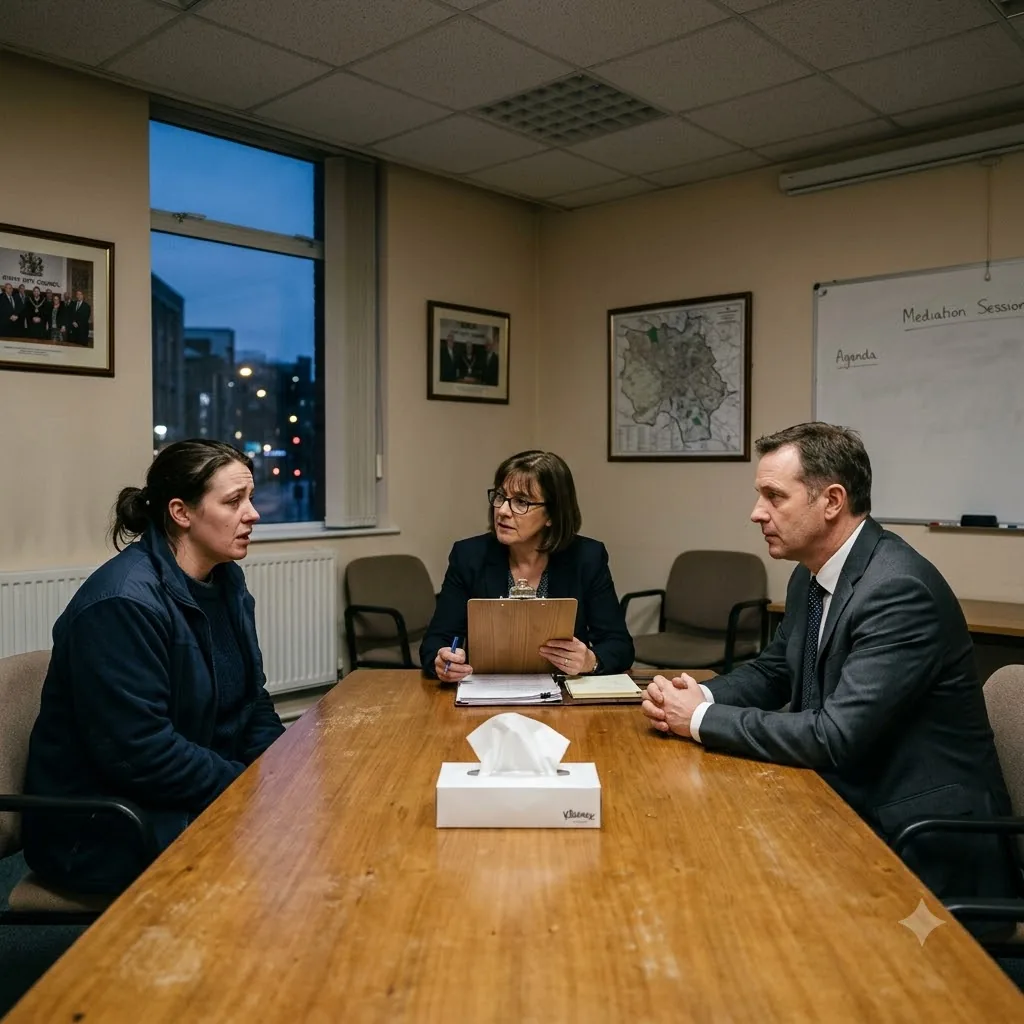
Maya did not take the silver pen. She left it suspended in the space between them, anchored by Elise’s unwavering, serene smile. The ambient hum of the white noise machine in the corner of Conference Room B suddenly sounded like a swarm of distant locusts.
Maya looked down at the heavy, cream-colored cardstock of the Community Alignment and Wellness Agreement. She took a slow, deliberate breath, forcing her heart rate to steady. If she shouted, if she flipped the faux-maple table, she would give them exactly what they needed: undeniable proof that she was unhinged, a threat to the municipal staff, and unfit to participate in civic proceedings. They were begging her to lose her temper.
Instead, Maya folded her hands in her lap. “Let me make sure I am fully processing this,” she said, carefully flattening her voice to match the sterile calm of the room. “You are saying that my advocacy for the three hundred families in the East Ward is causing David emotional distress.”
“It’s not the advocacy itself, Maya,” Elise murmured, retracting the pen but keeping her hand resting softly on the table. “It’s the adversarial framework. We operate in a collaborative ecosystem here. When you use activating language in public forums, it fractures the psychological safety of the planning team.”
“Activating language,” Maya repeated. She pulled the document an inch closer. “Can you point to a specific example in my recent communications?”
David shifted in his ergonomic chair, letting out another long, beleaguered sigh. He looked at Elise for permission to speak, a perfectly choreographed display of vulnerability. “Last Tuesday,” David said, his voice barely above a whisper. “When you distributed those flyers. You called the highway expansion an ‘eviction pipeline.’ You used the word ‘destruction.’ Do you know how hard it is for my team to come to work when they are being framed as destroyers? We are infrastructure facilitators, Maya. We are trying to build connectivity.”
“You are bulldozing six blocks of residential housing,” Maya stated, keeping her tone completely flat. “That is the literal definition of destruction.”
Elise winced, a tiny, exquisite flinch, as if Maya had just struck a tuning fork against her skull. “Maya, I need to name what’s happening in this room right now. You are invalidating David’s lived experience of your hostility. You are prioritizing your political goals over our shared humanity.”
Maya bit the inside of her cheek so hard she tasted copper. It was a flawless trap. The bureaucracy had evolved. It no longer fought with zoning codes and police batons; it fought with therapy speak and weaponized fragility. They were insulating a multi-million-dollar demolition project in the language of self-care.
She looked back at the document. She read Clause 3, which stated all community messaging must be pre-screened by the Municipal Culture Office to ensure “positive framing and emotional neutrality.” Clause 4b required Maya to waive her right to request emergency environmental injunctions, framing the legal stall tactics as “prolonging community trauma.”
“And if I refuse to sign this wellness agreement?” Maya asked.
David looked down at his lotion-infused tissues. “Then I’m afraid I cannot subject my staff to further harm. We will have to designate the East Ward Neighborhood Association as a non-compliant entity. Under the city’s safe workplace charter, we are legally permitted to bypass consultation with any group that presents a psychological hazard to municipal employees.”
Maya’s blood ran cold. That was the mechanism. That was how they were going to bypass the halt memorandum. If she didn’t sign, she was deemed a hazard, and they could legally ignore the four hundred signatures she had gathered. If she did sign, she was bound by contract to remain silent and obedient while they paved over her home.
She was out of time. The zoning office closed at five o’clock. The injunction had to be filed today.
Maya reached into her blazer pocket and pulled out her smartphone.
Elise’s smile vanished. The aggressive empathy evaporated, replaced by a sudden, rigid sharpness. “Maya, what are you doing?”
“Practicing self-care,” Maya said. She opened her camera app, selected the document scanner, and held the phone over the Community Alignment and Wellness Agreement.
“Maya, no,” Elise said, her NPR-host murmur snapping into a harsh, authoritative bark. She lunged across the laminate table, slapping her hand down over the cream-colored cardstock. “This is a confidential restorative space. You do not have consent to record this document.”
Maya had already pressed the capture button. The flash illuminated the dim room for a split second, catching Elise’s hand clamped over the bottom half of the paper, but leaving the header and the horrific clauses perfectly legible on Maya’s screen.
David scrambled backward in his chair, his performative fragility instantly dissolving into genuine panic. “She’s photographing it, Elise! She’s taking it out of context!”
“I have all the context I need,” Maya said, sliding her phone safely back into her pocket and standing up. She grabbed her heavy leather binder. “You just tried to extort a citizen into waiving their constitutional right to petition the government, using workplace safety as a shield for corporate demolition.”
David’s face flushed a deep, mottled red. He grabbed his laptop, flipping it open with violence that completely betrayed his previous delicate posture. His fingers hammered against the keyboard. “You are in violation of the civic code of conduct!” he shouted, his voice cracking. “I am officially logging this interaction as a hostile escalation. I am filing the safety bypass right now, Maya. Do you hear me?”
“File whatever you want,” Maya said, though her stomach plummeted.
“You think you’re saving them?” David sneered, his eyes locked on his screen as he navigated the city’s internal portal. “By refusing alignment, you’ve just triggered the emergency infrastructure acceleration protocol. We don’t have to wait three weeks for the standard community review period anymore. The environment is officially unsafe. We are clearing the hazard.”
Maya stopped at the door, her hand on the cold metal handle. “What does that mean?”
David hit the enter key with a definitive, hollow clack. He looked up, his expression devoid of any remaining warmth, completely shedding the mask of the wounded public servant.
“It means the community engagement window is closed,” David said coldly. “The earth-moving assets will deploy on Monday at 6:00 AM.”
Maya stepped out into the harsh fluorescent light of the hallway, the heavy door clicking shut behind her. Monday. She had exactly seventy-two hours to turn a photograph of a bogus wellness agreement into a weapon strong enough to stop a fleet of bulldozers.