Story code: ST-001656
Part 4: The Dead Room
The silver-haired investor did not shout. He did not threaten litigation, nor did he demand an explanation. He simply stood up, sliding his tablet smoothly into his leather portfolio with a soft, final zip.
“Auralis is a contaminated asset,” the man said. He didn’t look at Marcus. He spoke only to his two colleagues, who were already pushing their chairs back. “We do not invest in unmitigated legal exposure. Cancel the follow-up meetings.”
“David, wait,” Marcus said, stepping away from the smartboard. He held out his hands, the presentation remote clattering onto the oak table. “It’s a localized caching error. I can partition the dataset. I can scrub the telemetry logs-”
“You just admitted to live surveillance of a private network in front of three witnesses,” David said, his voice entirely devoid of emotion. He walked past Marcus without breaking stride. “You are unfundable. Do not contact my firm again.”
The heavy glass door hissed open, and within ten seconds, the three men were gone, disappearing down the polished concrete hallway.
The silence left behind in Conference Room A was absolute. The glossy slide behind Marcus-*100% Ethically Sourced Emotional Cloning*-glared down on the empty oak table.
Marcus stared at the doorway, his shoulders slumped, his chest rising and falling in rapid, shallow breaths. Slowly, he turned his head to look at Elias. The polished Silicon Valley veneer was gone, replaced by a bitter, hollow sneer.
“Are you happy?” Marcus asked, his voice trembling with a mixture of rage and devastation. “You just burned down three years of my life. You burned down a twenty-million-dollar valuation over a few gigabytes of discarded room tone.”
“You stole my voice, Marcus,” Elias said softly. “You bugged my livelihood.”
“Your livelihood is obsolete!” Marcus snapped, slamming his hands down on the table. “I was trying to immortalize you! Do you think you’re the only one? Do you think stopping me changes anything? The agency already has your generated file. They love it. It’s faster, it’s cheaper, and it doesn’t need to take a break because its throat hurts.”
Elias reached out and picked up his heavy aluminum backup drive. The metal was cold against his palm.
“You killed my funding,” Marcus sneered, stepping closer. “But you can’t un-train the model, Elias. The neural net is already compiled. The weights are locked. It knows exactly how you breathe. It knows exactly how you hesitate. I have off-site backups of the core algorithm that you will never find. You didn’t stop the software. You just made sure neither of us gets paid for it.”
Elias didn’t argue. He didn’t throw a punch. He just looked at the desperate, sweating man who used to be his friend, turned his back, and walked out through the glass door.
The drive back across the city was a blur. Elias barely registered the traffic, his hands gripping the steering wheel tight enough to make his knuckles ache. Marcus’s final words echoed in his head, looping like a corrupted audio file. *You can’t un-train the model.*
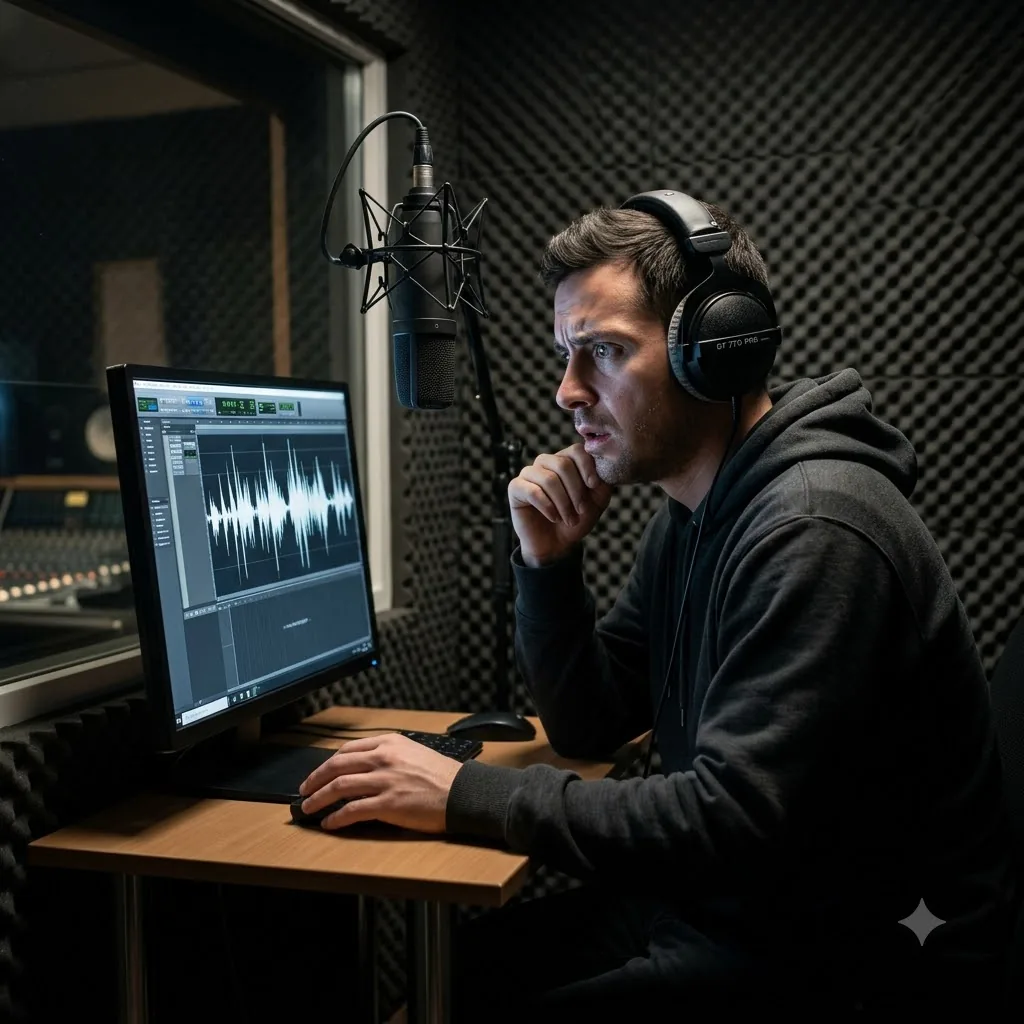
When Elias finally unlocked the door to his apartment, the heavy, soundproofed silence of his home studio hit him like a physical weight. He walked past his kitchen and stepped straight into Booth B.
The room was dead. The heavy Ethernet cable still lay coiled like a severed snake on the carpet. The router switch on the wall was dark. The primary monitor was black.
Elias sat in his wheeled chair. He looked at the expensive Neumann condenser microphone mounted on the boom arm. For fifteen years, that piece of metal and mesh had been his conduit to the world. It was how he paid his rent. It was how he expressed his art. He had spent ten thousand hours in this padded box, meticulously controlling every syllable, every inflection, every intake of air.
He had believed that by controlling the microphone, he controlled his identity.
But Marcus was right. The algorithm existed. Somewhere out there, sitting on a server farm or backed up on a flash drive, a ghost version of Elias was waiting. It didn’t matter if he formatted his hard drives. It didn’t matter if he never plugged his computer back into the wall. The digital map of his vocal cords-the microscopic topography of his exhaustion, his pain, and his humanity-had already been extracted and compiled.
Elias reached out and rested his fingertips against the cold metal grille of the microphone.
He could try to fight it. He could spend the next five years drowning in legal fees, chasing phantom files across the dark web, sending cease-and-desist letters to every corporate agency that suddenly sounded a little too much like him. But he would never catch all of them. His voice no longer belonged to him. It belonged to the math.
He let his hand fall away from the mic.
Elias sat perfectly still in the windowless, foam-lined room. He closed his eyes and simply breathed, focusing on the sharp, ragged click in the back of his throat. He didn’t speak. He realized, with a suffocating, bitter clarity, that in a world where his every spoken word could be infinitely replicated, silence was the only thing he truly controlled.