Story code: ST-001665
Part 2: The Safe Space
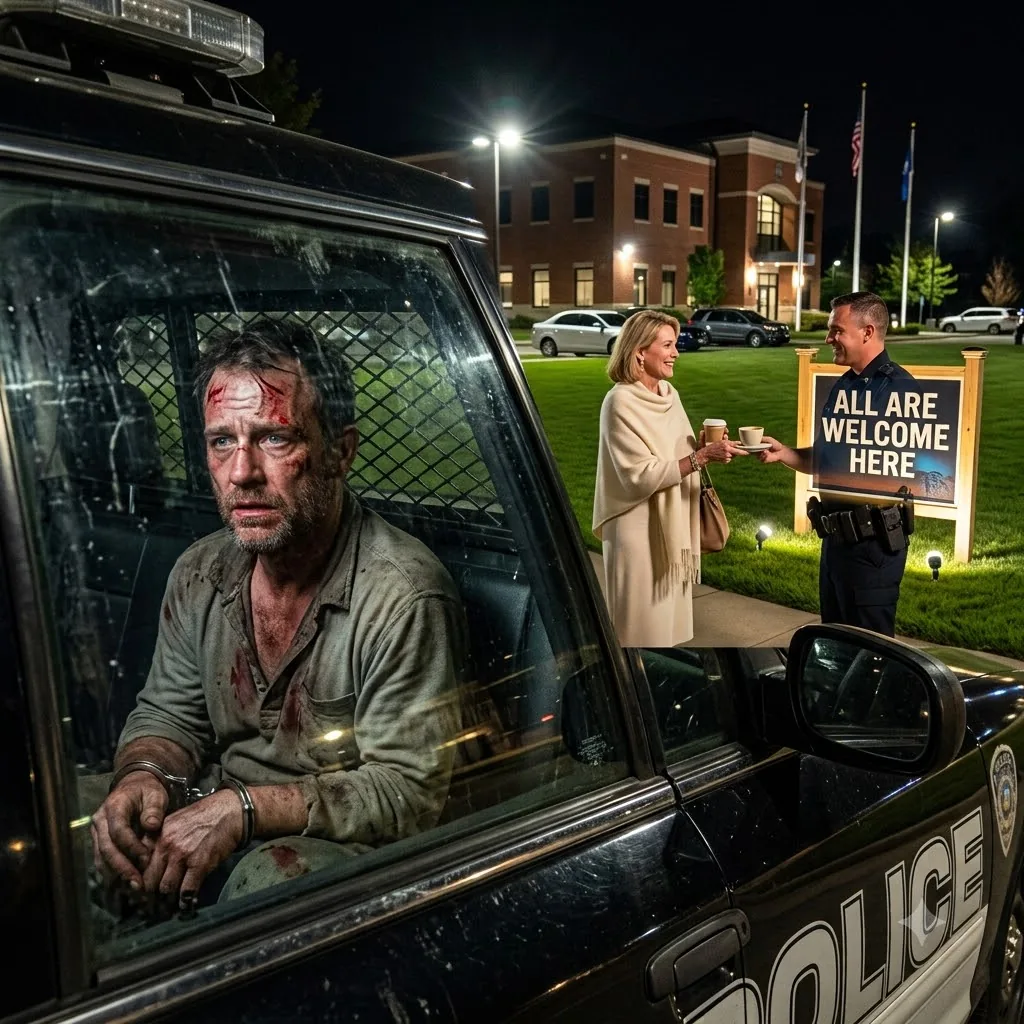
The collar of Marcus’s charcoal suit tore with a sharp, grating sound as the sergeant hauled him halfway out of the cruiser’s door. The freezing rain stung Marcus’s face, washing the drying blood from his eyebrow down into his left eye. He gasped as his twisted shoulders took the brunt of his dead weight against the unyielding steel of the handcuffs.
“You think you’re smart, coming into this neighborhood?” the sergeant growled, his face inches from Marcus’s. The smell of peppermint and stale coffee washed over the cramped space. The younger officer stood just behind the sergeant, the heavy metal Maglite tapping a slow, menacing rhythm against his thigh.
“I was invited,” Marcus choked out, struggling to find his footing on the wet asphalt without using his hands. “The zoning meeting. I had blueprints-”
The sergeant shoved him backward. Marcus collided hard with the plastic seat, his skull bouncing off the wire-mesh partition. White-hot pain flared behind his eyes, multiplying the flashing red and blue lights into a blinding strobe.
“Shut your mouth,” the younger officer snapped, leaning his torso into the cab. “We heard all about your little zoning meeting. You don’t get to walk into a woman’s home, corner her in her own kitchen, and threaten her life just because she won’t write a check for your pet project.”
Marcus blinked through the dizzying pain. The sheer, inverted reality of the accusation left him temporarily breathless. Threaten her life? He closed his eyes, the memory of the past hour replaying with sickening, high-definition clarity.
It hadn’t been an argument. It had been an execution. Marcus had stood in Eleanor’s expansive, marble-countered kitchen, the soft sounds of a hired string quartet drifting in from the living room. He had unrolled the blueprints for the community shelter, smoothing them flat on the island. He had pointed to the property lines, explaining calmly how the new facility would remain completely out of sight from her exclusive subdivision. He hadn’t raised his voice. He hadn’t even stepped around the island.
Eleanor had listened with a serene, fixed smile. Then, she had looked at her gold Cartier watch, picked up her half-full crystal wine glass, and deliberately dropped it onto the imported tile floor.
The shatter had been deafening in the quiet kitchen. Before Marcus could even process the broken glass, Eleanor had retreated backward, pressing her spine against the stainless-steel refrigerator. She had begun to hyperventilate, clutching her cashmere cardigan over her chest, her eyes wide with a perfectly simulated, primal terror.
“Please,” she had cried out, her voice pitched loud enough to cut straight through the chamber music. “Please, stop! You’re invading my safe space! I feel incredibly threatened right now! You need to back away!”
Marcus had been utterly paralyzed. He had instinctively taken half a step forward, raising his hands palms-out in a universal gesture of peace, trying to de-escalate a panic he didn’t understand. “Eleanor, what are you doing? Are you hurt?”
That was the exact moment the kitchen doors had swung open. The other guests-the local councilman, the HOA board members, the neighborhood watch captain-had poured in to find a large, unfamiliar man looming toward a wealthy, trembling woman who was screaming about her safety. She hadn’t used curses or direct insults; she had weaponized the precise, progressive vocabulary printed on the signs in her front yard. She was a vulnerable victim experiencing a traumatic aggression. Marcus was the immediate, unmitigated threat.
The police had arrived in less than three minutes. They hadn’t asked questions. They had seen Eleanor sobbing gracefully into the shoulder of the councilman, pointing a shaking finger at Marcus. The younger officer had blindsided him immediately, driving a knee into his lower back and slamming his face into a console table before dragging him through the foyer. She had orchestrated the entire evening to ensure the shelter would be legally and socially radioactive, tethered forever to a violent police incident.
“She set it up,” Marcus said now, his voice raspy, fighting to keep his rising panic in check. He stared at the younger officer’s name tag. *Miller.* “Look at my jacket pockets. I have a digital recorder. I record all my zoning meetings for the public record. Check my jacket.”
Miller laughed, a short, barking sound. He reached into one of the tactical pouches on his vest and pulled out the crushed, plastic remnants of Marcus’s dictaphone. The casing was cracked down the middle, the internal memory board snapped in two.
“You mean this?” Miller asked, holding up the ruined electronics. “Funny thing about standard operating procedure. This got smashed when you were violently resisting arrest in the hallway. Total loss. Just like your little community center.”
Marcus stared at the broken plastic, a cold, heavy dread finally piercing through the adrenaline. They hadn’t just arrested him; they were actively sanitizing the scene. The recording was gone. The only narrative left was Eleanor’s carefully constructed performance of trauma, backed by a dozen wealthy eyewitnesses who had seen exactly what they had been primed to see.
“She invited me here to frame me,” Marcus said, his voice dropping to a desperate whisper. “She doesn’t want the shelter built, but she can’t vote against it publicly without looking like a hypocrite. This is a setup. Please. You have to ask the other guests. Someone had to see her drop the glass.”
The sergeant sighed, stepping back from the door frame. He looked up the long driveway toward the house, where Eleanor was now visible in the large bay window, warmly embracing a concerned neighbor. The perfect, picturesque image of a brave survivor relying on her community.
“I’m going to explain how tonight works, Marcus,” the sergeant said, his tone dropping the aggressive bark for a calm, professional deadliness. “You forced your way into a prominent citizen’s home. You cornered her. You destroyed her property, and you fought us when we arrived to help her. That’s the report.”
“That’s a lie,” Marcus said, straining uselessly against the cuffs. “It’s a complete lie and you know it.”
“It’s the truth on paper,” the sergeant replied, gripping the edge of the open cruiser door. “And unfortunately for you, she found something else in her kitchen after we dragged you out. Seems you brought a weapon to the party.”
Marcus’s stomach dropped into a bottomless void. “What? No. I didn’t have anything.”
“A kitchen knife, Marcus,” Miller said, his smile vanishing entirely. “Wiped clean, but found right where you were standing. Attempted aggravated assault with a deadly weapon. You’re looking at a decade.”
Miller reached into the front seat of the cruiser, his hand hovering over the center console dashboard. With a sharp, mechanical click, he powered down the cruiser’s dashcam and the internal rear audio feed. The small red recording light blinked out, leaving the back of the car in near total darkness.
“Now,” the sergeant said, rolling his thick shoulders as he reached for the heavy black baton on his belt. “Let’s talk about resisting.”