Story code: ST-001666
Part 2: The Dead End
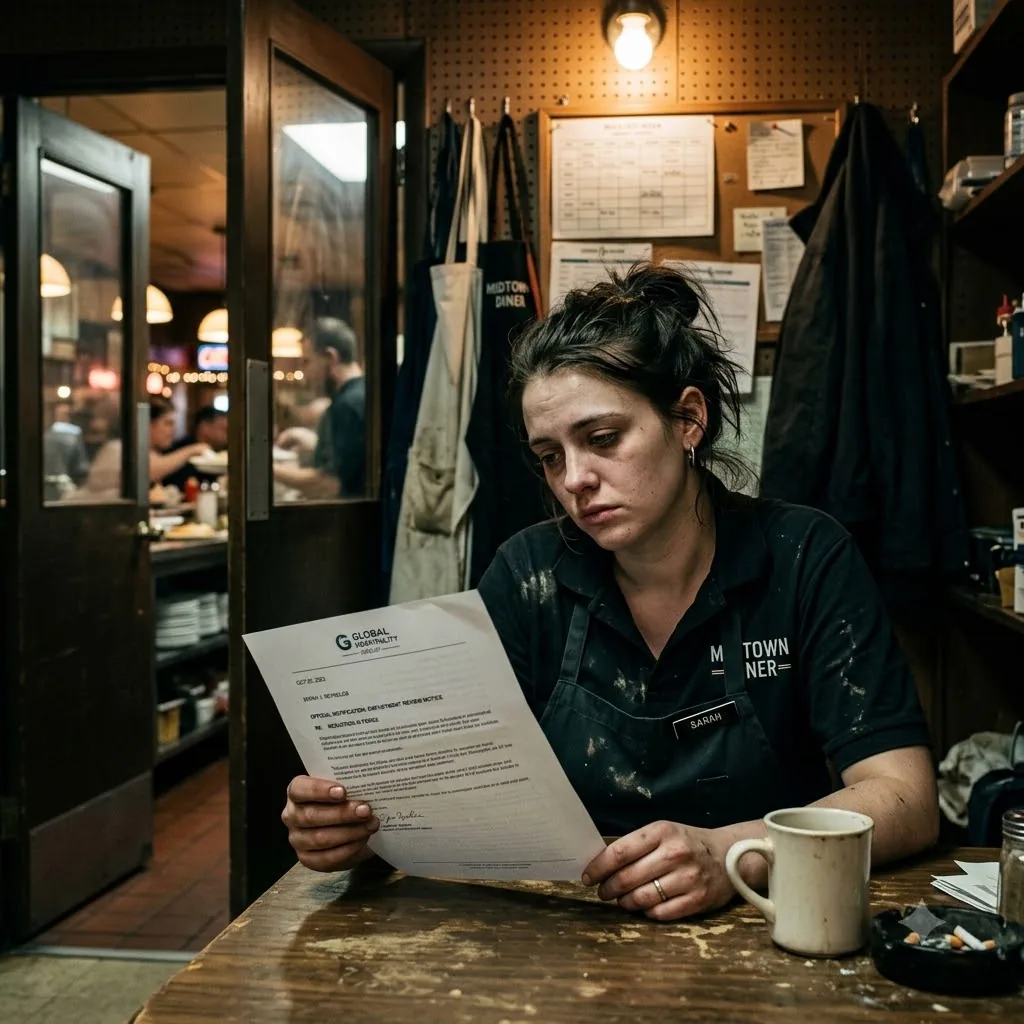
Elena’s fist closed so tightly her fingernails bit into the fleshy palm of her hand. The pale yellow paper crumpled against the stiff cardstock of the denial letter. She shoved the entire wad deep into the grease-stained front pocket of her apron, her heart hammering against her ribs like a trapped bird.
The silhouette stepping onto the loading dock wasn’t an Apex enforcer or a prison guard. As the heavy metal door clicked shut behind him, the dim fluorescent light revealed Dave, the driver for the regional linen service, wearing his standard grey coveralls. He carried a massive stack of shrink-wrapped floor mats, whistling a flat, tuneless melody around a wooden toothpick.
“Scare you, Ellie?” Dave asked, dropping the heavy rubber mats onto the concrete with a dull, dusty slap.
“Just lost in thought,” Elena managed. She forced her lungs to expand, her voice trembling only slightly.
Dave didn’t notice. He pushed past her into the sweltering kitchen, loudly shouting a greeting to the line cooks over the hiss of the grill. Elena leaned her back against the cold steel door of the walk-in freezer, squeezing her eyes shut. She was losing her mind. The adrenaline and paranoia were already setting in, and she hadn’t even done anything yet. But the crumpled weight in her apron pocket felt like a live grenade.
She couldn’t stay in the hallway. Rick’s voice barked from the dining room, demanding she clock out and clear her section so the evening shift could take over.
Elena moved through the final fifteen minutes of her shift in a complete, agonizing daze. She wiped down the stainless steel counters, the sharp smell of industrial sanitizer burning her nostrils, but all she could see was that jagged blue ink burned into her retinas. *Q3 antibiotic savings target.* A massive monetary figure. A chief medical officer’s initials.
It was a smoking gun. But a smoking gun didn’t matter if you didn’t know who to point it at, or who to hand it to.
As soon as she punched her timecard on the analog clock, she bypassed the employee breakroom entirely and walked straight out the back door into the alley. The late afternoon heat was oppressive, baking the sour smell of the dumpster into the stagnant air. She collapsed onto an overturned, sun-faded milk crate, her legs trembling from nine unbroken hours on the hard linoleum, and pulled her cracked smartphone from her jeans.
She had exactly thirty minutes before she had to catch the cross-town bus back to her empty apartment. Thirty minutes to figure out how to take down a billion-dollar private prison contractor with a single sticky note.
She opened her phone’s browser, the shattered glass of the screen spider-webbing across the search bar and cutting into the pad of her thumb. She typed in *Apex Corrections whistleblower lawyer* and then *Apex prison medical neglect*.
The results were a demoralizing, impenetrable wall of corporate public relations. Apex had an army of lawyers and search-engine optimizers. The first three pages of results were glossy company websites boasting about their commitment to “rehabilitative excellence” and “integrated, compassionate health solutions.”
She scrolled frantically past the sponsored ads and finally found a link to a local news article from two years ago. *Private Prison Contractor Settles Wrongful Death Suit.* The byline belonged to Marcus Vance, an investigative reporter for the regional metro daily paper.
Elena dialed the paper’s main line. Her hands were shaking so badly she dropped the phone, the cheap plastic case clattering loudly against the alley asphalt. She snatched it up, frantically wiping away the grit, and pressed it to her ear, listening to the sterile, endless ringing.
“Metro Desk,” a bored, nasal voice answered.
“I need to speak to Marcus Vance,” Elena said, her throat tight and dry.
“He’s on deadline. Can I take a message for his voicemail?”
“No, I need to talk to him right now. I have proof about Apex Corrections. About their medical unit denying medication to kill people.”
There was a long pause, a heavy sigh, and a series of clicks. A moment later, a sharp, hurried voice came on the line. “This is Vance. Make it fast, I’m filing a piece in ten minutes.”
Elena took a shaky breath, staring at the rusted brick wall of the alley. “My husband is at the Apex facility upstate. He has a massive, untreated jaw infection. They formally denied his antibiotics. But they sent the denial letter with an internal routing note stuck to the back. It says the denial was deliberately issued to meet a Q3 antibiotic savings target. It has the Chief Medical Officer’s initials on it.”
Total silence fell on the other end. Then, the rapid, rhythmic clatter of a computer keyboard stopped. “You have an internal Apex policy memo?” Vance asked, his voice suddenly very focused.
“I have a Post-It note,” Elena said.
Vance let out a heavy, disappointed breath. “A sticky note. Written by who?”
“I don’t know. It was just stuck to the back of my husband’s denial letter. It came in the official mail. Someone smuggled it out.”
“Listen to me carefully,” Vance said, his tone shifting from impatient to deeply pitying. “Apex is a fortress. Do you know how many calls I get from inmates’ families every month? Hundreds. They all have horrific stories of neglect. But a handwritten sticky note is not evidence. Apex lawyers will simply say you wrote it yourself to get a payout. Or they’ll say a rogue, disgruntled mailroom clerk wrote it as a prank. Without the actual internal policy document that note references, or the verified name of the whistleblower who wrote it on the stand, it’s completely useless.”
Elena felt the blood rapidly drain from her face, leaving her lightheaded. “But the math matches. If you look at their denial rates-”
“I can’t subpoena a multinational corporation’s financial records based on a piece of yellow paper,” Vance interrupted softly. “I’m sorry about your husband. Truly, I am. But if you try to take this to a judge, or to me, without the source document or the whistleblower’s identity, Apex will crush you. They will bury you in defamation suits until you’re living in your car.”
“He’s going to die,” Elena whispered, her voice cracking. “The infection is entering his blood.”
“Find the source document,” Vance said. “Or find the person who wrote the note. Until then, you don’t have a story. You just have a piece of trash.”
The line went dead with a hollow beep.
Elena lowered the phone. The narrow alley seemed to spin slightly around her. She pulled the folded letter from her apron and carefully peeled the yellow sticky note off the heavy cardstock. *Useless.* The reporter’s word echoed mockingly in her skull.
She flipped over the official envelope the letter had arrived in. In the top left corner, heavily stamped in faded red ink beneath the Apex return address, was a routing code. *Routing Station 4-B. Medical Admin.*
Whoever sent this was inside Station 4-B. They wanted the truth out, but they were too terrified to attach their name to it.
Suddenly, her phone buzzed in her hand, vibrating violently against her palm.
It was a prepaid automated text message. The sender ID was a generic five-digit shortcode.
*NOTICE: Apex Inmate #88491 (MILLER, D.) transferred to Medical Solitary. All phone, mail, and visitation privileges suspended indefinitely due to facility health protocols. Do not reply to this automated message.*
Medical solitary. Elena knew what that meant from the forums she scoured at night. It was the dark, isolated wing where Apex put inmates when they didn’t want the general population-or the state inspectors-to see them dying.
Elena stared at the cracked screen until the backlight timed out, leaving her sitting alone in the dimming shadows of the alley. She had no money, no legal help, and now, no way to contact her husband. She only had a red routing code, a crumpled sticky note, and a window of time that was rapidly, irreversibly slamming shut.