Story code: ST-001727
Part 2: The Clean Slate
Arthur’s muscles coiled, thirty-five years of muscle memory screaming at him to seize the wrists pinning him to the chair and throw the man to the concrete. He could feel the cold plastic of the seat bowing under his weight as he braced his steel-toed boots against the floor. The flash of the camera strobed, a blinding barrage of white light that turned the ruined factory into a series of jagged, frozen frames.
Julian leaned in closer, his breath smelling of peppermint and expensive espresso. He adjusted his grip on Arthur’s jacket, deliberately crumpling the heavy canvas to make the grease stains around the union patch more prominent. “Keep that dead-eyed look,” Julian said, his voice barely a murmur beneath the rapid-fire clicking of the camera shutter. “That hollowed-out, rust-belt despair. It’s exactly the narrative we need for the Series B funding deck.”
Arthur forced himself to breathe in through his nose, focusing on the scent of old machine oil and metallic dust that still clung to the cinderblock walls-the only familiar things left in the room. He thought of his mortgage, of the property taxes due in three weeks, and of the severance bridge payment hanging over his head. The union reps had been explicit during their final, grim meeting: *Do not give them a reason to classify you as hostile. They are looking for any excuse to void the transition contract.*
He stayed perfectly still. He let his face go slack, offering the camera nothing but a rigid, frozen mask.
“Got it,” the photographer chirped, lowering her lens. “The contrast between the blue vest and his dirt is fantastic.”
Julian released Arthur’s lapels, giving the jacket a final, dismissive pat as if dusting off a piece of antique furniture. He stepped back, instantly losing interest, his eyes already flicking back to his smartphone. “Great. Let’s move down the line. I want some wide shots of the whole miserable row.”
Arthur sat forward slowly, his shoulders aching from the unnatural posture. He smoothed his jacket with thick, trembling fingers. Beside him, Marcus let out a low, ragged cough, his eyes fixed intently on the ceiling rafters. Neither man looked at the other. The shame was too heavy, a suffocating blanket that settled over the freezing room.
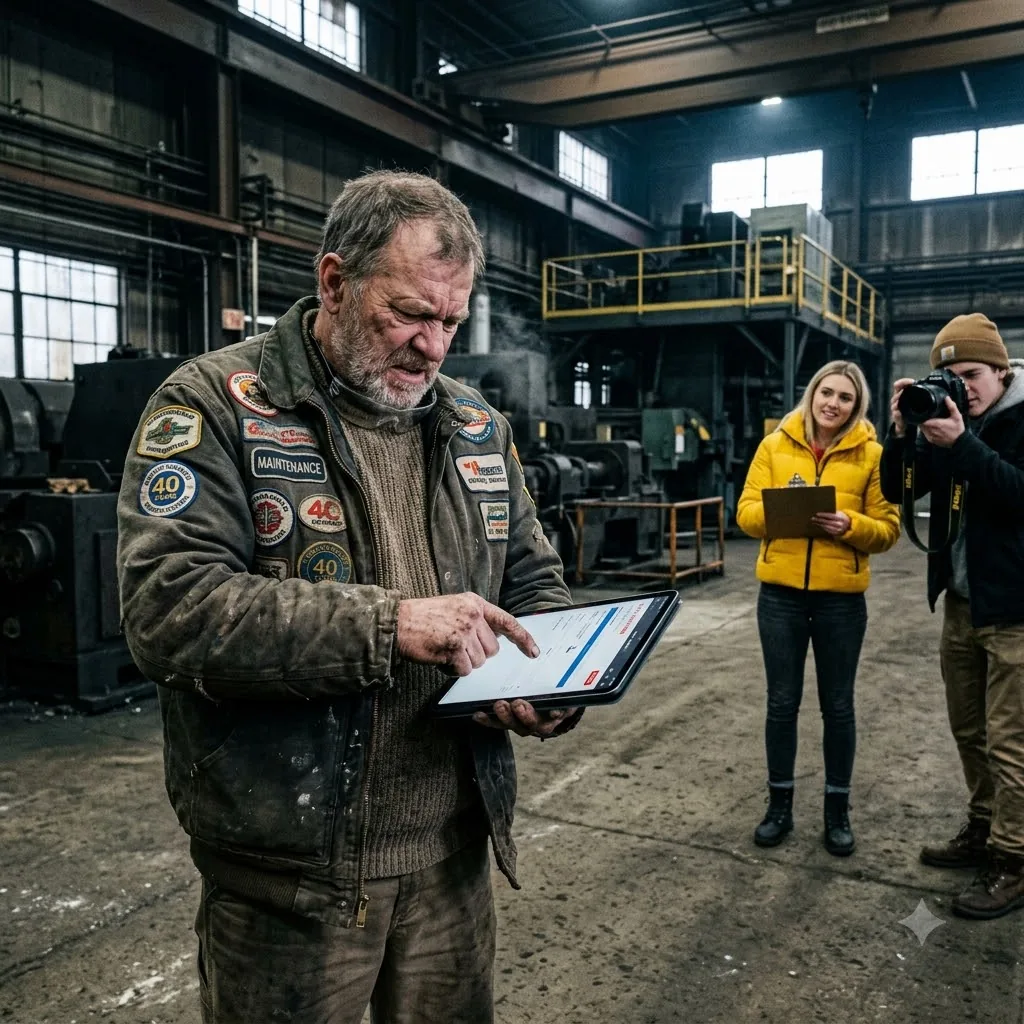
Arthur picked up the iPad again. The screen had advanced past the truncated summary of his life’s work. The header now read: *Phase Two: Placement and Synergistic Upskilling.*
He tapped the screen with a stiff finger. The system had generated a profile based on his fifty-character input. A bright green banner stretched across the top of his digital file: **Status: Tier-4 Unskilled / Clean Slate Candidate.**
Arthur stared at the words *Clean Slate*. He tapped the small info icon next to it. A pop-up box appeared: *Candidate possesses no transferable modern metrics. Previous experience categorized as Obsolete/Non-Compliant. Requires baseline behavioral realignment before technical training.*
He scrolled down to the actual job placements. The rumors at the union hall had promised advanced manufacturing-building the wind turbines and solar battery arrays Julian was constantly pitching to the local news. Arthur had spent three decades diagnosing micro-fractures in engine blocks and calibrating hydraulic presses to the millimeter. He knew machinery. He could learn their new machines.
But there were no manufacturing jobs listed on his screen. The drop-down menu for his “Synergistic Upskilling” offered three mandatory choices.
*Automated Facility Custodial Technician.*
*Drone Fleet Debris Removal Specialist.*
*Micro-mobility Rebalancing Agent.*
He tapped the first option. The job description loaded, detailing a daily quota of emptying recycling bins around the server farm and wiping down solar panels with microfiber cloths. The starting wage was listed at fourteen dollars an hour-less than half of what he had made as a master mechanic. Beneath the wage, a smaller font clarified that this was an “educational stipend,” meaning there would be no health benefits, no retirement matching, and no union representation.
It wasn’t a retraining program. It was a tax-subsidized janitorial service. They weren’t replacing the factory’s lost jobs; they were just paying them pennies to sweep the floors of the empty husk.
A sharp tap on his screen jarred him. A new window dominated the iPad: *Acknowledge Legacy Surrender.*
The text was dense, but the bolded bullet points were clear. To accept the stipend and unlock the severance bridge payment, Arthur had to legally agree that his previous certifications were invalid. He had to sign a non-disparagement clause promising never to mention his former union affiliation while in a “GreenTech uniform.” He had to agree that any attempt to perform unauthorized maintenance on GreenTech equipment-even tightening a loose bolt on a solar mount-would result in immediate termination and financial penalties.
They weren’t just paying him less. They were legally mandating that he forget he ever knew how to turn a wrench.
“They want us to quit,” Marcus whispered, leaning imperceptibly toward Arthur, his voice a harsh rasp. “Look at the fine print. If we walk away from the placement, they keep the state grant money, and we forfeit the bridge pay. It’s a trap.”
Arthur’s thumb hovered over the glowing green *Accept* button. The cold in his bones felt permanent now. If he pressed it, he erased thirty-five years of pride, reducing himself to a “Clean Slate” to be molded by a man who treated him like a petting-zoo animal. If he didn’t press it, his bank account would be empty by the end of the month.
Before he could make the choice, a shadow fell over his tablet.
Julian was standing in front of him again, a bright, artificial smile plastered across his face. The photographer was right behind him, this time balancing a small video camera on her shoulder. A young assistant in a pristine GreenTech polo shirt scurried forward, holding a neon-green baseball cap and a laminated piece of cardstock.
“Alright, Arthur, is it?” Julian said, glancing at the iPad screen to read his name. “We need some authentic transition testimonials for the social media push. B-roll is great, but we need you to speak.”
The assistant shoved the neon-green cap toward Arthur’s chest. It was bright, stiff, and bore the startup’s leaf logo.
“Put the hat on,” Julian commanded, his tone dropping its faux-friendly edge and hardening into a direct order. “Look right into the lens. The script is on the card. I want you to read the line: *My old way of life was destroying the future, but GreenTech saved me.* Read it with some emotion, Arthur. Let’s see some of that working-class gratitude.”