Story code: ST-001727
Part 3: The Prototype
Julian’s smartwatch vibrated violently against his wrist, interrupting his demand for working-class gratitude. He glanced at the glowing screen, his manicured features instantly twisting in irritation. “I have to take this. It’s the state grant committee.” He shoved the laminated script at the young assistant in the pristine polo shirt. “Chloe, get this done. I want the B-roll uploaded to the drive in five minutes so we can push it to social.”
Julian turned on his heel and strode briskly toward the loading docks, his voice already pitching into a sycophantic register as he tapped his earpiece to answer the call.
Chloe stepped into the void Julian left behind. She didn’t possess his manic, caffeine-fueled energy; she carried a cold, bureaucratic efficiency that Arthur found far more suffocating. “Alright,” she said, waving the videographer forward. “Tighten the framing. We need the new prototype in the shot to establish the synergy narrative.”
She grabbed a heavy, anodized metal assembly sitting on a nearby display cart and dragged it directly next to Arthur’s folding chair. It was a dual-axis solar tracking bracket, designed to pivot and angle heavy panel arrays toward the sun. Chloe adjusted its polished silver chassis with practiced hands, making sure the etched GreenTech logo faced the camera lens.
“Move your arm down,” Chloe instructed, pushing Arthur’s elbow off the armrest so his canvas jacket wouldn’t obscure the prop. “You’re framing the tech. Put the hat on, look at the lens, and read the card.”
Arthur didn’t take the neon-green cap. His eyes were locked on the prototype bracket resting three inches from his knee. Thirty-five years of reading blueprints, diagnosing micro-fractures, and feeling the invisible stress vectors of heavy machinery flared to life in his mind. He didn’t need a computer simulation to see the disaster sitting in front of him.
“This is your production model?” Arthur asked, his voice rough and echoing slightly in the cavernous space.
Chloe sighed, a sharp, nasal sound of profound annoyance. “It’s the Series B prototype. Now, please, the hat.”
Arthur leaned closer to the bracket, pointing a thick, grease-stained finger at the main load-bearing yoke. “You’ve got a half-inch hardened steel shear pin running directly through a cast aluminum housing. There’s no bushing.”
“It’s aerospace-grade aluminum,” Chloe recited, her tone dripping with rehearsed condescension. She looked past him. “Are we rolling?”
“You don’t put unbushed steel against cast aluminum in an outdoor, high-wind environment,” Arthur said, his voice rising, bouncing off the cinderblock walls. Down the line of folding chairs, Marcus and the rest of the autoworkers turned their heads, the heavy silence of the room suddenly shattered. “The galvanic corrosion alone will pit the joint. But when a fifty-mile-an-hour gust hits a full-sized solar panel array, it acts like a sail. The vibration will turn that steel pin into a drill bit. It’ll chew through the softer aluminum housing in three months. The whole array will shear right off the roof.”
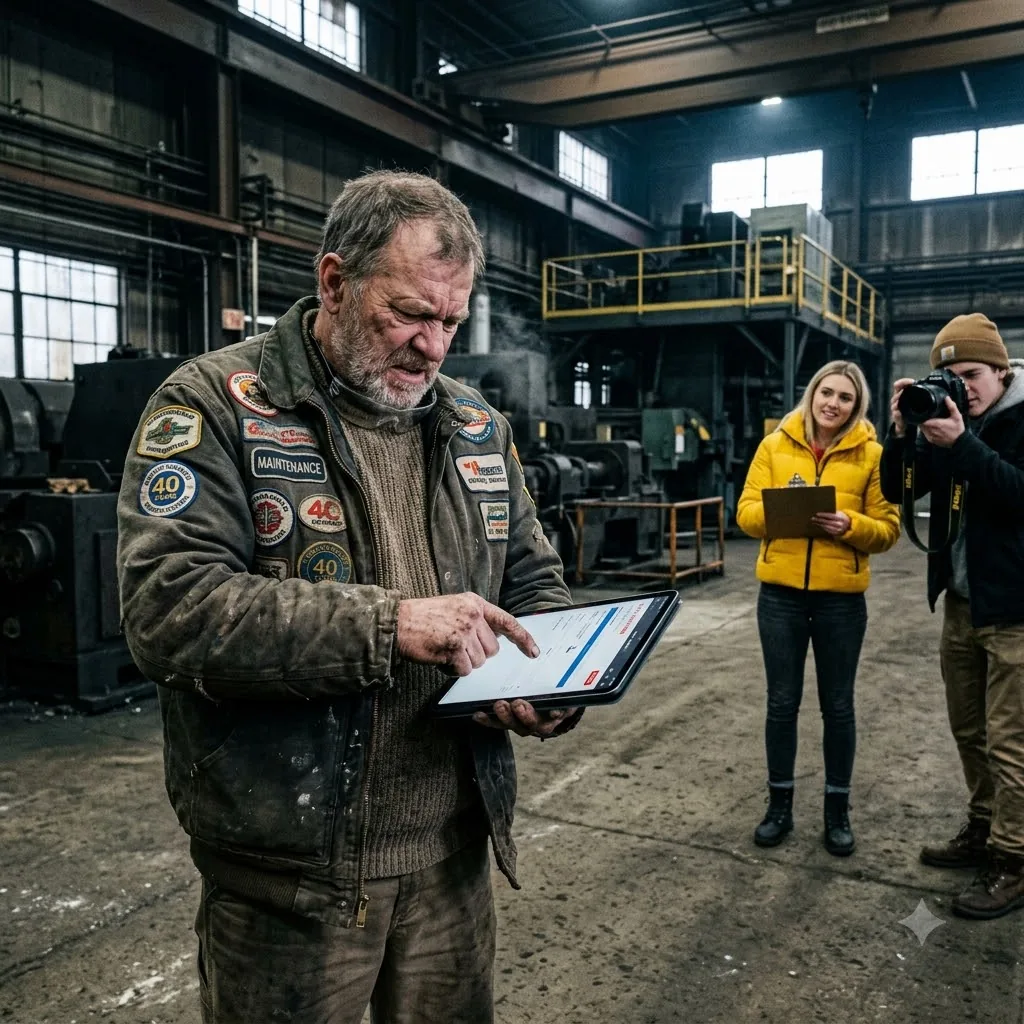
Chloe’s jaw tightened. She stepped directly in front of the camera, blocking the lens, and shoved the iPad back into Arthur’s chest. The screen still glowed with the *Legacy Surrender* clause.
“Arthur,” she said, her voice dropping to a flat, dangerous whisper. She tapped a perfectly manicured nail against the low-wage custodial contract on the glass. “You are currently classified as a Tier-Four Clean Slate Candidate. You have zero transferable modern metrics. You are not an engineer. You sweep floors. If you attempt to disparage patented GreenTech property, you violate the terms of your transition contract.”
She tapped the screen a second time, the glass clicking sharply under her nail. “If I press decline on this profile, you lose your severance bridge payment. You get nothing. Your family gets nothing. So you will put on the hat, you will look at the camera, and you will read the script about how we are saving your future.”
She stepped back out of the frame, giving the videographer a curt nod. “Rolling. Action.”
Arthur looked down at the iPad in his lap. *Status: Tier-4 Unskilled.* He looked at the neon-green hat resting on his knee. He felt the freezing dampness of the factory seeping through his boots, threatening to numb his toes. He felt the eyes of Marcus, and of every other man and woman sitting in the miserable semicircle, watching to see how far a man could be bent before he broke.
Arthur didn’t reach for the hat. Instead, he unzipped his heavy canvas jacket. He reached into his inner breast pocket, his thick fingers bypassing his reading glasses, and pulled out a tri-folded piece of heavy, cream-colored paper.
He unfolded it slowly. The harsh light of the camera rig caught the stark, bold red banner printed across the top of the page: *NOTICE OF INTENT TO FORECLOSE*.
Arthur ignored Chloe. He ignored the laminated script on his lap. He turned his face directly toward the camera lens, holding the bank notice up right next to his grease-stained union patch and their fatally flawed prototype.
“You want to talk about my future?” Arthur said, his voice steady, carrying the heavy, rhythmic rumble of the stamping presses that used to fill this room. He tapped the red letters on the foreclosure notice. “This is what your photo-op costs me. You bought this factory for scrap, you threw us out, and now you hold our own earned severance hostage unless we smile and sweep your floors for minimum wage.”
“Cut!” Chloe lunged forward, her pristine polo suddenly looking absurdly out of place against the sheer, heavy gravity of Arthur’s stare. “Turn the camera off!”
“Keep it rolling,” Arthur commanded, his voice cracking like a whip. He shifted his grip, angling the foreclosure notice so the lens could capture every terrifying number on the page, laying bare the sum total of his ruined livelihood. “You want authentic working-class despair for your investors? Here it is. Unedited.”
Chloe froze, her hand suspended halfway toward the camera lens, her mouth open but completely silent. For the first time all morning, the only sound in the cavernous factory was the quiet, relentless whir of the camera recording exactly what they had paid to see.