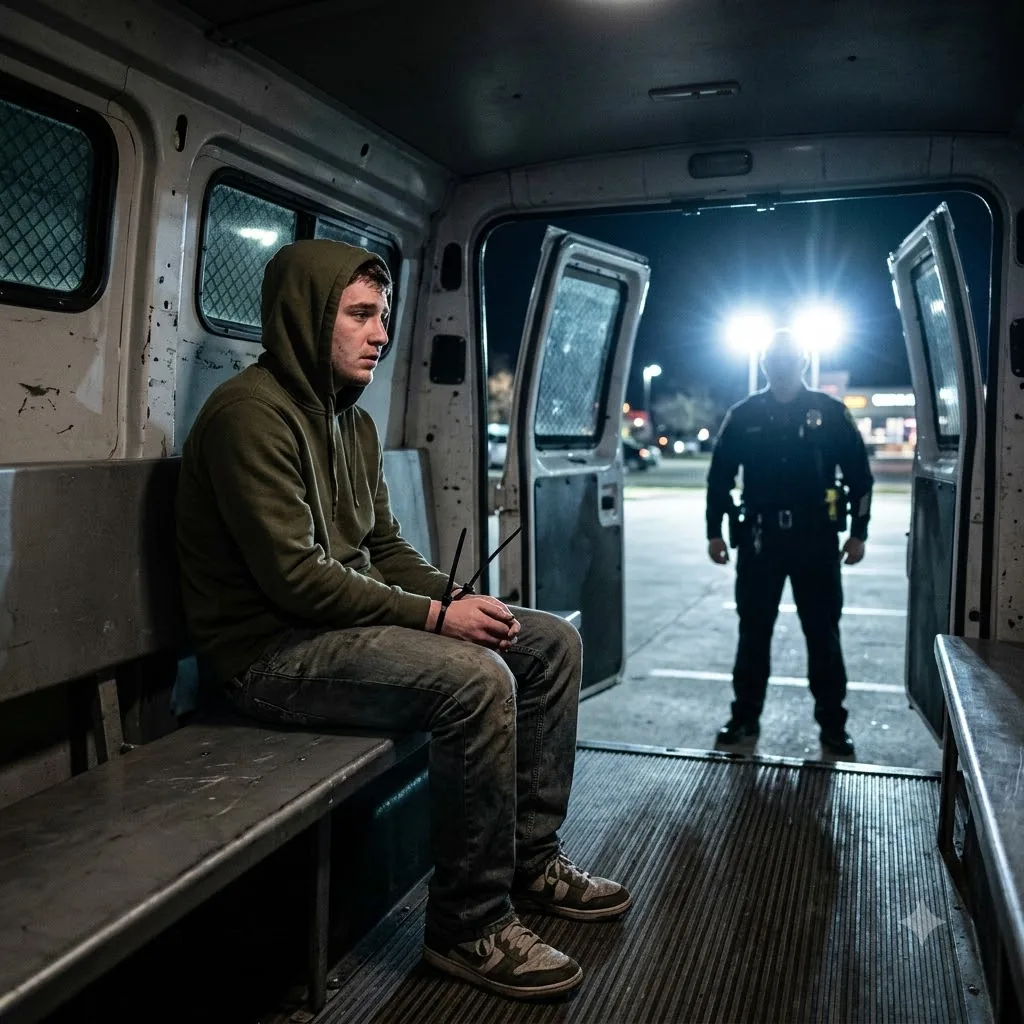
Story code: ST-001730
Part 3: The Manifest
The heavy steel door of the property vault shut with a pressurized hiss, the electronic lock engaging with a sickeningly final, echoing clack.
Mateo’s lungs hitched. Cortisol flooded his bloodstream. The DACA card was gone, sealed behind two inches of reinforced steel. Hector had done nothing. His older brother’s knuckles remained white over the keyboard, his eyes fixed dead ahead as he hit a final button. A harsh camera flash blinded Mateo, immortalizing his terrified, exhausted face into the Apex Correctional Solutions database.
“Escort to Medical Screening,” Hector announced mechanically, his voice devoid of any familial warmth. He stood, his heavy boots thudding against the linoleum as he rounded the plexiglass desk.
Hector grabbed Mateo by the bicep. The grip was ruthlessly professional, completely devoid of the secret, reassuring squeeze Mateo was desperately waiting for. He was shoved forward, forced to shuffle in his restrictive zip-ties down a long, cinderblock hallway that smelled sharply of glutaraldehyde and stale coffee.
The medical bay was little more than a converted closet containing a rusted phlebotomy chair, a humming bio-refrigerator, and a rolling metal cart. A contracted medical technician sat on a stool in the corner, mindlessly scrolling on his phone. He didn’t bother looking up when Hector marched Mateo into the room.
“Intake screening. Vitals and a standard tuberculosis blood draw,” Hector stated, releasing Mateo’s arm and stepping back to stand in the open doorway, arms crossed over his tactical vest.
The technician sighed heavily, shoving his phone into his pocket. He dragged a plastic phlebotomy tray onto the cart. Mateo’s eyes immediately locked onto the setup. His nursing instincts cut through his panic, zeroing in on the chaotic, unsterile mess. The sharps container mounted on the wall was overflowing dangerously past the fill line, used needles protruding from the top. Worse, the technician grabbed a torn rubber tourniquet that was visibly crusted with dried brown flakes, then reached for a vacutainer needle without making a single move toward the sink or a box of nitrile gloves.
Mateo glanced at the black dome camera in the ceiling. It was pointed at the door, but a faded blue privacy curtain hanging from a ceiling track obscured the far corner of the room. He needed to get Hector behind that curtain. He needed ten seconds away from the surveillance.
As the technician stepped forward with the soiled tourniquet, Mateo violently jerked his bound arms away, pressing his back against the wall.
“Hey!” the technician snapped, freezing in place. “Hold still, detainee.”
“I am not letting you puncture my vein with that equipment,” Mateo said, intentionally raising his voice so it echoed into the hallway. “You haven’t washed your hands, you haven’t gloved up, and that tourniquet is contaminated with dried bio-matter. Your sharps disposal is at a critical capacity. That is a direct, actionable violation of OSHA standard 1910.1030 for bloodborne pathogens. If you touch me with that, I am citing a cross-contamination hazard.”
The technician’s face flushed an ugly, mottled red. “Listen here, you little-”
“I’m not sitting in biological waste,” Mateo interrupted sharply, stepping further away. “Do it right or don’t touch me.”
“Guard!” the technician barked. “Subdue this non-compliant!”
It was exactly what Mateo wanted. Hector lunged forward, grabbing Mateo by the shoulders of his scrub top. Following standard facility protocol for a resistant detainee, Hector shoved him hard into the far corner of the room, violently yanking the blue privacy curtain along its metal track to shield the altercation from the hallway.
The heavy vinyl curtain snapped shut, isolating them in a cramped, shadow-filled square.
“What the hell are you doing?” Hector hissed, his voice dropping to a frantic, furious whisper. His hands were still gripping Mateo’s shoulders, pinning him against the cinderblock.
“You let him take the bag!” Mateo whispered back, his voice cracking, the clinical detachment finally shattering. “My deferred action card is in the lining! Without it, I am undocumented in this system. They are putting me on the 0600 ICE bus!”
“I am on probation here, Matty,” Hector pleaded, his dark eyes wide with a frantic, suffocating panic. The authoritative guard mask had completely melted away. “I have a daughter now. If I break a federal evidence seal on camera, I don’t just lose this job, I go to prison for tampering. I’ll pull your property file in the morning when I’m off-shift. I swear to God, I’ll flag it for legal review.”
“In the morning, I’ll be on a bus to the border!”
The privacy curtain was abruptly yanked open, the metal rings screeching violently against the track.
Mateo flinched, his heart slamming against his ribs. Hector instantly released Mateo, stepping back and dropping his hand to his utility belt.
A man in a crisp white shirt with silver supervisor bars on his collar stood in the opening, holding a sleek tablet and a printed sheet of paper. It was the older guard from the holding pen, now sporting his senior ranking uniform.
“Save your breath, Garza,” the supervisor said, his voice dripping with bureaucratic indifference. He held out the single sheet of paper. “Change of plans for this one.”
Hector took the paper, his chest heaving as he tried to regulate his breathing. He stared at the document, his brow furrowing deeply. “Sir? You’re pulling him from the 0600 regional transfer? He’s a local arrest. Standard protocol is the regional hub across town.”
“I’m changing his intake code to ‘undomiciled,'” the supervisor said, tapping the edge of his tablet with a stylus. “We’re pulling him from the regional manifest and putting him on the 0400 long-haul bus to the Otero County facility in New Mexico.”
Mateo’s breath caught in his throat. New Mexico. That was a thousand miles away.
“Otero?” Hector protested, his voice tight. “Sir, that’s across state lines. His arrest report says he was pulled over on a local traffic violation. He has a residential address in the city.”
“Not anymore, he doesn’t,” the supervisor replied flatly, pointing at the printed sheet in Hector’s hand. “Look at the updated form. Address is listed as transient. We are thirty bodies short for the Otero County contract manifest. The federal government pays us a hundred and ten dollars a day for local detention. They pay two-hundred and fifty dollars a head for interstate overflow transport.”
Mateo stared in horror at the printed paper. His medical knowledge, his legal status, his hidden DACA card-none of it mattered. It wasn’t about missing paperwork. It was a bounty.
“We need the long-haul manifest full to trigger the maximum contract payout,” the supervisor continued, looking Mateo up and down with cold, calculating eyes. “He’s young, he’s got a clean vitals sheet, and he has zero pre-existing conditions. He can survive a twenty-hour interstate ride in shackles without becoming a medical liability. Sign the bottom of the manifest, Garza. Get him cleared and prep him for the chain.”
The supervisor turned and walked out of the medical bay, the heavy thud of his boots fading down the hall.
Mateo looked at his older brother. Hector stood completely frozen, staring down at the falsified document that was about to traffic his brother across the country for a profit margin. Hector’s right hand hovered over the signature line, the blue pen trembling violently between his fingers.