Story code: ST-001730
Part 4: The Balance Sheet
The blue ink bled into the cheap, recycled paper of the transfer manifest. Mateo watched the tip of the ballpoint pen press so hard against the signature line that it nearly tore through the page. Hector’s hand was no longer trembling. The hesitation-the brief, frantic window where the ghost of his older brother had desperately tried to find a way out-was entirely gone. The harsh fluorescent lights of the medical bay caught the sharp angles of Hector’s jaw as he finished the loop of his last name.
Hector capped the pen. The soft, plastic click echoed against the cinderblock walls, sounding louder to Mateo than the heavy steel doors of the property vault closing minutes earlier.
“Hector,” Mateo whispered, the word scraping out of his dry throat, a final, pathetic attempt to reach the man who used to share his bunk bed.
“Stand up straight, detainee,” Hector replied. The voice was dead. Modulated, hollow, and perfectly calibrated for the black dome camera mounted in the hallway just beyond the open door. The Apex Correctional Solutions patch on his shoulder caught the glare of the overhead bulbs, a shield of gray threads that severed whatever familial tie had remained between them.
The contracted medical technician, who had watched the entire exchange in bored silence, finally stood and grabbed a rolling blood pressure cuff to push it into the corner. “He’s cleared. Vitals are baseline enough for transport.”
“Let’s move,” Hector ordered. He grabbed the thick nylon fabric of Mateo’s scrub top, twisting it tight against the zip-ties binding his wrists, and shoved him out of the medical bay.
They marched down the sterile, bleach-scented corridor. Mateo’s cheap sneakers squeaked against the polished linoleum, a desperate, frantic sound against the heavy, militaristic thud of his brother’s tactical boots. Mateo tried to pull back, just a fraction, just enough to look Hector in the eye one last time.
“My clinicals,” Mateo choked out, the reality of his shattered life finally crushing his chest, squeezing his lungs until black spots danced in his vision. “I have my final rotation on Tuesday. They’ll drop me from the program. I’ll lose everything. Everything we worked for.”
Hector didn’t slow down. He didn’t blink. He simply marched Mateo toward a set of heavy, reinforced double doors marked *TRANSPORT STAGING*. “Keep your eyes forward,” Hector said softly. There was no hidden message this time, no secret sibling code or promise of tomorrow. It was just a command from a guard to a prisoner.
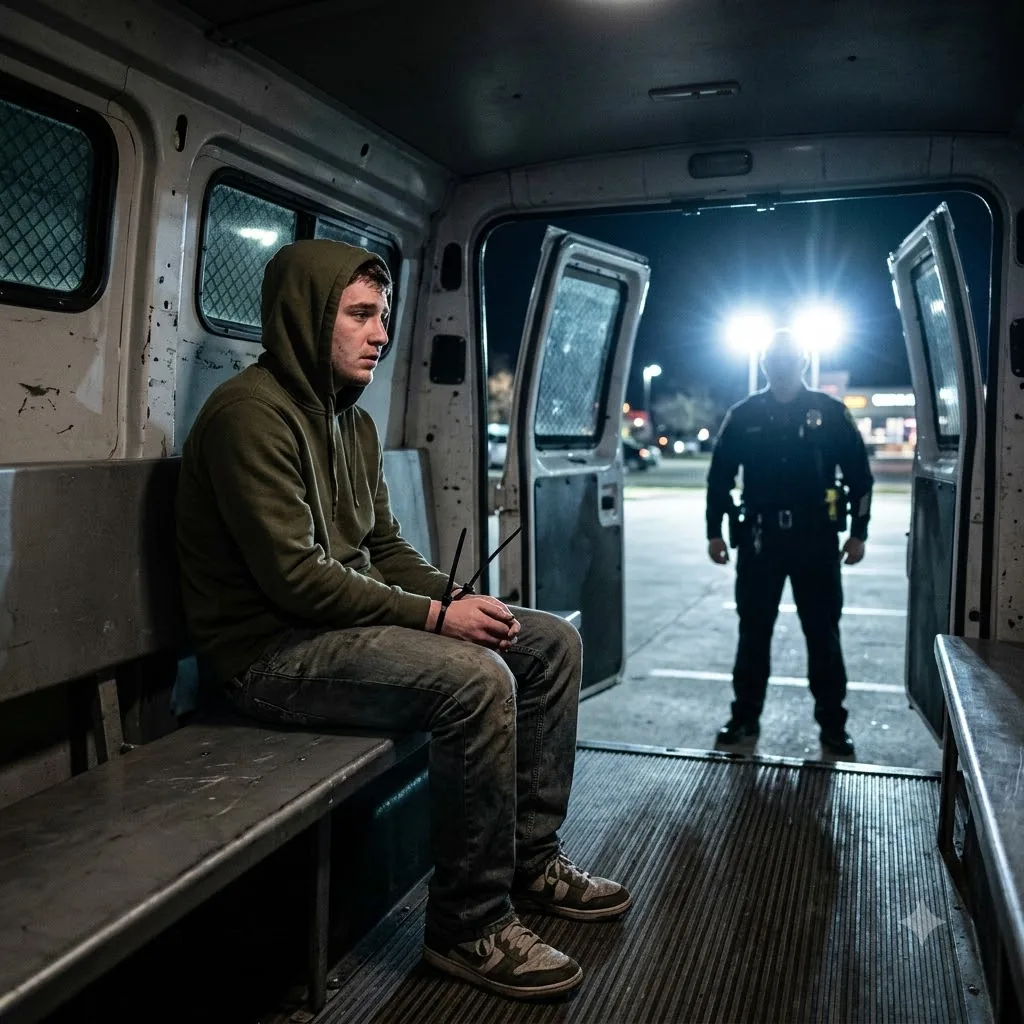
Hector shoved the double doors open. They stepped into a massive concrete cavern filled with the deafening roar of idling diesel engines. A gargantuan, unmarked white bus sat in the loading bay, its exhaust piping thick black smoke into the frigid night air. A line of men in faded orange jumpsuits and gray sweats were already being shackled together, a miserable, shuffling assembly line of human cargo.
Two transport officers, wearing heavy tactical vests and carrying thick rings of steel chains, walked over to meet them.
“One more for the Otero long-haul,” Hector shouted over the roar of the engines, holding out the falsified manifest.
The taller transport officer snatched the paper, barely scanning it. “He’s code transient? No medical flags?”
“Cleared by medical,” Hector confirmed, his voice brutally flat. “No personal effects for transport. Property is locked in local evidence.”
The DACA card. It was permanently gone now, buried in a gray plastic bin behind a locked door, functionally erased from existence.
“Turn around, transient,” the second officer barked at Mateo.
Mateo didn’t move fast enough. The officer grabbed his shoulder and spun him around, kicking his legs apart. Cold steel snapped around his ankles, heavy and unforgiving, pulling his stance down into a forced shuffle. A thick chain was wrapped around his waist, padlocked in the back, and his plastic zip-ties were cut, only to be immediately replaced by heavy iron cuffs tethered directly to the belly chain.
The sheer weight of the metal forced Mateo’s shoulders to slump. He looked down at his chained wrists. Radial nerve. Ulnar nerve. The anatomical terms flickered in his mind, but they were weak, useless echoes against the reality of the cold iron digging into his skin. Knowing the names of his bones couldn’t stop them from being locked in a cage.
“Sign the transfer receipt,” the transport officer told Hector, holding out a rugged digital tablet.
Hector took the stylus. Mateo stared at his brother’s face, searching for any trace of guilt, any crack in the armor. But Hector’s eyes were fixed entirely on the glowing screen. He signed his name with a quick, practiced scrawl.
With that digital stroke, Hector had officially finalized the transaction. The profound, sickening realization washed over Mateo, heavier than the iron chains binding his waist. Hector wasn’t a monster, but he wasn’t a protector, either. He was just a middleman, a terrified employee feeding his own community into a corporate balance sheet to keep a roof over his daughter’s head. And Mateo wasn’t a nursing student. He wasn’t a brother. He was a two-hundred-and-fifty-dollar line item on an interstate manifest, necessary to max out a profit margin.
“Load him up,” the officer commanded.
The chain attached to Mateo’s waist was violently yanked forward. He stumbled, his chained ankles limiting his steps to a clumsy, dragging shuffle. The freezing exhaust from the bus washed over him, biting through his thin cotton scrubs.
As he reached the metal grated stairs of the transport bus, Mateo forced himself to look back over his shoulder.
Hector was still standing in the doorway of the staging area, bathed in the harsh, artificial glare of the facility lights. He was holding the falsified paperwork in one hand, resting the other on his heavy utility belt. He didn’t look at Mateo. He didn’t watch the bus. Instead, Hector turned his back on the loading bay and walked away into the sterile hallway, heading back to his elevated desk, back behind the bulletproof plexiglass, ready to process the next payout.
The heavy pneumatic door of the bus hissed shut, sealing Mateo inside the windowless metal tube. The engine roared, vibrating through the iron chains cutting into his hips, as the vehicle lurched forward into the dark.