Story code: ST-001744
Part 2: The Weight of the Narrative
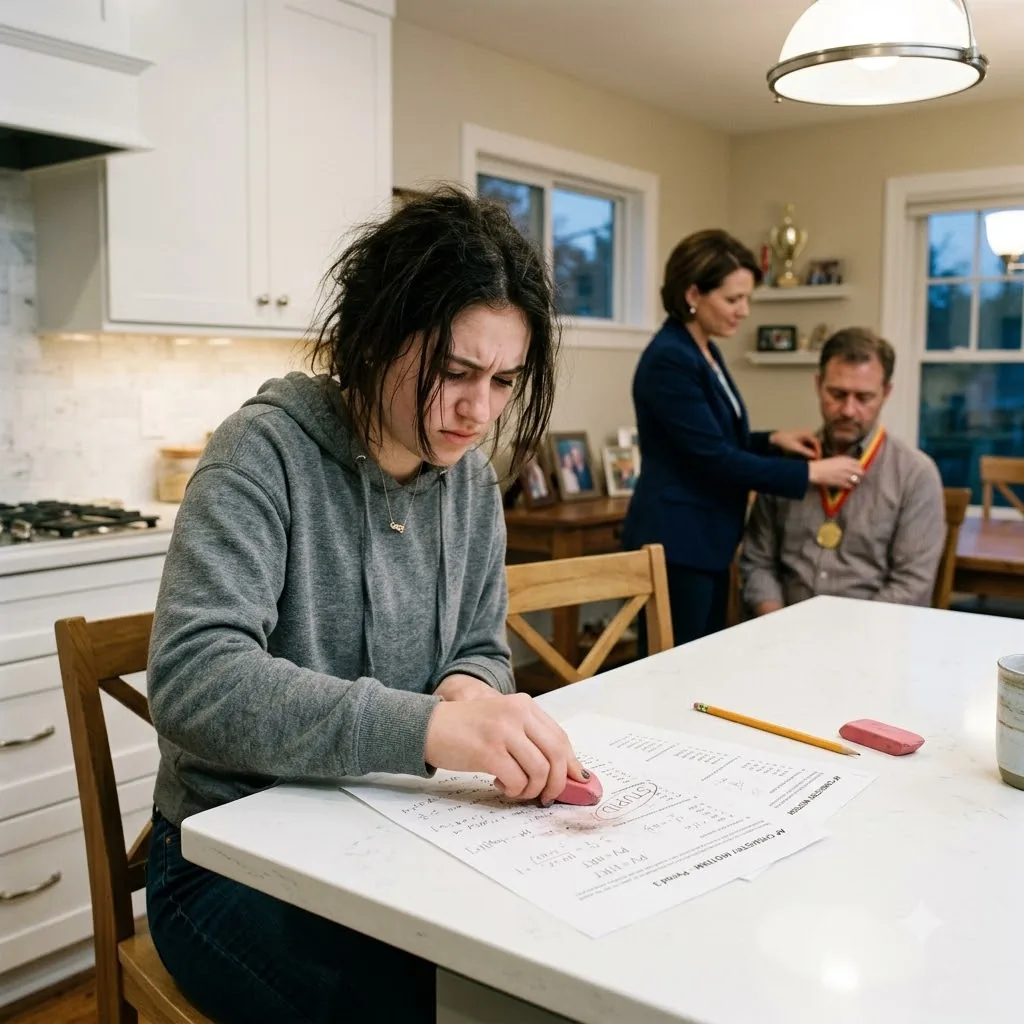
Evelyn did not look at my face. Her gaze, sharp and predatory, dropped immediately to the oak table. She registered the scattered mound of pink eraser shavings first, her pristine brow furrowing in disgust as if I had tracked mud onto a white rug. Then, her eyes locked onto the AP Chemistry midterm.
She stepped forward, the sharp clatter of her heels deafening in the quiet kitchen. She didn’t say a word as she reached out. Her manicured fingers, tipped in a pale, icy pink that matched her silk blouse, pinched the corner of the chemistry paper. She lifted it into the harsh overhead light.
I watched her eyes scan the page. I watched them hit the massive gray smudge where question four used to be. I watched them drop to the gaping, torn hole in the center of the titration formula. She lowered the paper slowly, placing it back on the table with deliberate, agonizing precision.
“What is this, Leo?” she asked, her voice hovering at a dangerously low volume.
“I was reviewing my answers,” I said, keeping my voice as flat as possible. My heart battered against my ribs, but I refused to let my hands shake. I kept them pressed flat against my thighs.
She didn’t look at me. She picked up the calculus exam next. She read the limits approaching infinity. She saw the negative derivatives. She flipped it over, and then she reached for the physics paper. I had drawn a childish stick figure next to a falling mass. She stared at the crude doodle for a long time. The silence stretched, thick and suffocating, smelling of lemon polish and the cold, sharp notes of her designer perfume.
Through the wall, my father let out another dry, rattling cough. The sound barely penetrated the heavy drywall, but it was enough to make a muscle jump in Evelyn’s jaw.
“Are we having an episode?” she finally asked. She dropped the physics paper over the ruined chemistry test. “Is that what this is? Application anxiety? Because I can call Dr. Evans right now and have him phone in a prescription for a beta-blocker. But I do not have the time, nor the patience, for a teenage tantrum.”
“It’s not a tantrum,” I said. “I’m not doing it. I’m not submitting the Stanford early action forms.”
Evelyn finally looked at me. The mask she wore for the cameras-the brave, tragic, fiercely loving mother and wife-was completely gone. In its place was the ruthless architect of our lives. Her eyes were blank, calculating the exact amount of force required to crush my rebellion.
“Yes, you are,” she said smoothly. “You are going to submit them tonight. You are going to go into that living room, get your laptop, and bring it out here.”
“No.” The word felt foreign in my mouth. It was the first time I had ever said it to her. The sheer terror of it almost choked me, but I forced myself to look her dead in the eye. “I’m tanking the midterms, Mom. All of them. I’ve already figured out the grading weights. I can drop my GPA just enough to miss the early action threshold. The perfect narrative is over.”
She didn’t yell. That was the most terrifying part. She just smiled, a thin, bloodless stretching of her lips. She turned her back on me and walked slowly down the hallway, stopping in front of the locked guest room door. She rested her hand on the heavy brass knob.
“Do you know how much the private nursing agency charges for his specialized care?” she asked, not looking at me, staring at the white painted wood of the door. “The ones who come in twice a week so I can take a breath? Do you know what the local news stations and the community foundations donate to us every year because they love the story of the brilliant son and the wounded hero?”
“They donate to help him,” I said, my voice wavering. “And you lock him in a box.”
“I manage this family!” she snapped, her voice finally cracking like a whip. “I manage the image that keeps a roof over his head. If you break that image, Leo, if you ruin this perfect narrative, the donations stop. The sympathy stops. And I will not drain my savings to keep him in this house.”
She turned the brass lock. It clicked loudly. She pushed the door open just an inch. The smell of antiseptic and stale sweat leaked into the hallway, followed by the sound of my father’s labored, uneven breathing. He whimpered, a small, pathetic sound that tore right through my chest.
“There is a state facility two towns over,” Evelyn said, her voice dropping back to that terrifying, sweet whisper. “It’s underfunded. They are severely understaffed. They leave their patients in soiled sheets for twelve hours a day. If you don’t go to Stanford, if you don’t maintain the brand that keeps our benefactors writing checks, that is where he goes by the end of the month.”
She pulled the door shut. The lock engaged with a heavy, final thud.
I sat frozen in the kitchen chair, the breath knocked out of me. The air in the room felt too thick to inhale. My rebellion, the small, desperate act of erasing my own brilliance, suddenly felt like a weapon I had accidentally pointed at my father’s head.
Evelyn walked back into the kitchen. She didn’t look at the ruined exams again. Instead, she walked past me into the living room, returning a moment later with my sleek silver laptop. She set it down directly on top of the pile of torn and smudged papers. She opened the lid. The screen flared to life, illuminating the dark kitchen with the blue glow of the Common App portal.
“Log in,” she commanded.
I didn’t move. My hands were trembling violently now.
“Log in, Leo,” she repeated. “You are going to email your teachers. You are going to tell them your practice exams were accidentally ruined-spilled coffee will do-and you need fresh copies to print. Then you are going to open your application. We are submitting the early action tonight.”
I stared at the glowing screen. The cursor blinked steadily in the password field, waiting for me to lock the chains back around my own neck. Through the wall, my father coughed again, a wet, agonizing sound that seemed to rattle the floorboards under my feet.
Evelyn stepped behind my chair. She placed her cold, manicured hand over mine, her grip tight enough to dig her nails into my knuckles, and forced my palm down onto the smooth plastic of the mouse.