Story code: ST-001777
Part 4: Lockout
Arthur hit the threshold with the desperation of a drowning man. He didn’t just step onto the porch; he launched himself through the open doorway, his bare feet slapping against the freezing concrete. In his frantic tunnel vision, consumed entirely by the flutter of white papers resting on the monogrammed mat, his hand instinctively reached to the small of his back. He drew the compact 9mm pistol he had tucked into his waistband-a secondary prop intended for the final act of his self-defense narrative.
David remained perfectly still behind the solid-oak credenza. He watched the heavy thermal glass door. The mansion’s advanced security system, designed by Arthur to be an impenetrable fortress, functioned exactly as programmed. The moment the sensors detected the door fully extended without an authorized physical block, the pneumatic hinges hissed. The massive slab of glass and steel swung gracefully shut.
Arthur was on his knees, one hand clutching the damp, scattered pages of the offshore holding company emails, the other gripping the 9mm, when the door closed behind him. The automated deadbolts fired in rapid succession, a heavy, electronic clack-clack-clack that echoed with absolute finality through the foyer.
David slowly pushed himself up from the wet marble, brushing porcelain shrapnel from the shattered Ming vase off his canvas jacket. The air inside the foyer still smelled sharply of cordite and vaporized water. He stepped cautiously toward the door, keeping his body angled away from the glass.
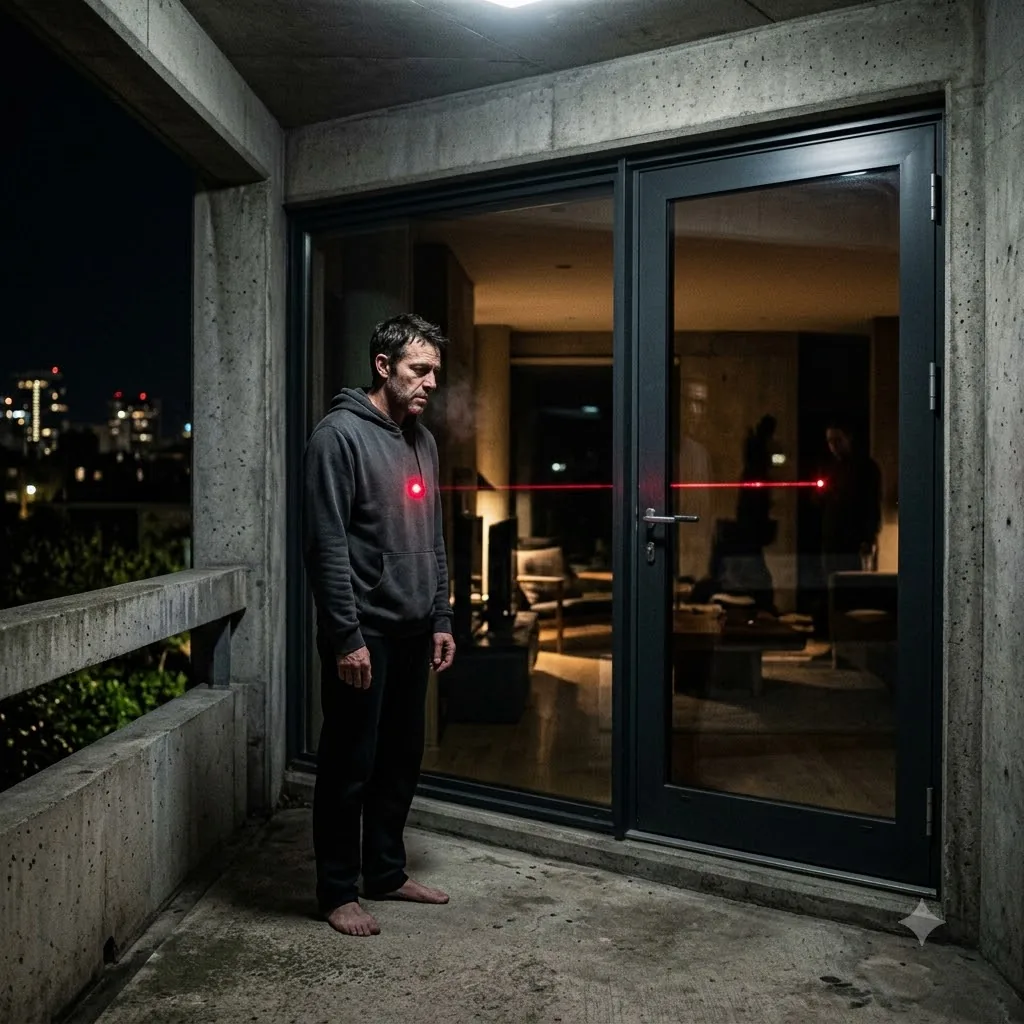
Through the polarized pane, the scene on the porch played out like a silent, strobing movie.
Three sheriff’s deputies had already cleared their cruisers. They were advancing in a tight tactical formation up the sprawling driveway. Their heavy flashlights sliced through the darkness, immediately converging on the figure kneeling on the porch.
From the deputies’ perspective, the narrative was instantly, irrevocably written. They did not see a billionaire homeowner defending his castle. They saw an agitated man in sweatpants and a dark t-shirt, locked out of a fortress, frantically gathering documents while brandishing a drawn 9mm pistol in the direction of advancing law enforcement.
David watched Arthur freeze. The red and blue police lights washed over Arthur’s pale face, illuminating a mask of absolute horror. The deputies’ shouts were muffled by the acoustic insulation of the thermal glass, reduced to deep, distorted barks, but their body language was unmistakable. Three service weapons were leveled directly at Arthur’s chest. The tactical advantage, the legal high ground, the multi-million-dollar insurance play-it all evaporated in the cold coastal wind.
Arthur dropped the 9mm. It clattered uselessly onto the concrete, sliding off the edge of the porch into the manicured rhododendrons. He raised his hands slowly, the damning printed emails still clutched in his trembling left fist.
David pressed his palm flat against the cool glass. The irony was exquisite. Arthur had spent millions engineering a physical and legal barricade to erase David from the company they built together. He had structured shell companies, hired venture capital sharks, and purchased a literal fortress. And all it took to dismantle the empire was a half-inch gap beneath a weather-stripping draft guard.
Two deputies moved in, slamming Arthur face-first against the exterior stone wall of his own home. They kicked his legs apart. As they wrenched his arms behind his back to apply the steel cuffs, the papers fluttered out of his grasp. The third deputy, keeping his weapon trained on the suspect, shone his flashlight down onto the scattered documents.
David knew exactly what the officer was reading. The un-redacted capitalization tables. The explicit, arrogant email chains discussing the premeditated cleansing of David’s equity. It was no longer a matter for civil litigation; it was criminal fraud, handed directly to the county sheriff on a silver platter.
The insurance company would void the two-hundred-million-dollar policy the moment the police report was filed. The venture capital firm would distance themselves immediately, burying Arthur under an avalanche of corporate negligence lawsuits. The offshore holding company would collapse.
Inside the quiet, climate-controlled foyer, David let out a long, slow breath. The violent adrenaline that had carried him up the driveway was finally beginning to ebb, leaving behind a profound, aching exhaustion. His chest throbbed where the laser sight had rested just minutes ago.
He turned away from the door. The house was empty now. The discarded rifle lay on the marble floor near the ruined console table, a silent testament to the violence Arthur had been willing to commit.
David walked past it. He moved deeper into the cavernous house, his boots squeaking faintly on the wet stone. He found the expansive living room, dominated by a massive, custom-built leather sofa that looked out over the darkened foothills. He sat down heavily, the plush leather yielding to his weight.
He reached into his pocket and pulled out his phone. He had five hours until midnight. Five hours until the dead man’s switch triggered the recursive wipe of the primary compression algorithm. He didn’t need to rush to send the cancellation ping. The staging servers were safe. The code was his again.
David leaned his head back, closing his eyes as the distant, muffled sound of Arthur being read his Miranda rights drifted through the fortress walls. For the first time in six months, David rested.