Story code: ST-001610
Part 4: Zero Fill
Sterling turned away, smoothing the lapels of his charcoal suit with absolute, terrifying calm. He pulled the heavy metal door of the command trailer open, letting the morning sunlight spill across the floorboards.
“Federal transit will be here in three minutes,” Sterling said, not looking back. “Clear the error logs, Greg. Make sure the local database reflects the glitch narrative before the morning news crews arrive at the perimeter. We have a school day to run.”
The door clicked shut, sealing Greg back inside the sterile, blue-lit hum of the mobile unit.
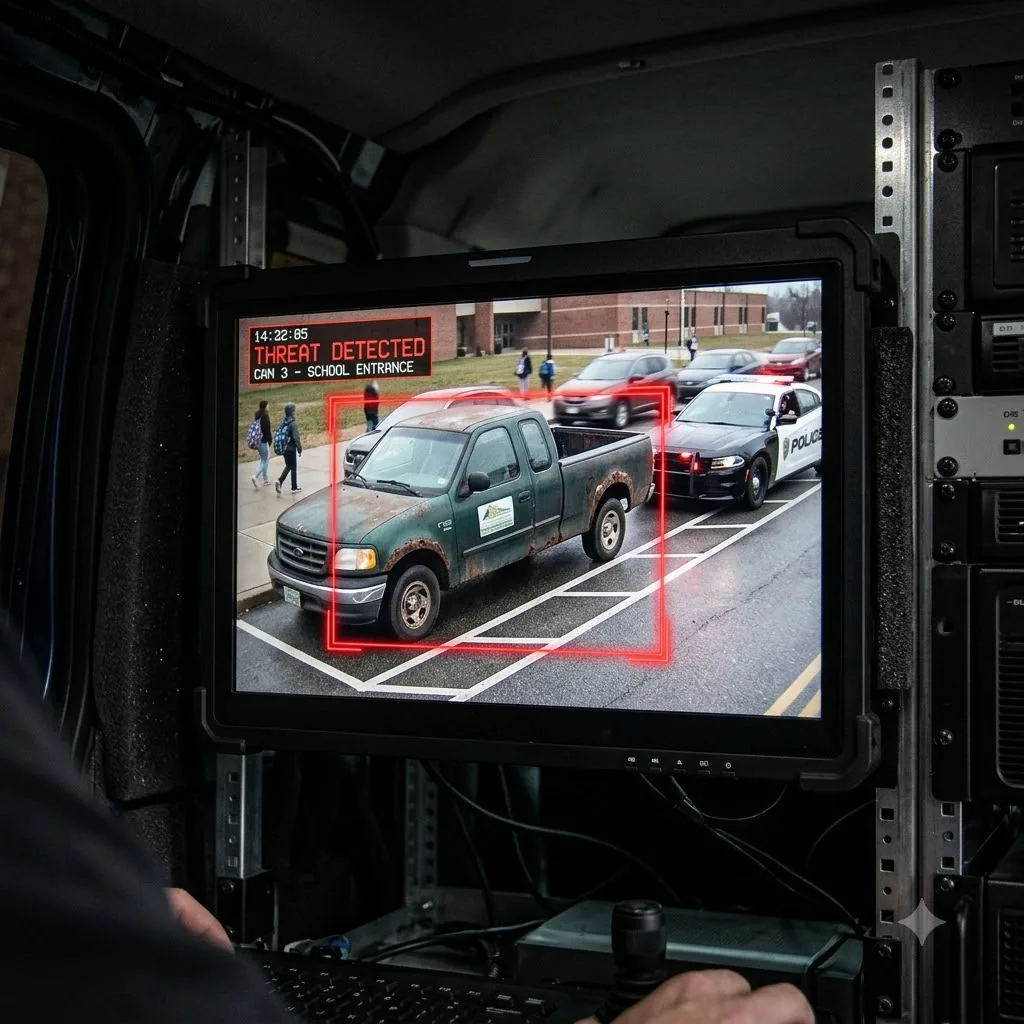
Greg stared at his monitors. On screen three, the stark gray Department of Homeland Security interface remained active, the ICE deportation detainer glowing like a radioactive isotope next to the rusted Ford’s license plate. On screen six, the auxiliary drone feed showed the black campus transport van idling near the loading zone. Two tactical guards stood by its rear doors, waiting for the federal handoff. Fifty yards away, the teenage girl sat on the curb, weeping into the fabric of her crimson marching band jacket while a school nurse hovered awkwardly beside her.
Greg’s hands hovered over his mechanical keyboard. He knew exactly how the architecture functioned. The DHS shadow registry and the spoofed National Crime Information Center warrants didn’t live in the cloud. To avoid federal oversight and Freedom of Information Act requests, Sterling had required the system’s cross-referencing brain to be housed entirely in the physical server rack bolted to the floor right behind Greg’s chair. It was a localized cache.
If Greg simply cleared the error logs as instructed, the shadow system would remain intact. The fake felony warrant would transfer to the federal agents upon arrival, providing the paper trail necessary to drag the father into an undocumented detention center.
But if the local cache ceased to exist, the entire digital chain of custody would evaporate.
Greg pulled up his root administrative terminal. A blinking white cursor pulsed against a pitch-black background. He calculated the cost of what he was about to do. He had personally signed the two-million-dollar vendor agreement. Section four of his contract contained a catastrophic liability clause regarding the intentional sabotage of district infrastructure.
If he destroyed the servers, the school board would not just fire him. Sterling would unleash the district’s legal team before lunch. They would sue Greg for breach of contract, destruction of property, and operational losses. They would seize his LLC, his house, and his retirement accounts. They would bury him in litigation until he was thoroughly, inescapably bankrupt. His career in security architecture would be over by sunset.
Greg looked back at the drone feed. The girl was picking up the bent, silver pieces of her broken flute from the asphalt.
Greg’s fingers struck the keyboard. He didn’t type the command to clear the logs. Instead, he bypassed the standard UI and accessed the drive partition manager. He initiated a zero-fill hard wipe-a brutal, unrecoverable formatting protocol designed to overwrite every single byte of data on the server rack with zeroes.
He targeted the primary operating drive, the backup partitions, and the DHS shadow cache.
The prompt appeared in stark white text: *WARNING. THIS ACTION WILL PERMANENTLY DESTROY ALL LOCAL DATA. PROCEED? (Y/N)*
Greg pressed ‘Y’ and hit Enter.
The server rack behind him screamed. The heavy cooling fans instantly maxed out to a deafening roar as the mechanical hard drives spun into a violent frenzy. Terabytes of proprietary algorithms, facial recognition databases, and the illegal immigration shadow registry were systematically shredded into digital dust.
Across Greg’s console, the monitors began to die. The tactical blue UI fractured into lines of static, then collapsed entirely into blank, black screens. Only monitor six-the drone feed running on an independent, hardwired battery backup-remained alive.
Greg watched the parking lot feed closely. Down by the transport van, the two tactical guards suddenly tapped their earpieces. One of them pulled a ruggedized tablet from his vest, staring at the screen. Without the local server broadcasting the spoofed NCIC alert, their connection to the warrant had vanished. The system was no longer telling them they were holding an armed, assaultive felon. Their digital authorization to detain the man had just completely ceased to exist.
The lead guard looked around, visibly confused, holding a civilian with absolutely no active warrants in a school parking lot. The liability of false imprisonment settled over the guards in real-time. The officer holstered his weapon, walked to the back of the transport van, and opened the doors.
The father stumbled out into the sunlight. The guard pulled a safety cutter from his belt and sliced the heavy plastic zip-ties off the man’s wrists.
The father didn’t wait for an explanation. He sprinted across the drop-off lane, dropping to his knees on the asphalt and wrapping his arms fiercely around his crying daughter.
The heavy metal door of the command trailer burst open. Sterling stood in the doorway, his calm facade entirely shattered, his face pale as he listened to the dying, mechanical grinding of the formatting servers.
“What did you do?” Sterling hissed, stepping toward the ruined console.
Greg leaned back in his ergonomic mesh chair, surrounded by the dark monitors. He had just lost everything he had spent the last ten years building, but as he watched the father walk his daughter away from the rusted truck, Greg finally felt like he could breathe.