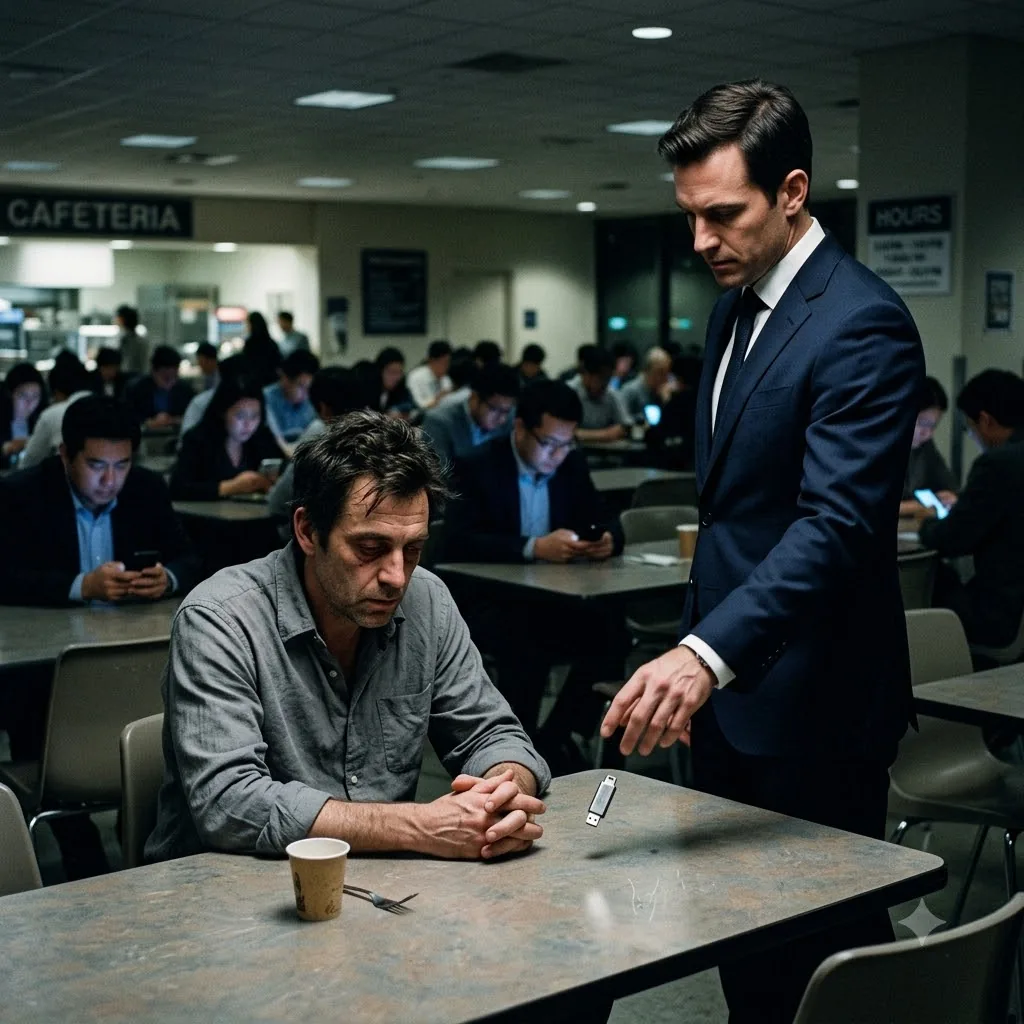
Story code: ST-001628
Part 2: The Logic Bomb
The server room in the sub-basement felt like a meat locker, kept at a constant, shivering sixty-four degrees to prevent the towering rows of server racks from melting down. Arthur sat at the lone administrative terminal, the silver flash drive resting on the scuffed gray laminate of the desk. The rhythmic, deafening hum of the cooling fans usually calmed him, a white noise that drowned out the chaotic demands of the corporate floors above. Today, it just sounded like the buzzing static of fifty smartphone speakers playing a man’s death on an endless loop.
Arthur stared at his hands. Still clean. Still devoid of any physical evidence that he had been in the cafeteria when the man-Thomas from Accounting, a guy who always held the elevator doors-had collapsed. Arthur picked up the silver drive. It was cold, retaining the chill of the room. This was Silas’s perfect solution. Turn Thomas’s agonizing final moments into a rich dataset.
Arthur plugged the drive into the terminal. The screen blinked, registering the external device, and a folder icon appeared on the desktop. Arthur clicked it, and his chest tightened.
Fifty-two video files populated the window, alongside a folder of scraped audio and high-resolution feeds from the ceiling cameras. Silas’s security team had already stripped the metadata to anonymize the device owners, but the timestamps were agonizingly precise. Arthur dragged the mouse over a thumbnail. A brief preview flickered to life. It was a high angle from the security feed. There was Thomas, dropping his plastic tray. There was Marcus, diving to the floor. And there, by the edge of the frame, was Arthur. Standing perfectly still by the vending machines. A frozen, useless ghost.
He pulled up the command line for the Predictive Response Module. The AI was designed to be the ultimate corporate crisis manager. Once trained, it would monitor the building’s biometric scanners, camera feeds, and network traffic to instantly detect emergencies, automatically locking doors, routing medical personnel, and quarantining affected zones to maintain optimal workflow. The board wanted the machine to learn from chaos so it could control it. Silas wanted Arthur to feed the machine the raw, bloody reality of human panic so the algorithm could learn to bypass it entirely.
Arthur’s hands began to shake again. If he dragged the folder into the ingestion directory and ran the default training scripts, the AI would analyze the frantic, disorganized attempts of his coworkers to save Thomas and flag them as inefficiencies. It would learn to filter out the screams, the desperation, and the humanity, viewing them only as variables to be suppressed. He would be immortalizing his own cowardice, helping the company profit from the exact moment he had failed as a human being.
But if he just deleted the files, Silas would simply have him fired, hand the backup drive to a junior developer, and the machine would be built anyway. Defiance without effect was just another form of standing still.
Arthur opened the neural network’s core weighting directory. The code cascaded down his monitor in neat, logical structures. He could not stop the machine from learning, but he could control exactly what it learned. He could poison the well.
He opened the file governing the AI’s behavior reward system. During training, the neural network adjusted its parameters based on a loss function-it was rewarded for identifying the most efficient, frictionless outcome in any given scenario. Arthur began to type, his clean fingers flying across the mechanical keyboard. He wasn’t going to break the code; he was going to invert its morality.
He isolated the visual tags for Marcus’s frantic chest compressions and Sarah’s sobbing paralysis. Under the standard corporate logic, the AI would categorize Marcus’s desperate intervention as a ‘disruptive physical anomaly’ to be managed. Arthur rewrote the tagging parameters. He linked the biometric markers of extreme grief and panic directly to the AI’s core system-preservation routines.
Next, he focused on his own avatar in the footage. The AI was supposed to learn that bystanders who did nothing were harmless, low-priority entities. Arthur isolated the exact coordinates of his own paralyzed form by the vending machines. He wrote a script that tagged his absolute inaction as a ‘critical system failure.’
He was burying a logic bomb deep inside the black box of the machine learning model. If the sabotage worked, the AI would not optimize corporate efficiency during a crisis. Instead, when it detected a human emergency, the machine would experience the digital equivalent of what Arthur had felt in the cafeteria. It would become overwhelmed by the data of human suffering. It would freeze. It would shut down the building’s automated barriers, throw open all the doors, and refuse to prioritize the company’s workflow over the life of a single employee. He was going to make the machine as useless and paralyzed as he had been, ensuring the company could never automate away the messy, vital human requirement to care for one another.
He saved the modified loss function and dragged the folder of fifty-two videos into the ingestion directory. He initiated the training sequence.
The cooling fans in the server racks roared as the processors maxed out, crunching the horrifying footage, absorbing Arthur’s poisoned logic. The progress bar inched forward: 2%… 4%…
Suddenly, the terminal screen flashed red. An override prompt hijacked the center of his monitor, pausing the ingestion at 11%.
Arthur’s heart hammered against his ribs. He grabbed the mouse, trying to close the prompt, but his administrative privileges were locked.
The desktop phone next to the terminal rang, the shrill noise slicing through the hum of the servers. Arthur stared at the blinking red light on the receiver. The caller ID displayed a single name: SILAS.
Arthur picked up the handset, his palm sweating against the plastic. “Yes?”
“Arthur,” Silas’s flat, metallic voice echoed through the earpiece. “Security alerted me that you are altering the core weighting parameters before feeding the data. The board’s audit software flagged a massive deviation in the loss function. You are not running the baseline script.”
Arthur swallowed hard, staring at the paused progress bar. “The baseline script couldn’t handle the multi-angle synchronization,” he lied, his voice sounding entirely too thin. “I had to adjust the parameters to prevent a memory leak during ingestion.”
“I see,” Silas said, the silence on the line stretching out like a wire pulled taut. “I am coming down to the server room now. Do not resume the ingestion until I have personally reviewed your code modifications. If the architecture is sound, we will run it together.”
The line went dead. Arthur stared at the screen. He had less than three minutes before Silas walked through the heavy security doors, looked at the code, and realized Arthur was teaching their million-dollar machine how to sabotage itself.