Story code: ST-001807
Part 3: The Response Time
The tarnished brass bell above the front door chimed again, its cheerful ring entirely at odds with the men stepping over the threshold. The two arrivals in identical charcoal suits did not bother with the pretense of looking like sympathetic bureaucrats. They carried heavy, industrial-grade steel chains that clinked against the doorframe, a massive brass padlock, and a stack of stiff red plastic signs bearing the word CONDEMNED in stark white lettering. They moved with a rigid, athletic discipline that immediately set off alarm bells in Marcus’s head.
A woman stepped into the shop directly behind them. The young woman with the light panel immediately stood taller, and Julian lowered his smartphone a fraction of an inch, his shoulders dipping in reflexive deference. The newcomer wore a tailored cashmere trench coat over a severe black suit. Her eyes swept over the scattered thirty-ought-six cartridges and the puddle of chemical solvent spreading across the floorboards. She did not look at Marcus as a human being; she looked at him the way a developer looks at a dead tree slated for removal.
“Director Elaine,” Julian murmured, angling the camera so she was just out of the frame. “We have a Section Four immediate hazard on the broadcast.”
Elaine offered a single, tight nod. “Seal the building,” she instructed the men with the chains. “Public safety takes priority.”
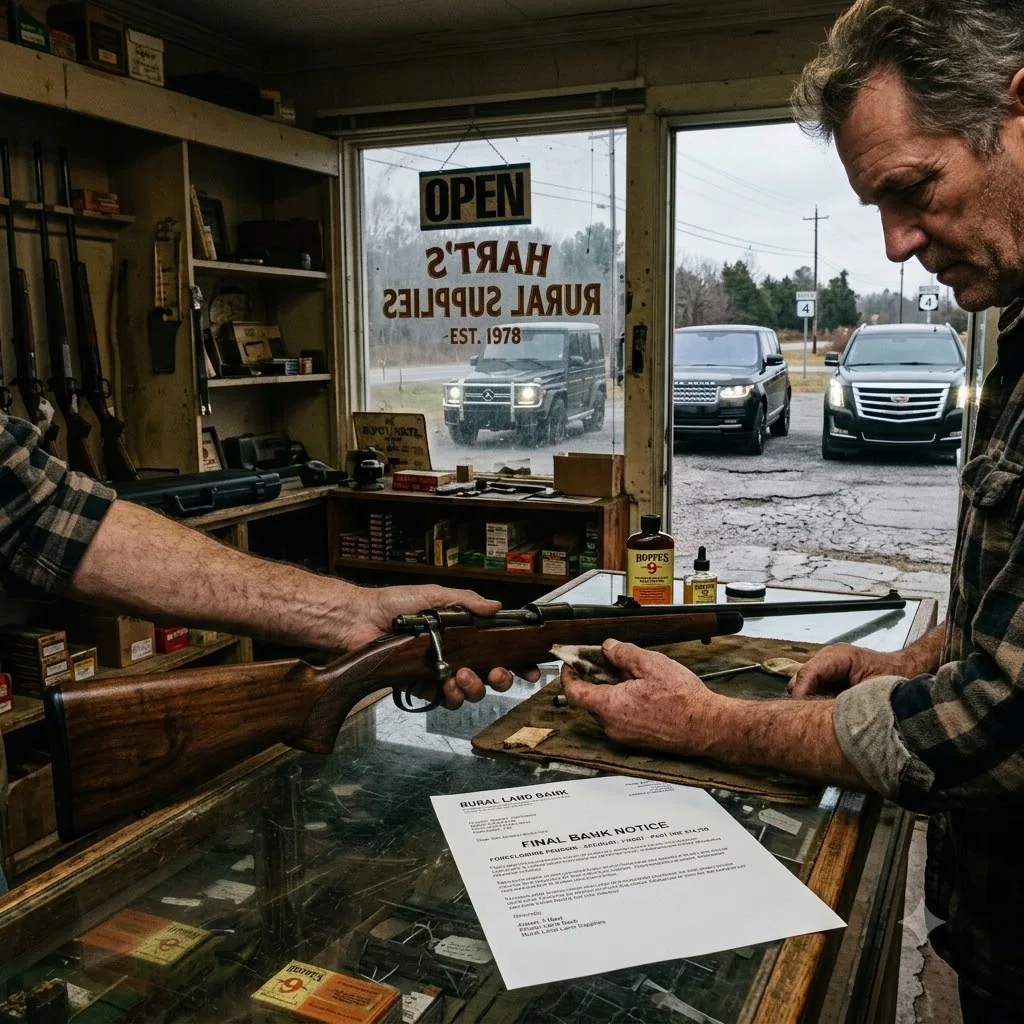
Marcus inhaled the sharp, eye-watering fumes of the spilled Hoppe’s No. 9 solvent. The scent was usually a comfort, a reminder of quiet autumn evenings spent maintaining good tools, but now it was being weaponized into an excuse to steal his livelihood. The heavy steel of the Winchester receiver still sat on the greasy rag nearby. He could easily reach it. The two men with the chains stepped into the center of the room, their eyes tracking his every micro-expression.
Marcus didn’t reach for the rifle. He looked at the blinking red icon on Julian’s smartphone. The digital audience was watching, waiting for the rural brute to explode. Marcus realized that the only way to survive the trap was to spring it himself, on his own terms.
Moving with the same deliberate, unthreatening slowness he used when tracking game in dry brush, Marcus stepped away from the spilled solvent. He walked down the length of the glass counter toward his antique National cash register. The two men dropped the heavy chains onto the floor with a deafening metallic crash. Their hands hovered instinctively near their waistbands. Marcus noticed how their tailored suit jackets draped unnaturally over their right hips. He knew the distinct, blocky outline of concealed tactical firearms when he saw them.
Marcus pressed the heavy, silver total key on the register. The mechanical bell rang out with a sharp *ding*, and the wooden cash drawer shot outward, hitting his apron.
“Sir, step away from the counter,” Elaine said, her voice a flat, commanding whip. “This property is now under administrative seizure. You need to vacate the premises immediately.”
Marcus ignored her. He maintained his vacant, polite customer-service smile, lifted the plastic coin tray out of the drawer, and reached into the hollow space beneath it.
Julian took a step back, raising the camera defensively. “Look at this erratic behavior, folks,” Julian narrated, his voice dripping with manufactured alarm. “This is exactly the kind of instability our task force is working to manage.”
Marcus pulled out a thick, spiral-bound logbook. Its edges were frayed, and the cardboard cover was warped from years of sitting in the damp, unheated shop. He dropped it onto the glass counter directly beneath the blinding glare of the battery-powered light panel.
“Since we’re broadcasting live about public safety in the valley,” Marcus said, his deep voice effortlessly cutting through Julian’s panicked narration. He looked straight into the camera lens, bypassing the interlopers to speak directly to the thousands of coastal viewers watching him on their screens. “I want to make sure your audience gets the full picture of the danger we’re facing out here.”
Elaine narrowed her eyes. She recognized the sudden shift in tone. Marcus wasn’t playing the part of the cornered animal anymore. “Julian,” she snapped. “Cut the feed.”
Julian’s thumb hovered over his screen, but he hesitated. Marcus could see the reflection of the display in the glass counter; the chat was scrolling at a furious blur, viewer engagement spiking wildly as the tension broke script. Julian was too addicted to the viral metrics to press the button.
Marcus flipped the warped cover of the logbook open. The pages were filled with neat, handwritten columns of dates, times, and incident codes.
“These are the county dispatch logs,” Marcus told the camera, tracing a calloused finger down a column of red ink. “I’m the head of the neighborhood watch. Because for the last four years, there hasn’t been anyone else left to do it.”
He tapped a line on the paper. “Three weeks ago. Break-in at the old pharmacy two doors down. Call placed at two-fifteen in the morning. The county sheriff arrived at three-forty. Eighty-five minutes. Over an hour waiting in the dark while glass was breaking.”
“Remove him from the building. Now,” Elaine ordered, stepping forward and dropping all pretense of bureaucratic calm.
The two men in the charcoal suits stepped up to the counter. As they reached out, their jackets pulled tight, fully revealing the black polymer grips of high-end handguns tucked into their belts.
“Assault behind the diner last month,” Marcus continued, his voice rising in volume and authority, pinning Julian to the spot. “Response time: forty-two minutes. Vandalism at the elementary school. No unit available. They never even showed up.”
Marcus looked away from the camera and locked eyes with Elaine. “You come in here, knock over my inventory, spill my solvent, and declare my shop a public safety hazard. But the real hazard isn’t on my floor. The real hazard is that the state abandoned this zip code four years ago. You cut our emergency funding. You closed the local precinct. You left us to rot.”
Marcus reached under the counter one last time. The two men froze, hands dropping instantly to their holsters, ready to draw on live camera. Marcus telegraphed his movement perfectly, keeping his hands flat and visible as he brought up a single, heavy, dark-red twelve-gauge shotgun shell.
He placed the shell on the glass counter. The brass head gleamed under the harsh LED lighting.
With one finger, Marcus slid the shotgun shell slowly across the glass. It plowed through the puddle of chemical solvent Julian had spilled, leaving a clean streak behind it, and stopped inches from Elaine’s manicured hands.
“You brought an awful lot of expensive muscle to chain a failing bait shop,” Marcus said quietly, pointing at the men flanking her. “I see the printing under their jackets. Those aren’t state troopers. They’re private security. Armed to the teeth.”
Elaine stared at the red plastic shell on the glass, her jaw clamped shut, the crushing weight of the live broadcast suddenly turning against her.
Marcus leaned over the counter, closing the distance between them, ensuring every word was caught by Julian’s microphone. “So here is my question for your viewers. Since you’re locking my doors today and forcing me out in the name of public safety… which one of your armed private security guards is staying behind tonight to protect my block?”