Story code: ST-001807
Part 4: The Glass and the Broom
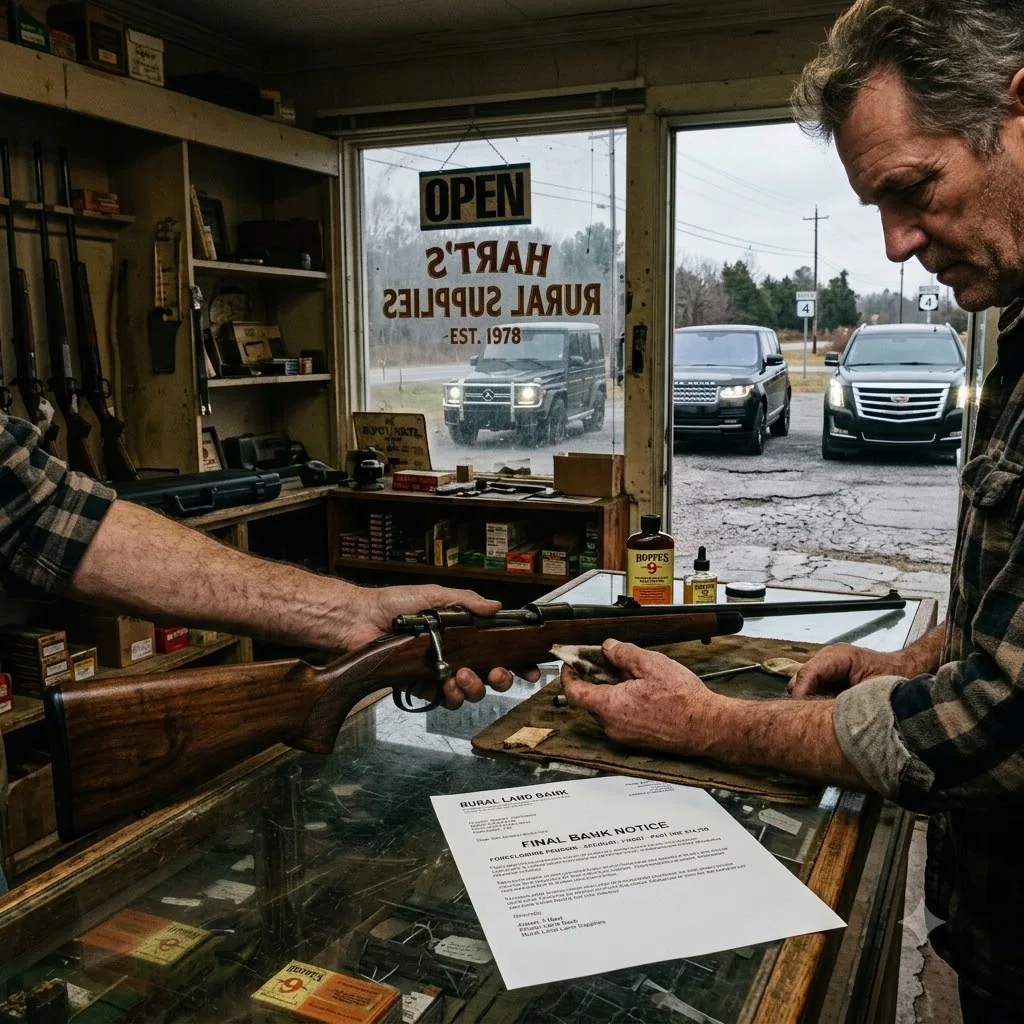
The heavy silence in the bait and tackle shop was broken only by the frantic, silent scrolling of text reflected in the unbroken half of the glass counter. Marcus kept his eyes locked on Elaine. He did not move his hand from where it rested near the red shotgun shell.
Elaine stared at the brass head of the shell, then up at Marcus’s face. The polished veneer of the Coastal Initiative Director visibly cracked, revealing the raw, bureaucratic fury of someone unaccustomed to being cornered by a man in a canvas apron. It was obvious she had lost the narrative. The digital audience, primed for a poverty spectacle, was now watching her armed mercenaries occupy a vulnerable neighborhood.
“Julian,” Elaine said. Her voice was no longer a command; it was a tight, controlled hiss. “Cut the feed.”
Julian tapped his screen frantically. The blinking red *Live* icon vanished. The harsh, cinematic glow of the battery-powered light panel remained, casting long, stark shadows across the peeling wallpaper.
“You think you’re clever,” Julian sneered, his tailored suit suddenly looking absurd and out of place among the rusted hooks and pine dust. He lowered the smartphone, the camera lens pointing at the floorboards. “You just guaranteed a full tactical closure. You won’t even be able to legally stand on this sidewalk by Monday morning.”
“I asked a question,” Marcus said, his tone perfectly even, untouched by Julian’s threat. “Who is staying to protect the block?”
One of the men in the charcoal suits-the one on the right, whose hand had been hovering near his concealed waistband-stepped forward. His jaw was set tight, a muscle ticking violently under his ear. Marcus could see the humiliation radiating from the man’s rigid posture. A rural shopkeeper had just casually exposed his concealed weapon on a live broadcast, entirely stripping the guard of his intimidating mystique.
The man didn’t speak. He simply hoisted the thick, industrial-grade steel chains he had been carrying and slammed them down directly onto the center of the vintage glass counter.
The impact was deafening. The century-old glass exploded downward with a violent, concussive crash. Jagged shards rained into the display case below, showering a meticulously arranged collection of hand-tied trout flies, vintage brass reels, and cork bobbers in a thick layer of ruin. The heavy steel links of the chain settled into the wreckage like a snake, crushing the delicate feathers of the custom lures.
The guard stepped back, his hand dropping instinctively toward his hip again, waiting for the provocation. Marcus knew exactly what the man wanted. He wanted Marcus to lunge. He needed Marcus to reach for the Winchester receiver resting on the oily rag, to give them the excuse they desperately craved to draw their weapons and justify the violence.
Marcus remained perfectly still. He did not blink. He did not move his hands from the wooden lip of the register. He let the final fragments of glass tinkle softly into the display case. The sharp, toxic fumes of the spilled Hoppe’s No. 9 solvent mixed with the metallic smell of the chain. Marcus simply looked at the guard, offering him nothing but the quiet, immovable presence of a man who had survived worse winters than this.
The stillness stretched until it became suffocating. The guard’s shoulders twitched, visibly unnerved by the total lack of aggression.
“We’re leaving,” Elaine barked, turning on her heel. Her cashmere coat flared as she marched toward the door. She didn’t look back at the shattered counter or the spilled chemicals. “Pack the lights. Leave the chains.”
Julian scrambled to follow, pulling the young woman with the light panel along with him. The glare vanished from the shop, plunging Marcus back into the familiar, dim afternoon shadows. The men in the charcoal suits backed away slowly, their eyes locked on Marcus until they crossed the threshold.
The tarnished brass bell chimed its cheerful, oblivious note as the door swung shut.
Through the front window, Marcus watched the entourage pile into the four black SUVs. The doors slammed in rapid succession. The massive, horizontally parked vehicles roared to life, their synchronized idle vibrating the loose aluminum siding of the diner across the street. They pulled away from the curb, kicking up a spray of loose gravel and dirty snow, speeding south toward the highway. Within seconds, they were gone, swallowed by the gray horizon of the hollowed-out valley.
Marcus stood alone in the shop. The silence returned, heavy and immense.
He looked down at the ruin of his front counter. The vintage glass was irreplaceable. The thirty-ought-six cartridges were scattered across the floorboards, soaking in the amber puddle of chemical solvent. Beneath the ruined cardboard box, the bright pink bank foreclosure notice was stained and unreadable.
He had won the afternoon. The digital audience had seen the truth, and the task force had retreated without locking his doors. But as Marcus reached into the corner for his push broom, the adrenaline faded, leaving a cold, hollow ache in his chest. Viral moments didn’t pay the regional bank. An internet victory wouldn’t stop Elaine from filing the administrative seizure paperwork first thing on Monday morning. The state bureaucracy did not possess a sense of shame; it only possessed endless resources.
Marcus dragged the stiff bristles of the broom across the floorboards. The brass cartridges clinked against the shattered glass, a small, musical sound in the empty room. He swept the debris into a neat pile, knowing that by Monday, there would be nothing left here to sweep at all.