Story code: ST-001817
Part 4: The Airtight Tomb
I left the letters on the mahogany table. I didn’t yell. I didn’t threaten him with the health department or the police. The blistering rage that had carried me all the way to his door just evaporated, leaving behind a cold, hollow exhaustion. There is no satisfaction in screaming at a ghost, and standing there in the gloom of his hoarded tomb, that was exactly what Arthur was. A ghost who used our suffering as a seance to feel alive.
I walked out, leaving the front door hanging open behind me.
The next morning, at exactly 7:00 AM, a fleet of white vans pulled up to the curb of our rental. There was no knock from Arthur, no polite tapping on the frosted glass. Instead, a foreman in heavy work boots handed me a clipboard with a pre-paid, expedited work order. Arthur had hired the most expensive biohazard mitigation and structural repair company in the tri-state area.
For three days, men in white Tyvek suits swarmed the property. They tore out the rotting joists, scrubbed the basement with industrial fungicides, and completely rebuilt the bathroom ceiling. They replaced the ruptured pipes. They even installed a state-of-the-art ventilation fan.
Arthur never showed up.
There were no texts about the humidity clause. No threats of eviction. When the first of the month rolled around, an automated email from his management portal notified us that our rent had been refunded in full, along with our security deposits. He had given us exactly what we had been begging for. He fixed the house. And in doing so, he severed the only twisted lifeline he had left. The transaction was complete, and the silence descended.
But the repairs weren’t enough to glue things back together inside the house.
The evening the contractors packed up and drove away, Elias brought empty cardboard boxes into the living room. Sam didn’t even unpack her scrubs; she just started stuffing them into garbage bags. The air in the house was finally clean, smelling faintly of fresh primer and ozone from the air scrubbers, but the psychological rot had already set in.
“I can’t sleep here, Leo,” Sam said, her voice tight as she taped up a box of kitchen stuff. “Every time I close my eyes, I hear that ceiling cracking. I keep seeing that sick old man standing in the yard.”
“It’s structurally sound now,” I said, leaning against the doorframe. My lungs still ached, a lingering tightness that the doctors at the urgent care said would take weeks to clear. “The mold is gone.”
“It doesn’t matter,” Elias said, hauling a duffel bag over his shoulder. “The guy is completely unhinged. He literally let us choke on black mold so we would text him. What happens next time? What happens when he gets lonely in February and decides to tamper with the carbon monoxide detector just so we’ll complain? I’m out, man. My cousin is letting me take his couch.”
I didn’t argue. I couldn’t blame them. By midnight, they were gone.
I stayed. I didn’t have a cousin with a spare couch, and my bank account was too drained from the medical co-pays to front first and last month’s rent somewhere new. Plus, the house was technically pristine now. The rent was refunded.
I spent the first week alone, wandering through the quiet, empty rooms. The silence was absolute. The ancient boiler in the basement had been replaced; it no longer clattered and hissed. It just hummed, a low, efficient vibration that I could barely hear. The roof didn’t leak when it rained. The floors didn’t creak under the weight of waterlogged beams.
It was perfect.
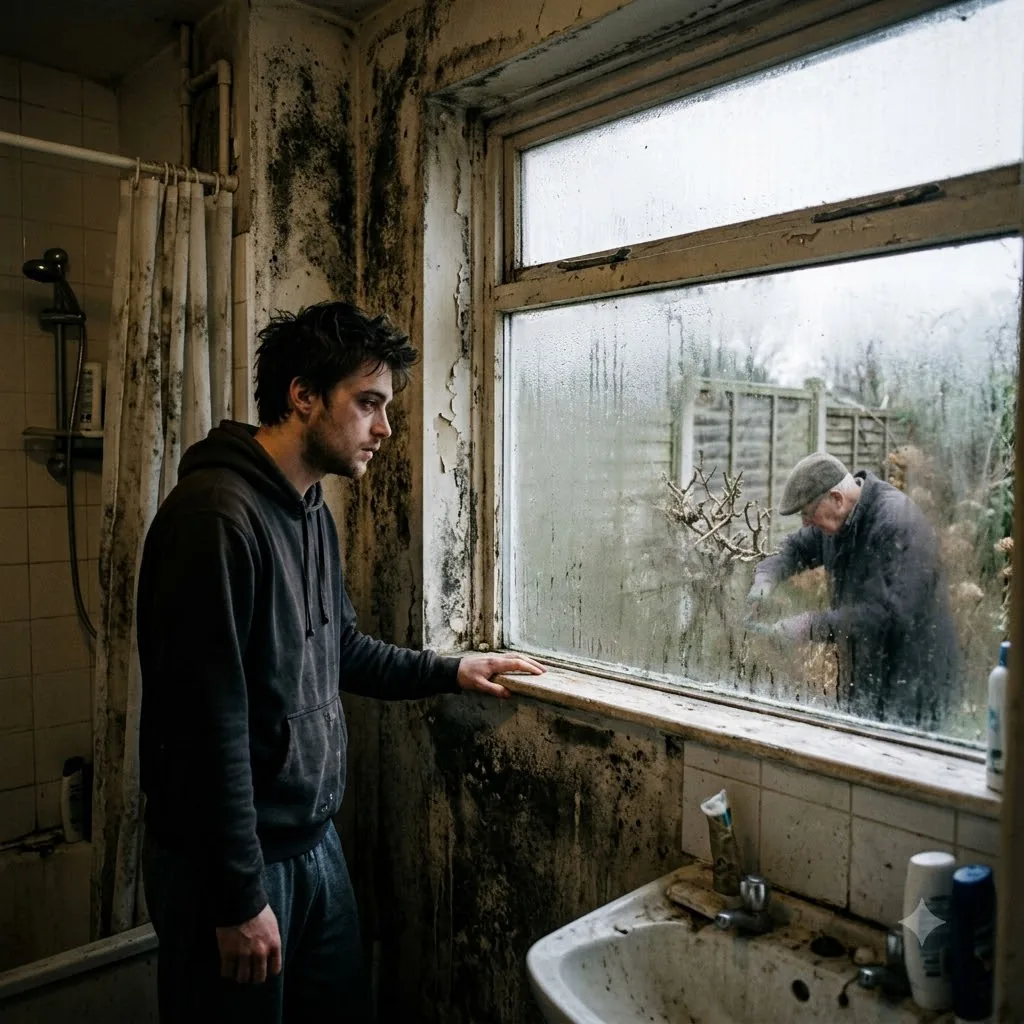
On Tuesday morning, I woke up at dawn. The habit was deeply ingrained in my nervous system. I swung my legs out of bed, bracing myself for the familiar sound of pruning shears clipping at dead wood. I walked down the hall and stepped into the bathroom.
The new linoleum was spotless. The new drywall was perfectly smooth, painted a sterile, eggshell white. I walked over to the new window-clear glass, double-paned, securely latched-and looked down into the side yard.
The perennial bed was empty. The shattered glass and toxic rubble had been painstakingly raked away by the landscaping crew. Even the dead rosebush was gone, dug up by its roots, leaving behind nothing but a flat patch of dark, leveled dirt.
Arthur was not there.
I rested my forehead against the cold, clean glass. My breathing was steady, the agonizing cough finally subsiding, but my chest felt incredibly heavy. I thought about Arthur, sitting alone in that massive, rotting mansion thirty minutes away, surrounded by trash bags and returned letters. He had bought exactly what he was supposed to buy. He had provided the service expected of him. And his reward was the very thing that broke him.
I was living inside it now. The house was fixed, the danger was gone, and I had never felt so utterly, suffocatingly isolated. I looked around the spotless bathroom, listening to the flawless, mechanical hum of the new ventilation fan, and realized with a slow, creeping dread that Arthur’s wealth hadn’t just built his airtight tomb. He had trapped me in one, too.