Story code: ST-001831
Part 3: The Honeypot
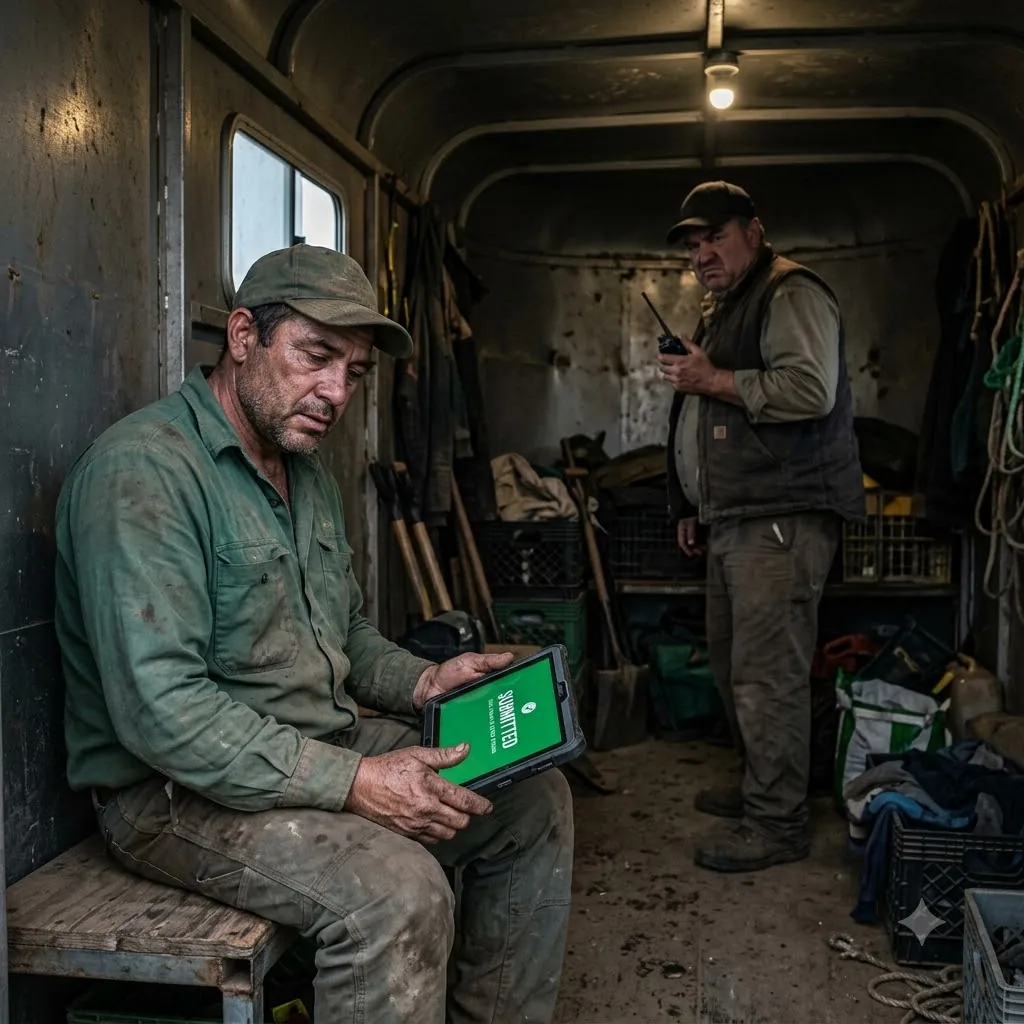
The aluminum floor buckled under Mateo’s boots as the trailer violently lurched forward. Sparks showered outside the metal door, the deafening screech of the excavator’s steel bucket tearing into the trailer’s siding. Hector shouted something in the pitch black, but his voice was swallowed by the grinding roar of the diesel engine. Mateo scrambled backward, his hands desperately seeking purchase on the smooth, sweltering walls. He wedged himself under an aluminum bench, bracing for the sickening sensation of weightlessness. Thirty yards. That was the distance to the trench. At the speed the heavy machinery was pushing them, they would plunge over the edge in seconds, followed by thirty-six tons of collapsing earth.
The air inside the unventilated metal box was rapidly becoming unbreathable. The summer heat baked through the corrugated roof, turning the trapped darkness into a suffocating oven. Davis was sobbing loudly near the front, blindly pounding his fists against the locked door. The trailer bounced savagely over a deep rut, sending men tumbling over one another in a tangle of heavy boots and desperate limbs. Mateo clamped his eyes shut, his muscles locked tight, waiting for the floor to drop out from beneath them.
But the plunge never came.
Instead, the excavator’s treads let out a final, agonizing shriek of metal on rock, and the trailer slammed to a bone-jarring halt. Mateo’s head cracked against the aluminum bench, his teeth snapping together.
The massive diesel engine outside idled down to a low, rhythmic thrum, and then, with a heavy mechanical sigh, it died completely.
The silence that rushed in was thick and heavy, broken only by the ragged, wheezing breaths of the seven men trapped in the sweltering dark. The temperature was soaring past a hundred and ten degrees. Sweat stung Mateo’s eyes. He crawled out from under the bench, his heart hammering against his ribs like a trapped bird. Why had Garrett stopped? Were they teetering on the edge?
Then, a new sound cut through the oppressive heat. The crunch of gravel. Not the slow, heavy tracks of an excavator, but the fast, sharp approach of heavy-duty rubber tires. Several of them. The vehicles braked hard, kicking up a spray of dirt that peppered the exterior aluminum wall.
Heavy doors slammed shut. One. Two. Three. Four.
Boot steps swarmed the gravel outside. They were fast, disciplined, and numerous. None of the heavy, dragging footsteps of an exhausted construction crew.
“Clear the perimeter! Two on the door!” a loud, authoritative voice barked.
Before Mateo could process the command, a heavy tool struck the brass padlock outside. The slide-bolt violently scraped back. The steel door was yanked open with such force it slammed against the exterior siding.
Blinding, pure white sunlight flooded the narrow aisle. Mateo threw his hands up, shielding his eyes from the agonizing glare. As his vision adjusted, the shapes in the doorway sharpened into terrifying focus.
They weren’t suspended over the trench. The excavator had pushed the trailer in the exact opposite direction, wedging it tightly into the dead corner of the site’s chain-link perimeter fence, effectively trapping them inside until the door was opened from the outside.
Blocking the blinding sun were three unmarked, white Ford Transit vans, their engines still humming. Standing in a tight semicircle around the trailer door were half a dozen men and women wearing dark sunglasses, tactical vests, and green cargo pants. Across the chest of the man stepping onto the threshold, large yellow letters spelled out a single, devastating acronym: ICE.
“Federal agents! Keep your hands where I can see them! Nobody move!” the lead agent shouted, stepping into the sweltering trailer with a fistful of thick plastic zip-ties.
Hector slowly lowered himself to the rubber mat, his calloused hands resting on top of his hardhat, his shoulders sagging in quiet defeat. The rest of the crew followed, their exhaustion and terror giving way to the crushing reality of the raid.
Mateo backed slowly against the rear wall, raising his trembling hands. He looked past the tactical vests, past the unmarked white vans, and saw Foreman Garrett.
Garrett wasn’t hiding. He was leaning casually against the massive yellow tracks of the excavator, completely unbothered by the federal raid happening ten feet away. A man in a plain polo shirt with a silver badge clipped to his belt was standing next to him, holding a digital tablet.
“You said there were seven in the box?” the plainclothes agent asked, his voice carrying easily through the dry Texas air.
“Seven,” Garrett confirmed, taking a slow sip from a stainless-steel thermos. “Locked ’em up the second the system flagged it so they couldn’t scatter into the brush.”
Mateo’s breath caught in his throat. He strained to listen, edging slightly toward the open doorway.
“Your company’s HR software just feeds this to you directly?” the agent asked, sounding mildly impressed as he tapped his own screen.
“It’s an automated algorithm,” Garrett said, a smirk pulling at the corner of his mouth. He pulled his company phone from his vest and tapped the glass. “Corporate calls it an ‘anonymous safety portal’ to make them feel safe. But the moment a complaint gets typed in, the algorithm strips the anonymity, pings the device IP, and routes a priority alert straight to the site supervisor’s dashboard. Pinpointed exactly which trailer tablet was being used. Soon as I saw the ping, I knew exactly who was whining about the trench.”
Mateo stared at Garrett’s phone screen in the distance. The realization hit him with the force of a physical blow. The absolute, one-hundred-percent guarantee. It wasn’t a bug. It wasn’t a breach. The betrayal was built entirely into the code by design. A digital honeypot for whistleblowers.
“And the tip to us?” the agent asked, looking up from his notepad.
“Also automated,” Garrett shrugged, dropping his phone back into his pocket. “Called your tip-line. Punched in the site zip code, hit three for a group tip, entered the coordinates. Didn’t even have to speak to a human being. The system just connects the dots.”
An agent grabbed Mateo by the bicep, spinning him firmly but securely around to face the corrugated aluminum wall. The cold, rigid plastic of a zip-tie tightened brutally around his wrists, biting into his skin.
Mateo pressed his cheek against the sweltering metal of the trailer. He looked out through the doorway one last time. Garrett met his gaze. There was no rage in the foreman’s eyes. There was no malice. It was just business. The corporate machine had handed Garrett the perfect trap, and Mateo had willingly walked right into it, locking the door behind himself with a single tap of a blue button.