Story code: ST-001841
Part 3: The Unearthing
“I said take your hand out of that pocket!” The lead officer’s voice tore through the strobing red and blue lights. The laser sight of a firearm danced a frantic, glowing red dot directly over Kevin’s sternum.
Kevin couldn’t breathe. The cul-de-sac, usually dead silent at this hour, was a chaotic amphitheater of flashing sirens, shouting adults, and the terrifying, metallic clicks of safety catches being disengaged. The cold wind bit through his thin hoodie, but sweat rolled down his ribs.
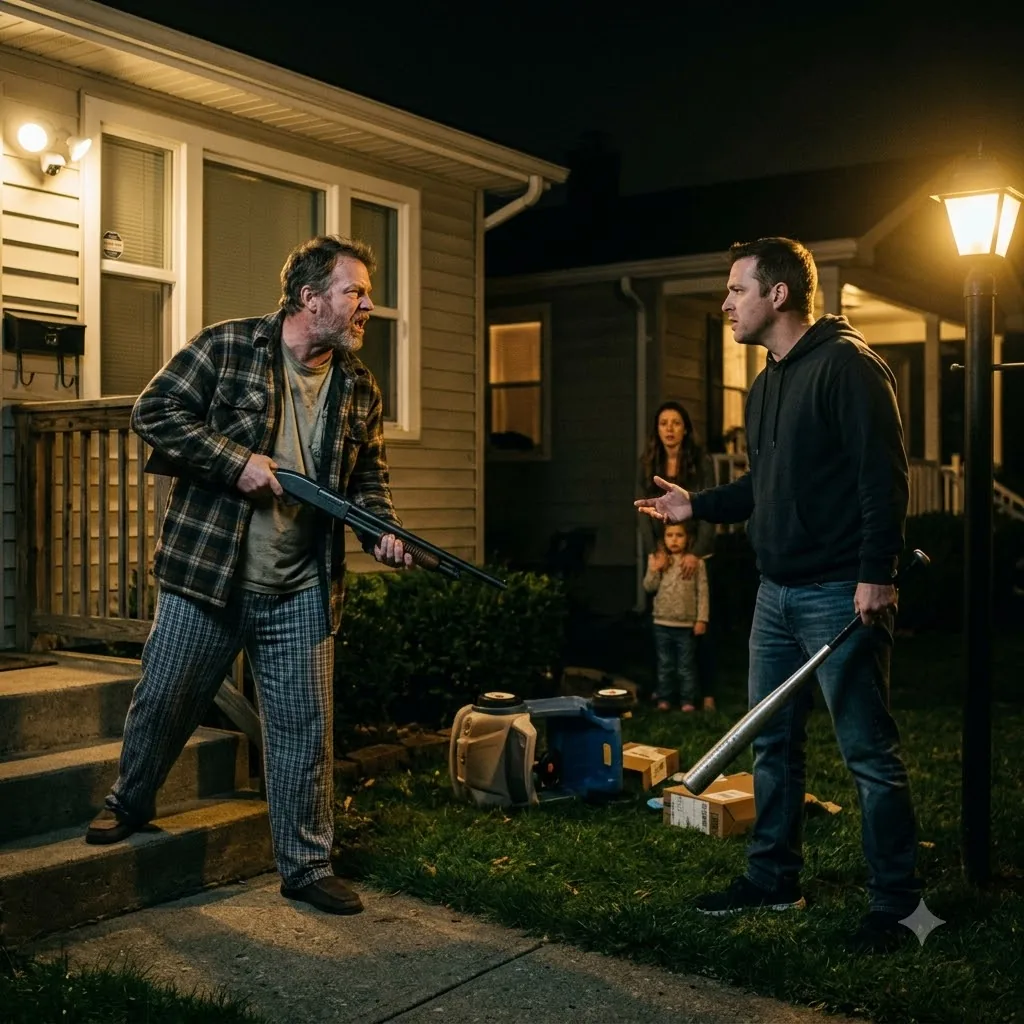
“He was digging around my vehicles!” Mr. Miller shrieked from the porch, his empty hands still raised high in the air above his head, his robe flapping in the freezing breeze. “He’s a thief! Make him empty his pockets! I know he’s got burglary tools or a weapon in there!”
“Shut up, Gary!” Kevin’s father, David Lin, screamed back, his voice cracking with sheer, suffocating panic. He turned toward the officers, holding his empty hands out as if he could physically block the bullets with his bare palms. “Don’t shoot! He’s seventeen! He’s my son! He’s a straight-A student, he doesn’t steal!”
“Sir, step back immediately!” the second officer barked, moving in a wide, cautious arc across the frost-covered grass to get a clear flanking angle on the driveway. “Kid, this is your last warning. Two fingers. Pull whatever is in that pocket out, nice and slow, and drop it on the pavement.”
Kevin’s thumb blindly traced the sharp, folded edge of the heavy-duty plastic document sleeve hidden in his front pocket. It was tightly folded in half, creating a rigid, rectangular block that fit precisely into his damp palm. He had sealed it heavily with packing tape to protect the contents from the wet, rotting organic matter of Mr. Miller’s backyard compost bin. He had been so close. One more scoop of mulch, and the evidence would have decomposed gracefully into the earth alongside the eggshells and coffee grounds, buying him at least a few more weeks of the illusion.
“Kevin!” his father pleaded, taking a half-step forward before an officer’s flashlight beam snapped directly to his face, warning him back. His father’s face was pale, his jaw trembling violently. The absolute certainty in his father’s eyes-the unshakeable belief that his son was a victim of a terrible misunderstanding-was the heaviest weight of all. “Kevin, listen to me! Just do what they say. Prove him wrong. Show them you don’t have anything dangerous! Please!”
The red laser dot rested steadily over Kevin’s heart. He was out of time. Dying on the concrete was no longer a metaphorical preference; it was a literal, impending reality.
Slowly, agonizingly, Kevin uncurled his rigid fingers inside the fabric. He pinched the top edge of the folded plastic sleeve between his thumb and index finger.
“I’m taking it out,” Kevin rasped, his voice trembling so violently it barely carried over the idling engines of the police cruisers. “It’s not a weapon.”
“Do it. Slow,” the lead officer commanded, bracing his stance.
Kevin’s elbow bent. He dragged his hand upward. The dirt-crusted plastic emerged into the blinding glare of the halogen security lights and the strobing police flashers. It looked exactly like what it was: a muddy, taped-up plastic package. In the high-stakes paranoia of the moment, to the officers, it could have been a makeshift explosive, a brick of narcotics, or a stolen car part.
“Drop it!” the officer yelled.
“No, wait,” Kevin said, terrified that if he dropped it, it would bounce, the tape would hold, and the officers would swarm him anyway to seize it. “It’s just paper. Let me show you.”
“Drop the package on the ground and step back!”
“Kevin, empty it! Do what he says!” Mr. Lin screamed, his voice breaking into a terrified sob.
Kevin lowered his hands to his waist, his shaking fingers catching the edge of the clear packing tape he had used to seal the thick plastic sleeve. With a harsh, ripping sound that seemed abnormally loud in the tense driveway, he tore the tape away. He unfolded the rigid plastic, peeling the muddy flaps back to expose the interior.
“Hands where we can see them!” the second officer yelled, but the command lacked its previous lethal edge. The cops were leaning in slightly, their postures shifting as they tried to make sense of the muddy craft project the teenager was frantically dismantling.
Kevin reached inside the plastic sleeve and pulled out the crumpled, deeply creased stack of papers he had intercepted from the mail that afternoon. The school district’s official seal was printed at the top left corner of the heavy cardstock.
He didn’t drop them. He simply held them out with both hands, letting the freezing November wind catch the loose edges of the heavily textured pages.
The lead officer kept his weapon raised, but he lowered his mounted flashlight slightly, illuminating the crumpled papers in Kevin’s trembling hands. The harsh, blinding white beam caught the thick, undeniable streaks of bright crimson ink slashed aggressively across the pages.
There were no tools. No weapon. No contraband.
“What is that?” the officer asked, his aggressive, locked-in stance faltering into genuine, jarring confusion. “Is that… homework?”
Mr. Miller lowered his hands on the porch, his terrified, wide-eyed expression melting into a bewildered squint. “What the hell?”
But Kevin wasn’t looking at the cops, and he wasn’t looking at the neighbor who had nearly shot him. He was looking at his father.
David Lin had taken a slow, unauthorized step forward onto the concrete. Then another. The officers didn’t stop him. The deadly threat had evaporated, leaving behind a bizarre, silent tableau. His father stopped just three feet away, his bare chest shivering in the cold, his eyes locked onto the papers illuminated by the harsh police spotlight.
The wind fluttered the top page, exposing the second. Then the third.
AP Calculus: 42%. AP Physics: 38%. Advanced Chemistry: 45%.
The red ink was violent, slashing across the official midterm progress reports like open wounds. There were boldly circled warnings about academic probation, handwritten notes regarding chronically missed assignments, and the terrifying, unchangeable letter ‘F’ stamped repeatedly down the right-hand columns of every page.
The pristine, meticulously curated reality of the Lin household-the reality built on grueling early-morning tutoring sessions, expensive SAT prep courses, framed academic awards, and the unshakable, singular goal of Stanford early admission-hung completely suspended in the freezing air.
Kevin watched his father’s eyes dart from the red-inked failures to the muddy plastic folder in Kevin’s other hand, and finally, to the dirt caked deep into the knees of Kevin’s jeans. He could see the exact moment the math of the situation finally calculated in his father’s mind. The midnight creeping. The frantic digging in the neighbor’s compost bin. Staring down the barrel of a loaded shotgun rather than simply emptying a pocket.
He wasn’t a teenage criminal trying to hide stolen property. He was a drowning boy trying to bury his own academic execution.
“Kevin,” his father whispered. The protective, roaring fury that had charged out of the house only minutes ago was entirely gone. In its place was a quiet, devastating horror. His father stared at the crumpled, red-stained pages as if they were venomous snakes. His mouth opened, but no other words came out.
The police lowered their weapons completely, their radios crackling in the background, the air suddenly thick with a deeply uncomfortable, private tension that had nothing to do with the law.