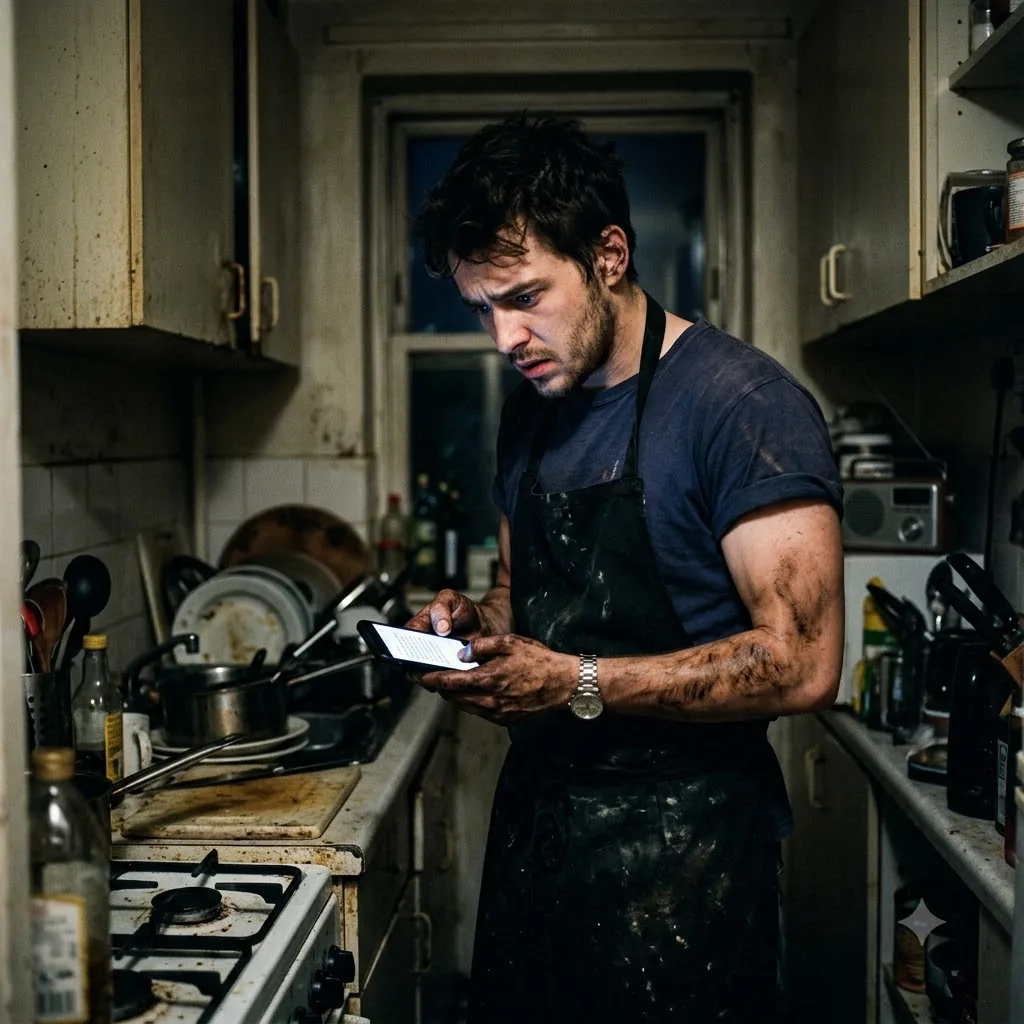
Story code: ST-001852
Part 2: The Collateral Damage
The brass deadbolt snapped back with a metallic crack that echoed off the peeling yellow walls of the studio. Kevin scrambled backward on the mattress, his breath catching in his narrow chest as the heavy wooden door swung inward. His father stood in the threshold, framed by the harsh fluorescent light of the hallway. Ba was still wearing his thick wool work jacket, the shoulders dusted with a fine layer of sleet. He didn’t say a word as he stepped inside, pushed the door shut, and slid the chain into place. The finality of the metal sliding into its groove made Kevin flinch.
“Eighty-two seconds,” Ba said. His voice was dangerously quiet, lacking the explosive anger Kevin had braced for. It was worse. It was the icy, calculated tone of a man assessing a fatal structural collapse.
“Ba, I didn’t-I couldn’t move,” Kevin stammered, his hands instinctively gripping the rough fabric of his blanket. “I don’t know what happened to me.”
Ba walked past the tiny kitchenette, his heavy boots leaving damp impressions on the cheap linoleum, and stopped at the foot of the bed. He pulled his own phone from his pocket. The screen was glaringly bright. “Eighty-two seconds that man was on the floor. I watched it forty times on the subway ride over here. And for eighty-two seconds, you stood there holding a tray of bread while a man suffocated.”
“I froze,” Kevin whispered, the words tasting like ash. “I know. I know I did.”
“Knowing does not fix this,” Ba snapped, tossing his phone onto the mattress next to Kevin’s. “Do you understand what is happening out there? It is not just a video anymore. It is a hunt.”
Kevin looked down at his father’s phone. The screen was open to a massive group thread-an endless stream of rapid-fire messages in Mandarin, links to Twitter threads, and angry red exclamation points. It was the local community association chat, a network of hundreds of neighborhood families, business owners, and gossips.
“Mr. Lin recognized you,” Ba said, unbuttoning his coat. “He eats at the restaurant every Tuesday. He took one look at that brightened screenshot and sent it to the association. Now your aunt knows. Your cousins know. In an hour, every person we have ever shared a meal with will know you let a man die for a viral video.”
“I wasn’t filming!” Kevin shot back, a flash of defensive heat cutting through his panic. “I didn’t pull out my phone! I wasn’t like the rest of those vultures in the dining room!”
“You were worse!” Ba roared, the sudden volume rattling the thin windowpanes. “They were stupid. You were a coward. You had the kitchen doors right behind you. You could have called an ambulance. You could have screamed for the manager. You just watched.”
The absolute truth of the accusation hit Kevin like a physical blow. He slumped forward, burying his face in his hands. The smell of the roasted garlic and stale grease on his arms made him nauseous. The crushing weight of his inaction pushed down on his spine, a heavy, suffocating force that threatened to crack his ribs. He pictured the man in the navy suit, the terrifying shade of gray creeping up his neck, the desperate clutching of his chest. Kevin had stood there. He had possessed the power to intervene, the CPR training, the basic human instinct to help, and he had buried it all beneath a mountain of inexplicable, paralyzing fear.
“So what do we do?” Kevin asked, his voice muffled by his palms. “Do I go to the police? Do I put out a video apologizing?”
“Apologizing?” Ba scoffed. He reached into his coat pocket and pulled out a folded piece of printer paper. “If you apologize, you admit guilt. If you admit guilt, the internet destroys you, and then the restaurant sues you to save their own reputation. Rossi will throw you to the wolves to keep his liquor license.”
Ba unfolded the paper and thrust it into Kevin’s lap. It was a typed statement, barely a paragraph long.
“You post this on your social media accounts,” Ba commanded. “Right now. You lock the accounts immediately after. It says you were suffering a severe panic attack caused by a diagnosed anxiety disorder. It says management had locked the emergency phone in the manager’s office, and you were waiting for the key. We threaten them with a hostile work environment lawsuit if they contradict you.”
Kevin stared at the black ink on the page. It was a masterful, cynical piece of deflection. It weaponized mental health and shifted the blame entirely onto the restaurant’s infrastructure. It was exactly the kind of ruthless survival tactic his father had used to keep his failing hardware store open through two recessions.
“Ba, this is a lie,” Kevin said softly. “The phone isn’t locked. And I don’t have a diagnosed disorder. I just froze. I was scared. If I post this, I’m blaming Mr. Rossi for my own cowardice.”
“You are surviving,” Ba corrected, his jaw set in a rigid line. “If you do not post this, they will not just dox you. They will dox the family. Your sister’s university email is already public. They are leaving reviews on my store’s page saying I raised a sociopath. You will drag us all down into the dirt because you want to feel morally pure about your failure.”
Kevin’s chest tightened. The isolation of his guilt was shattering, expanding outward to infect his entire family. The digital mob wasn’t just circling him anymore; they were burning down everything connected to him. He picked up his father’s phone, scrolling past the Mandarin text messages to the linked Twitter thread.
The top reply had a picture of his apartment building.
*This is the coward’s place,* the caption read. *Third floor. Corner unit.*
He looked up at his father, the typed lie trembling in his hands. Before he could speak, the heavy silence of the apartment was violently broken by the harsh, sustained buzzing of the downstairs intercom, followed immediately by the sound of something heavy smashing against the glass of the front lobby door.