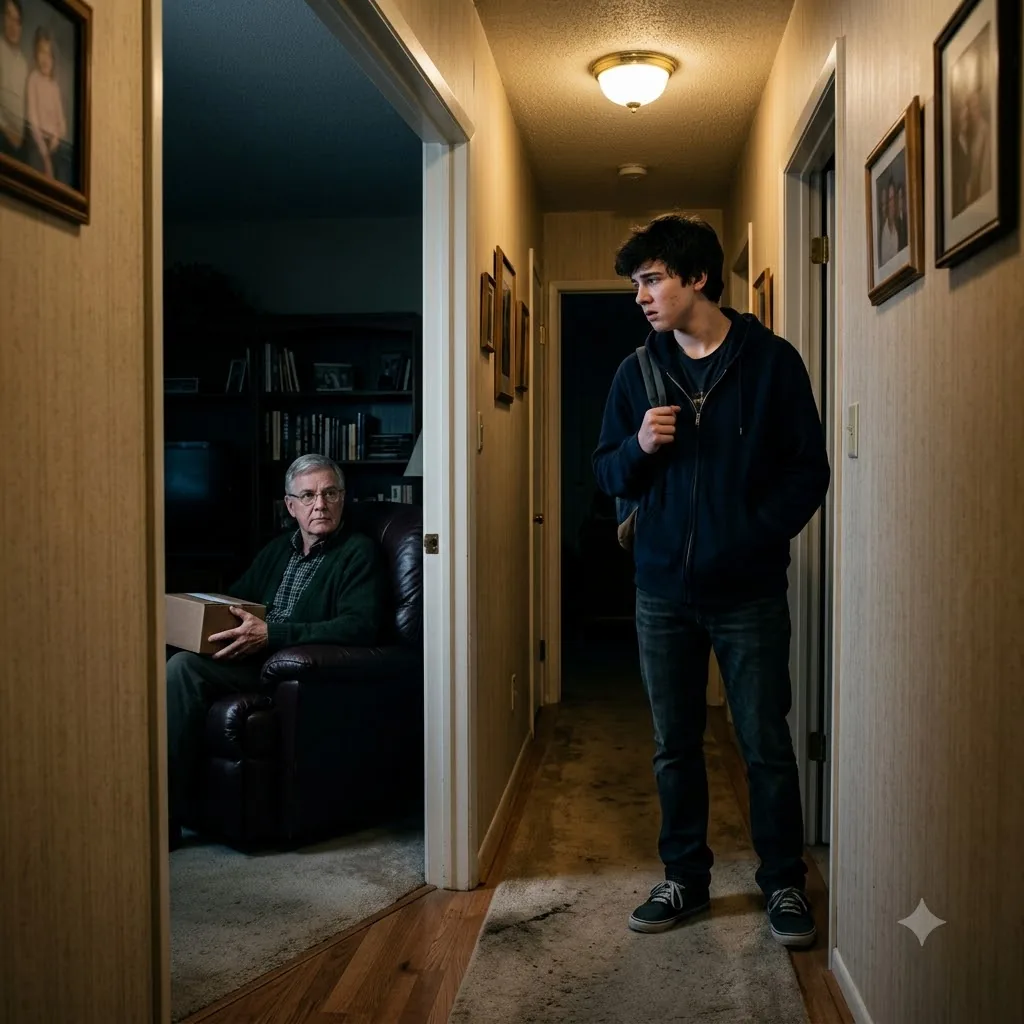
Story code: ST-001857
Part 2: The Architecture of Control
Ash’s boots felt fused to the floorboards. *The facility.* The words hung in the stale air of the foyer, a death sentence delivered with the cadence of a grocery list. Ash calculated the distance to the front door again. Ten feet. A sprint, a turn of the deadbolt, a dash into the wet night. But to where? If the supposedly air-gapped burner phone was flashing its microphone telemetry straight to the leather recliner, the escape network was already dead. There was no safe house left to run to.
The father stepped past Ash, the scent of expensive cedar cologne masking the smell of the damp earth outside. He didn’t look back to see if Ash was following. He didn’t need to. That was the most terrifying part of his control-it was assumed, absolute, and woven into the very fabric of reality.
Ash followed him out into the biting cold. The driveway was empty save for the father’s black sedan. The headlights flared to life, illuminating the curtain of drizzle. Ash slid into the passenger seat, the leather cold and unforgiving. The doors locked with a heavy, mechanized thud that resonated in Ash’s chest, sealing the cabin.
As the car rolled out of the subdivision, the glow of the dashboard cast harsh shadows across the father’s profile. The cardboard box sat on the center console, a monument to Ash’s failure.
“You’re trying to calculate the attack vector,” the father said softly, his eyes fixed on the slick road. “I can see the gears turning. You’re wondering how a decentralized, mathematically sound encryption protocol failed you.”
Ash stared straight ahead, jaw clenched. The burner phone in the jacket pocket felt like a lump of radioactive material.
“The math didn’t fail,” the father continued, his voice taking on the dry, lecture-hall tone Ash had hated since childhood. “The math is elegant. The cipher is unbroken. You built a fortress of equations. But you built it on my foundation, Ash.”
Ash finally looked at him. “The pawn shop,” Ash whispered, the first words spoken since the den. “You said you flashed the firmware when I hit the cellular tower.”
“A slight oversimplification for dramatic effect,” the father conceded, turning the steering wheel with precise, minimal movements. “I didn’t flash it at the tower. The baseband processor was already mine. When you bought that specific handset, you thought you were randomly selecting a refurbished unit off the grid. But who do you think supplies the refurbished electronics to the secondary markets in this region? You trust the software, Ash, but you blindly trust the hardware. The moment that device powered on and pinged a local tower, it didn’t just register a network. It phoned home. To me.”
The sheer scale of the surveillance net pressed down on Ash, suffocating and vast. It wasn’t just a hacked phone; it was a compromised supply chain. The father hadn’t intercepted the message by breaking the encryption; he had simply read the keystrokes directly from the compromised operating system before the encryption even triggered.
“And the box?” Ash asked, eyes dropping to the cardboard package on the console. The hardware wallet. The false passports. The ticket out.
“A courtesy,” the father replied. “I let you order it. I let the courier deliver it. I wanted you to feel the proximity of your escape. I needed you to understand that no matter how close you get, the boundary of your world is drawn by me.”
The sedan turned off the main highway, tires crunching onto an unlit access road bordered by dense, towering pines. This was the route to the industrial park on the edge of the county-a sprawling complex of windowless server farms and logistics hubs. The facility.
“What do you want?” Ash’s voice shook, betraying the carefully maintained stoicism. “You caught me. You stopped the extraction. What now?”
“Now, you stop playing the runaway,” the father said. The car slowed as a massive, brutalist concrete structure loomed out of the fog. “Your talent for systems architecture is remarkable. Your evasion tactics, while flawed, showed a level of creativity my current security analysts lack. You are going to work for me, Ash. Down in the sub-levels. You will find the vulnerabilities in our external networks, and you will patch them.”
“I’ll refuse. I’ll burn it all down from the inside.”
The father smiled, a thin, bloodless stretching of the lips. He reached over, tapped a sequence on the car’s integrated touchscreen, and a live video feed bloomed on the display.
Ash’s breath caught. It was a grainy, night-vision feed of a narrow alleyway. A figure in a heavy trench coat was pacing nervously, checking a watch.
It was Elias. The extraction contact.
“Elias is currently waiting at the secondary rally point,” the father said smoothly. “He thinks you’re just running late. He doesn’t know his own phone is currently acting as a homing beacon for a tactical retrieval team waiting two blocks away.”
The sedan rolled to a stop in front of a pair of massive steel doors set into the concrete face of the building.
“You have absolute control over your next action, Ash,” the father said, placing a hand on the cardboard box. “You can open your door, walk into this facility with me, and begin your new orientation. If you do, Elias gets tired of waiting, goes home, and lives a long, unremarkable life.”
The father leaned closer, the scent of cedar now mixed with the ozone hum of the dashboard electronics.
“Or, you can resist. And I make one phone call, and Elias disappears into a black site before the sun comes up. Your defiance has a price, Ash. Who is going to pay it?”
Ash stared at the live feed, watching Elias pace, completely unaware of the crosshairs resting squarely on his back. The heavy keys in the father’s pocket jingled as he unbuckled his seatbelt. The steel doors of the facility began to grind open.