Story code: ST-001885
Part 4: The Receivership
David stared at the weeping woman, the silence between them broken only by the distant hum of a lawnmower from a neighboring subdivision that wasn’t currently collapsing. Martha reached into her slacks with a trembling hand, retrieving a crumpled, sweat-stained sheet of paper.
“It’s a debt verification form,” she pleaded, her voice barely a rasp. “The commercial lender just needs your signature. Just confirming the fifteen-thousand-dollar lien is valid. Once the bridge loan funds at three o’clock, I’ll convene an emergency board meeting. I’ll waive the fines. I’ll release the lien on your house. I swear to you, David.”
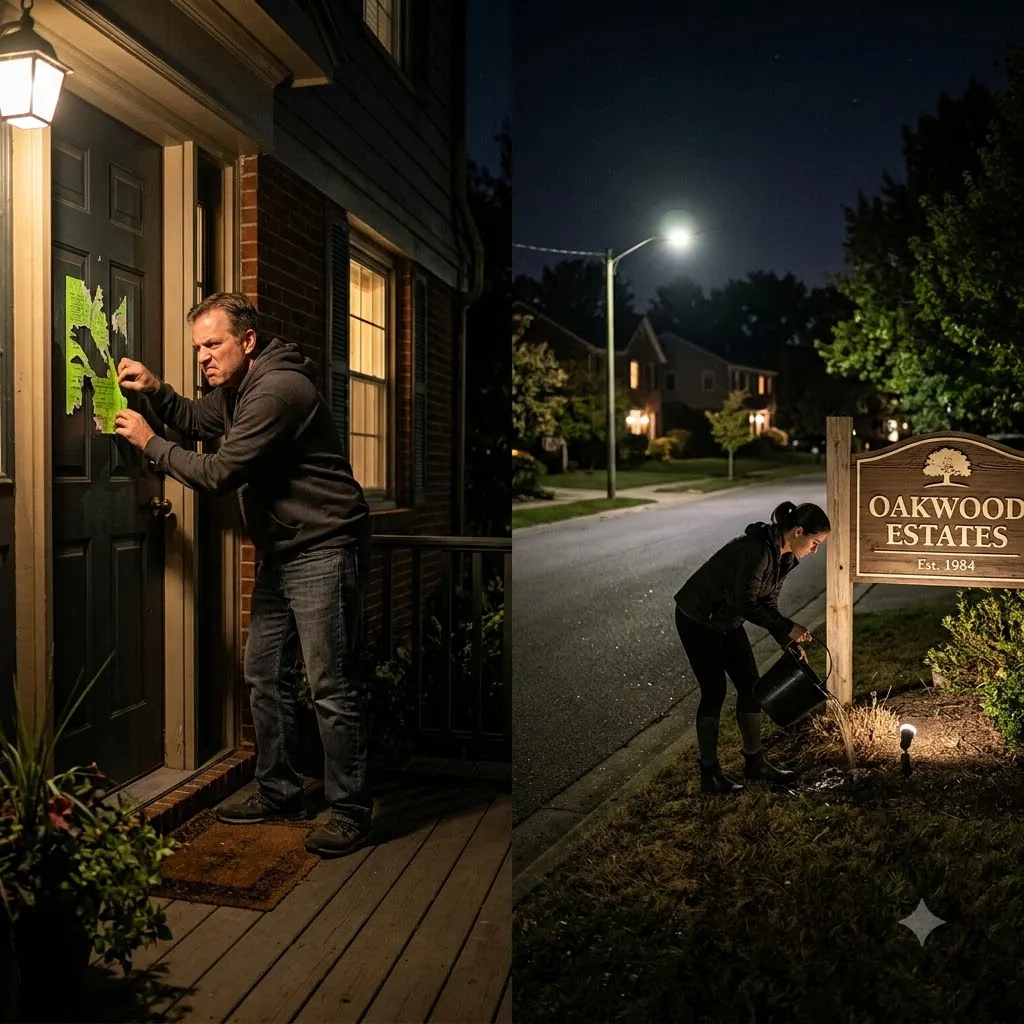
David looked at the paper trembling in her grip, then up at the bright red zip-tie dangling from the irrigation vault. He had spent months fighting this woman’s tyranny, losing sleep over the neon-green sticker glowing on his front door, terrified of losing his home over drought-friendly plants. Now she was asking him to save her.
“You bankrupted the association to water some decorative flowers, Martha,” David said, his voice dropping to a terrifyingly calm register. “And now you want me to commit federal bank fraud so you can pretend none of this happened.”
“If you don’t sign it, we all lose our homes!” she cried, stepping toward him.
“I guess we’d better start packing,” David said.
He turned his back on her, walking slowly up his gravel driveway and into his house. He locked the deadbolt. He didn’t answer when she spent the next hour pounding on his fiberglass door, begging through the wood until her voice completely gave out.
The fallout was faster and more brutal than David could have ever anticipated.
The HOA’s master insurance policy lapsed exactly at midnight. By Tuesday morning, David received an overnight envelope from his mortgage servicer. Automated systems had detected the covenant breach. By Thursday, his monthly mortgage payment tripled as the bank force-placed an exorbitant commercial insurance policy on his property to protect their collateral.
Talking to his panicked neighbors, David learned everyone had received the exact same letter.
Within two weeks, the Whispering Pines Homeowners Association officially filed for bankruptcy. The county immediately stepped in, dissolving the board and placing the neighborhood into municipal receivership. To settle the crippling six-figure water fines Martha had accumulated, the county receiver levied a mandatory, un-appealable special assessment of twelve thousand dollars against every single property in the subdivision.
It was a lethal combination. The residents, already suffocating under the massive force-placed insurance premiums, broke. The mass defaults began before the end of the month.
Sixty days later, the late August heat baked the cul-de-sac into a silent, shimmering oven. David carried a taped cardboard box down his driveway, sliding it into the back of a rented moving van. He wiped the sweat from his forehead, looking at his drought-resistant agave plants. They were thriving, their thick blue-green leaves soaking up the relentless sun.
The house behind them, however, belonged to the bank. Between the municipal special assessment and the tripled mortgage payment, David’s savings had evaporated in six weeks. The house was gone.
He slammed the metal door of the moving van and looked down the street. The neighborhood was a ghost town. Moving trucks were a daily fixture on the block. The prized entrance monument in the distance was completely barren, the award-winning hydrangeas reduced to withered black stalks surrounded by cracked, baked earth.
A silver sedan turned the corner and parked in front of Martha’s pristine, two-story colonial. A man in a blue polo shirt stepped out of the driver’s side. He didn’t carry a clipboard or a violation sticker. He carried a heavy wooden stake, a laminated metal sign, and a large rubber mallet.
David walked slowly down the asphalt, his sneakers kicking up small clouds of dust. He stopped at the edge of Martha’s property.
Martha was already outside. She sat on the concrete curb, wearing the same leather gardening gloves and heavy rubber clogs from that night in the dark. She wasn’t weeding or pruning. Her once-immaculate lawn was completely dead, a brittle expanse of yellow straw, killed by the same shutoff valve that had triggered the end of their world.
David stood behind her for a moment. Then, without a word, he sat down on the hot concrete next to her.
Martha didn’t look at him. She stared straight ahead at the man in the polo shirt.
The man positioned the wooden stake in the center of Martha’s dead lawn. He raised the rubber mallet and brought it down with a heavy, rhythmic thud.
*Thwack. Thwack. Thwack.*
The red and white FORECLOSURE sign stood stark against the dying grass. The bank representative took a photo with his tablet, got back into his silver sedan, and drove away, leaving nothing but the sound of the dry wind rustling through the dead oak leaves overhead.
David rested his forearms on his knees. He had destroyed the tyrant of Whispering Pines, and it had cost him everything he had left.
“The agave looks good, David,” Martha rasped, her voice dry and utterly hollow.
David stared at the metal sign planted in her lawn, feeling the residual heat of the asphalt radiating through his jeans. “Thanks, Martha. Takes almost no water at all.”