Story code: ST-001892
Part 2: The Oath and the Algorithm
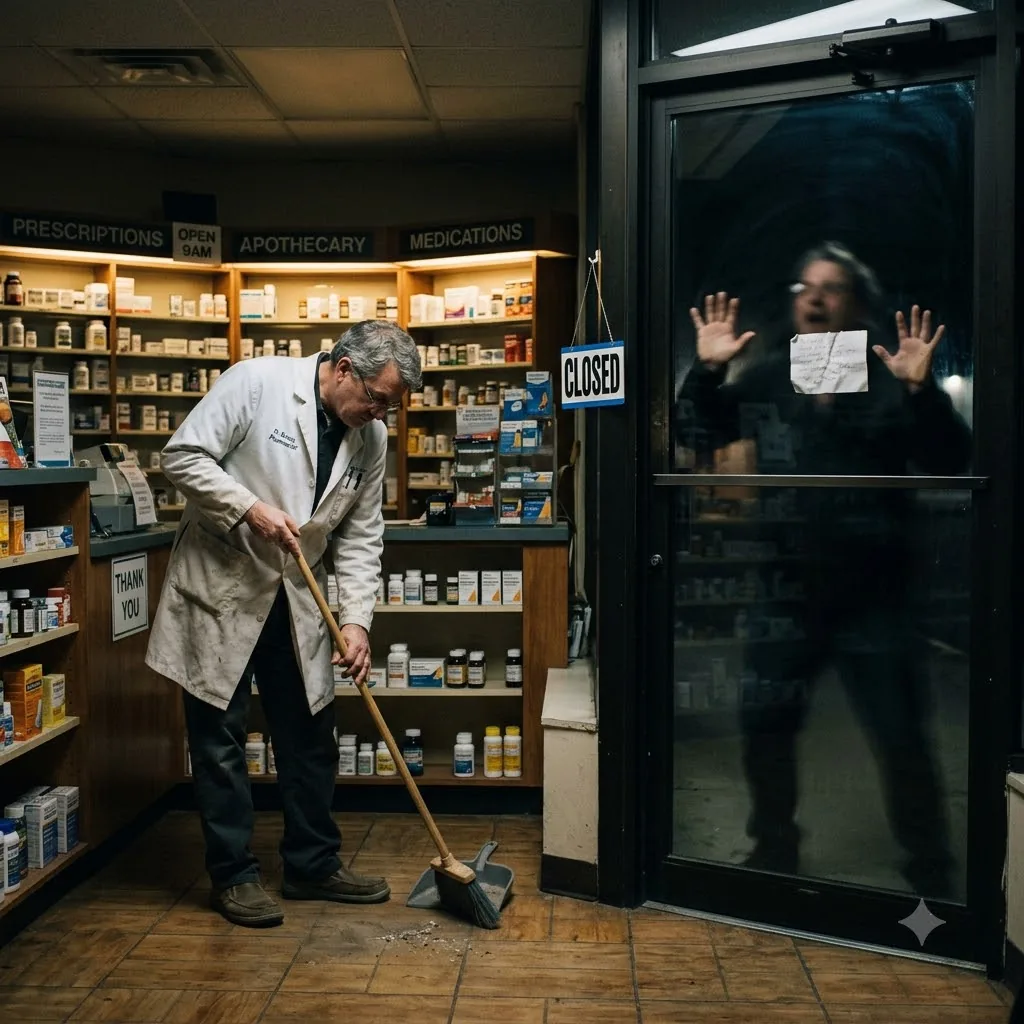
Elias leaned closer to the polycarbonate pane, his knees aching against the unyielding linoleum. The glass was cool, radiating the late-autumn chill from the parking lot. He squinted through the condensation of her ragged breaths. The crumpled paper pressed against the barrier wasn’t a standard note or a forged clinic slip. It was a county hospital discharge prescription, printed on the distinctive blue-patterned security paper that resisted photocopying. The dark smears obscuring the patient’s name weren’t dirt; they were blood, thick and beginning to oxidize into a rusty brown along the torn edges.
Her fingers, trembling violently as they flattened the paper against the glass, bore a plastic hospital admission band. Elias tracked the smeared red fingerprints to a crude, makeshift dressing wrapped tightly around the woman’s collarbone. It was soaked through. She wasn’t an addict looking for an early refill, and she wasn’t a thief. She was a legitimate trauma patient.
Elias shifted his focus to the legible portions of the prescription. His eyes darted across the emergency room doctor’s scrawl, picking out the dosage and the medication. Oxycodone-Acetaminophen, 10-325mg. A heavy, highly controlled Schedule II narcotic. Below it, a secondary script for Cephalexin, a broad-spectrum antibiotic. He knew exactly what this was. The hospital had patched her up, handed her the paper scripts, and pushed her out into the night to free up a bed.
“We are closed,” Elias said, his voice loud but muffled by the acoustic dampening of the reinforced door. He pointed a stiff finger toward the plastic sign hanging in the window. The digital clock on the wall behind him read 9:18 PM. “The registers are locked. The safe is locked. I cannot help you.”
He knew she couldn’t hear the exact words, but the rigid, dismissive gesture was universal. His profession allowed zero exceptions for Schedule II narcotics. To dispense Oxycodone legally, he had to log into the state’s Prescription Drug Monitoring Program. His terminal was already shut down. Booting it up to access the PDMP after hours would instantly flag his credentials in the corporate system. Unlocking the front door would trigger a perimeter breach alert to the regional security center. Bending the rules for a controlled substance wasn’t just a fireable offense; it was the kind of violation that brought DEA auditors and the state pharmacy board crashing down on his license.
The woman outside didn’t move away. Instead, her pale face contorted in a silent scream of sheer agony. Her head dropped forward, her forehead thudding weakly against the glass. She mouthed something, her lips cracked and dry.
Elias stayed on his knees, paralyzed by the collision of his ingrained corporate training and the undeniable human suffering inches away. “Go back to the emergency room,” he mouthed clearly, exaggerating the syllables. He pointed down the street, toward the county hospital three miles away.
The woman shook her head slowly, leaving a greasy smudge of sweat on the polycarbonate. She slid one bloody hand down her coat, plunging it into her pocket. When she pulled it out, she pressed a small, crumpled handful of cash against the glass, right next to the prescription. It was a collection of ones and fives, stained and wrinkled. She didn’t have insurance. She didn’t have a car to get back to the hospital. She had walked here, bleeding, carrying the only money she had to her name.
She pulled the cash away and replaced it with her palm, pointing a single, trembling finger toward the end of the block. Toward the intersection of 4th and Mercer.
A cold knot formed in Elias’s stomach. He knew the intersection well. It was the local open-air market. The territory where the corner boys sold pressed pills made of drywall powder and fentanyl, stamped to look exactly like the legitimate painkillers locked in his time-delay safe. He had seen the aftermath countless times. Legitimate patients-construction workers with crushed vertebrae, elderly women with untreated neuropathy, trauma victims turned away by broken systems-pushed beyond the threshold of their own endurance. When the pain became a physical fire that eclipsed all rational thought, the fatal street alternatives became their only remaining choice.
The woman was crying now, silent tears cutting clean tracks through the grime on her cheeks. She tapped the prescription, then tapped her injured collarbone, then pointed toward the intersection again. Her message was devastatingly clear. *If you don’t help me, I have to go to them. I cannot survive this pain until morning.*
Elias stared at the solid lock protecting his livelihood, his pension, and his flawless fifteen-year record. He had built an impenetrable wall against the chaos of the streets. The glass barrier was there for a reason. If he opened that door, he became entirely liable. If she died from a complication on his floor, if corporate security called the police, his life as he knew it was over.
The woman held his gaze for one long, agonizing second. Then, her shoulders slumped. The frantic energy of her survival instinct seemed to evaporate into the freezing night air. She let the bloody prescription paper fall to the concrete. She didn’t bother picking it up. She turned her body, wrapping her coat tightly around her bleeding shoulder, and took a slow, stumbling step away from the pharmacy.
She was heading straight toward Mercer.
Elias watched her silhouette merge with the deep shadows of the parking lot. His hand hovered over the floor tiles. The heavy ring of security keys, clipped to his belt loop, dug sharply into his hip. The state board’s regulations echoed loudly in his mind: *A pharmacist must exercise professional judgment in the best interest of the patient.* But the corporate handbook was equally loud: *Zero tolerance for off-hours dispensing. Zero tolerance for security breaches.*
He saw her stumble near the edge of the streetlight’s glow. A dark sedan with tinted windows was already idling at the corner, its brake lights casting a demonic red glow over the cracked pavement.