Story code: ST-001894
Part 2: The Compliance Trap
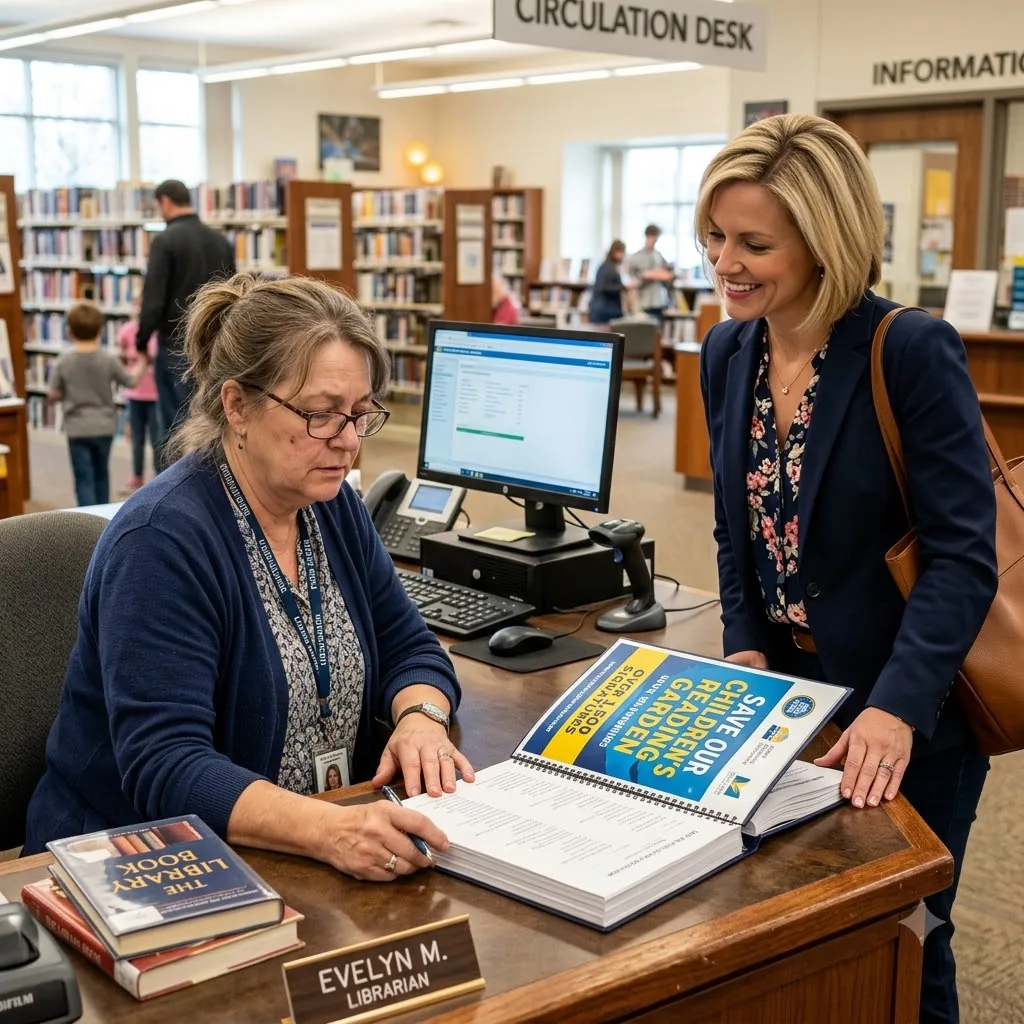
Eleanor pressed her palms against the cool laminate of the circulation desk, staring at the block of single-spaced text. The words blurred, then sharpened into horrifying focus. The legal rider didn’t just demand the removal of three picture books. It outlined a binding arbitration agreement. If the library board voluntarily complied with the removal request, it triggered a “remediation protocol,” legally conceding that the library had violated municipal obscenity statutes. The penalty for this admission wasn’t a fine; it was the immediate surrender of curatorial and operational control to a newly formed “Community Standards Committee”-a committee the document explicitly stated would be chaired by the lead petitioner.
Eleanor grabbed the heavy binder and marched toward the back offices. The hallway smelled of old paper and the industrial floor cleaner the night crew used. Through the glass walls of the director’s office, she could see Marcus pacing, his phone pressed tight to his ear, his tie already loosened.
She pushed the door open. Marcus held up a hand, silencing her. “No, I understand,” he was saying, his voice strained. “We are a public institution. We hear your concerns. We’ll handle it immediately.”
He dropped the receiver onto its cradle and rubbed his temples. “That was the mayor’s office. Chloe didn’t just drop off a petition. She stood in our parking lot, recorded a ten-minute video about institutional decay, and posted it. It already has four thousand shares. Our switchboard is completely locked up.”
“Marcus, you need to read this,” Eleanor said, dropping the massive, glossy binder onto his desk. It landed with a heavy smack. “This isn’t a concerned mom complaining about a picture book. It’s a trap.”
Marcus barely glanced at the cover. “I don’t care what it is, Eleanor. It’s a PR nightmare. We are three weeks away from the town council voting on our annual budget. If we look like we’re fighting parents over community values, they will slash our funding by thirty percent.”
“It’s not about values,” Eleanor insisted, flipping the thick pages past the inflammatory graphics and out-of-context quotes until she reached the suffocating wall of text at the back. She pointed a trembling finger at the rider. “Look at Section Four. If we pull these books based on this petition, it’s classified as an admission of fault. It binds the library to an external oversight board. They’re using the books as a smokescreen to take over the library’s governance.”
Marcus leaned back, his face pale. He stared at the dense legal text, but Eleanor could tell his eyes weren’t tracking the words. He was too consumed by the flashing red lights on his phone console. Every line was ringing.
“We don’t have the legal budget to fight this,” Marcus said, his voice dropping to a hollow whisper. “If we refuse the petition, they’ll drag us into court, and the council will drop us to avoid the scandal. If we fight, we lose.”
“If we comply, we lose the whole library,” Eleanor shot back.
Marcus shook his head, looking exhausted. “Just pull the three books, Eleanor. Take them off the shelves. Check them into the back room under a ‘routine review’ status. We won’t officially accept the petition, but we’ll remove the targets to calm the waters. It’s a compromise. Just do it.”
“Marcus-”
“Do it,” he snapped, his voice cracking with panic. “Before the local news gets here.”
Eleanor stared at him, a cold wave of isolation washing over her. Marcus was the director, the one supposed to defend the collection, and he was caving before the first hour was over. She picked up the heavy binder and walked slowly out of the office.
The main floor of the library was usually a sanctuary, a quiet expanse of dusty light and soft murmurs. Now, it felt like a target. The red lights on the circulation desk phones flashed in silent, frantic unison. She walked into the children’s wing, the bright primary colors of the low shelves feeling utterly at odds with the predatory document in her hand.
She found the three books easily. *The Garden at the End of the Block*, *Iron Rails West*, and *The Mill on the River*. Three slim, innocent picture books. She gathered them into her arms, their protective Mylar covers smooth against her skin.
Carrying them back to her terminal, she felt like an executioner. She sat down and brought up the library’s inventory software. Her cursor hovered over the status dropdown. To change it to ‘Under Review,’ she would have to scan the barcodes. Once she did, the public online catalog would immediately update, showing the community that the library had removed the books within an hour of Chloe’s demand. It would be a massive public victory for the outrage campaign. It would be blood in the water.
She set the books down next to the glossy petition. She couldn’t do it. There was something else, something she was missing. She opened the petition again, ignoring the legal jargon this time, and turned to the signature pages. Chloe had bragged about two hundred local signatures.
Eleanor typed the first five names into the library’s patron database. Nothing.
She tried the next five. Nothing.
She flipped through the pages, scanning the addresses. They were all located in a neighboring county, miles away from their library district. But that wasn’t what made Eleanor’s stomach drop.
She turned back to the very first page, where Chloe’s signature sat on the line designated for the “Lead Community Representative.” Eleanor leaned in close. The ink was a dark, bold blue. But the signature was jagged. The loops in the ‘C’ and the ‘h’ were erratic, pressed so hard into the thick paper that they had left deep indentations. It didn’t look like righteous anger. It looked like terror.
And right beneath Chloe’s signature, in the space reserved for the representative’s affiliated organization, someone had typed *Stanton & Cross LLC*.
Eleanor opened a web browser and searched the name. The first result wasn’t a political action committee or a conservative podcast network. It was a massive commercial real estate firm specializing in municipal asset liquidation.
A loud, sharp knock on the glass double doors made Eleanor jump. The library didn’t open for another twenty minutes. Standing on the sidewalk, glaring through the glass, were three men in tailored suits holding leather briefcases, flanked by a cameraman.
They weren’t looking at the books. They were looking at the building.