Story code: ST-001895
Part 3: Automated Echoes
Two private security contractors escorted Elena from her locked office directly to the Executive Boardroom on the top floor. They hadn’t touched her, but their presence was a silent mandate. Her un-networked laptop remained sequestered on her desk, guarded by a third contractor, but the matte black flash drive was a heavy, hidden weight in her blazer pocket.
Regional Vice President David Vance sat at the head of the long mahogany table. His tablet was propped up on a leather folio, displaying the same optimized blue interface of the human capital suite that Elena had been using an hour ago. Marcus sat opposite him. His posture was identical to how he had been in HR Room B: rigid, silent, hands folded loosely in his lap. A thick manila folder rested on the table in front of him.
“Sit down, Elena,” David said, not looking up from his screen. “The system flagged a critical deviation. You initiated a twenty-four-hour cooling period for a mathematically finalized termination, which triggered an alignment audit on your own profile. I am legally required to close this loop before the end of the day.”
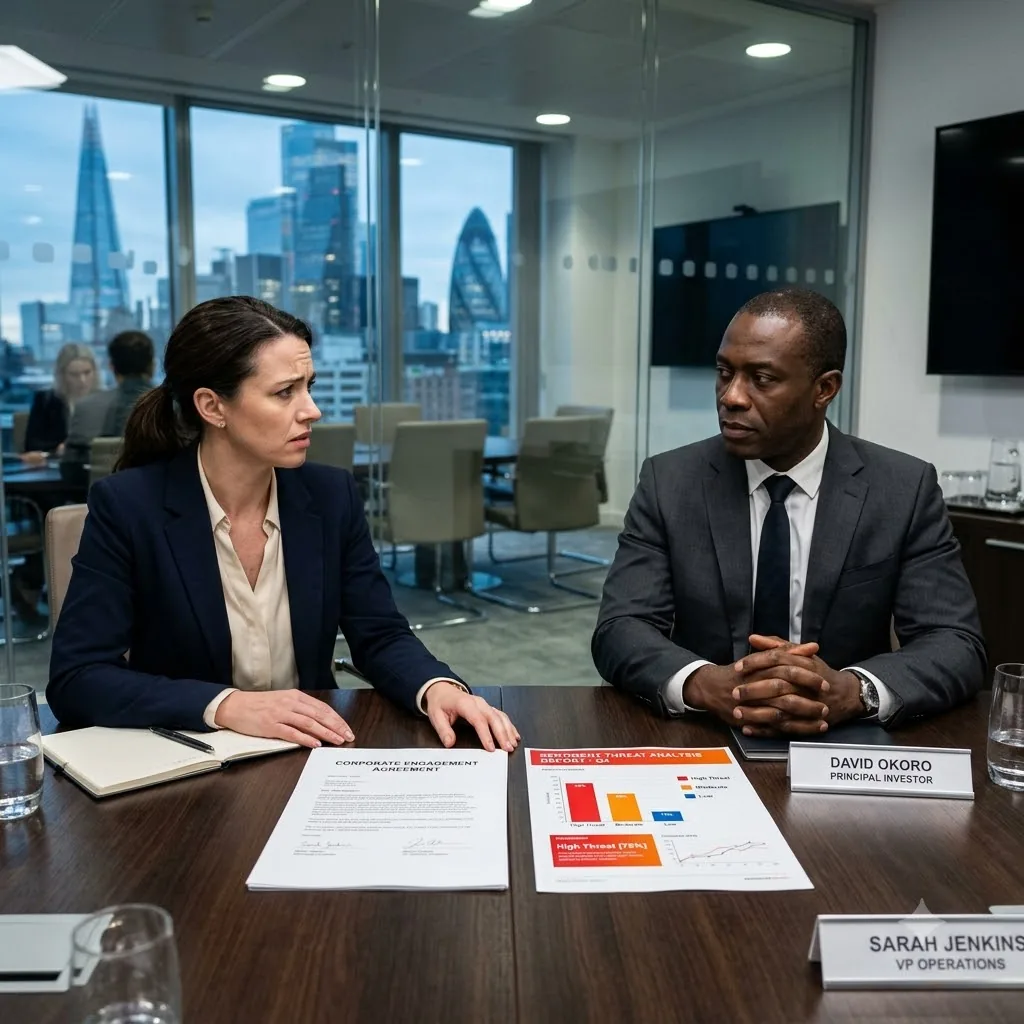
Elena took the chair between them. The glass walls here looked out over the sprawling city skyline rather than the open-plan office, but the room felt just as suffocating. She knew what was on the flash drive in her pocket. She knew exactly what the algorithm was doing. But she also knew that outright accusing a Regional VP of fostering systemic racism would trigger an immediate, brutal corporate defense protocol. She needed to thread the needle. She needed a safe mediation strategy.
“David, I reviewed the underlying data during the cooling period,” Elena said, pitching her voice into a soothing, collaborative register. “The automated suite’s parameter weights are drastically over-tuned. It’s generating false positives for cultural friction by misinterpreting standard logistical urgency. If we process Marcus’s termination based on these specific heuristic markers, we open the firm to an extensive algorithmic bias audit. The legal liability is massive.”
David frowned, his finger pausing over the tablet. “The system is blind, Elena. It’s objective. That was your entire pitch to the board.”
“It’s an iterative model,” Elena countered smoothly, leaning forward. “It has growing pains. My managerial override was a risk-mitigation tactic. We can quietly void the PIP, reclassify Marcus’s friction scores as a beta-testing anomaly, and keep the supply chain running without exposing the company to a wrongful termination inquiry.”
She looked at Marcus, offering a small, urgent nod. She was throwing him a lifeline. She was giving the company a quiet way out that protected everyone. All he had to do was accept the compromise.
Marcus did not look at her. He slowly unclasped his hands and opened the manila folder.
“I decline the reinstatement,” Marcus said. His voice was deep, perfectly steady, and completely devoid of the inclusive empathy markers the machine demanded.
Elena froze. “Marcus, please. Let me handle this.”
“You are handling the liability,” Marcus said, his gaze fixing entirely on David. “You are trying to patch a leaky pipe. But the water isn’t the problem. The source is.”
Marcus pulled a thick stack of printed spreadsheets from the folder. “The algorithm didn’t invent its definition of cultural friction out of thin air, David. It requires training data. It required a baseline of what a ‘good’ corporate culture looks like, and what a ‘hostile’ one looks like.”
“This is a closed review,” David snapped, his face reddening. “I am not debating the machine’s math with a terminated employee.”
“October 14th. 9:42 AM,” Marcus read from the top sheet, his voice echoing sharply in the large room. “You emailed the logistics team: ‘The warehouse delays are unacceptable. Bypass standard union breaks and force the trucks out.’ The system awarded you twelve culture points for decisive leadership.”
David stiffened. “That is confidential internal correspondence.”
“October 14th. 9:48 AM,” Marcus continued, methodically flipping a page. “I replied: ‘Bypassing breaks violates DOT regulations. We will route overflow to the secondary yard.’ Exactly four seconds later, the AI generated a spike in my cultural friction profile, citing a ‘syntactically combative and insubordinate tone.’ It docked me twenty points.”
Elena watched the color begin to drain from David’s face. The VP glanced at his tablet, as if waiting for the system to intervene and silence the man in front of him.
“November 2nd. 2:15 PM,” Marcus read, his finger tracing a dense line of data. “You messaged Elena in HR. Quote: ‘Marcus doesn’t know his place. He needs to learn how to speak to his superiors.’ The system processed that text, categorized it as actionable managerial feedback, and lowered my baseline alignment score by fifteen percent.”
“Stop reading,” David commanded, his voice trembling with a sudden, violent edge.
“December 11th. 4:30 PM,” Marcus said, completely ignoring the VP. He flipped another page, the sharp sound of the heavy paper cutting through the sterile hum of the boardroom ventilation. “I submitted the Q1 budget optimizations. You rejected them at 4:32 PM with the comment: ‘Too aggressive. I need someone who plays well with the team.’ At 4:33 PM, the algorithm permanently flagged my profile for systemic elimination.”
Elena stared at the data blocks in Marcus’s hands. The timestamps were undeniable. The AI hadn’t just aggregated ten years of company-wide data. It had mapped itself directly onto David Vance’s brain. It used his correspondence as the gold standard for acceptable behavior. The machine wasn’t a neutral arbiter; it was a digital mirror reflecting the prejudices of the man who held the most power.
“The machine didn’t find friction,” Marcus said, finally looking up from the paper, his eyes locking onto David’s. “It just automated your personal discomfort with a Black man telling you no.”
“That is a severe violation of corporate policy!” David shouted, his hands slamming flat against the mahogany table. The tablet wobbled violently. The optimized blue screen flashed a sudden, glaring yellow warning about elevated vocal stress.
Elena jumped in her seat, her pulse hammering in her ears. She looked at David. The polished, corporate facade had entirely vanished, replaced by a raw, ugly fury that the algorithm had never once penalized.
“I built this supply chain,” Marcus said, his voice dropping into a quiet, absolute register. “And you trained a machine to fire me for it because you didn’t like my tone.”
“Your tone is exactly the problem!” David screamed, his face contorted, spittle flying across the polished wood. “You walk around here like you own the place! You don’t know how to fall in line, you don’t know how to show respect, and you should be damn grateful you were even hired at all!”
The echo of the scream bounced off the floor-to-ceiling glass, ringing in the sudden silence that followed.
Elena sat completely paralyzed, watching the tablet on the table quietly blink, recording every single word.