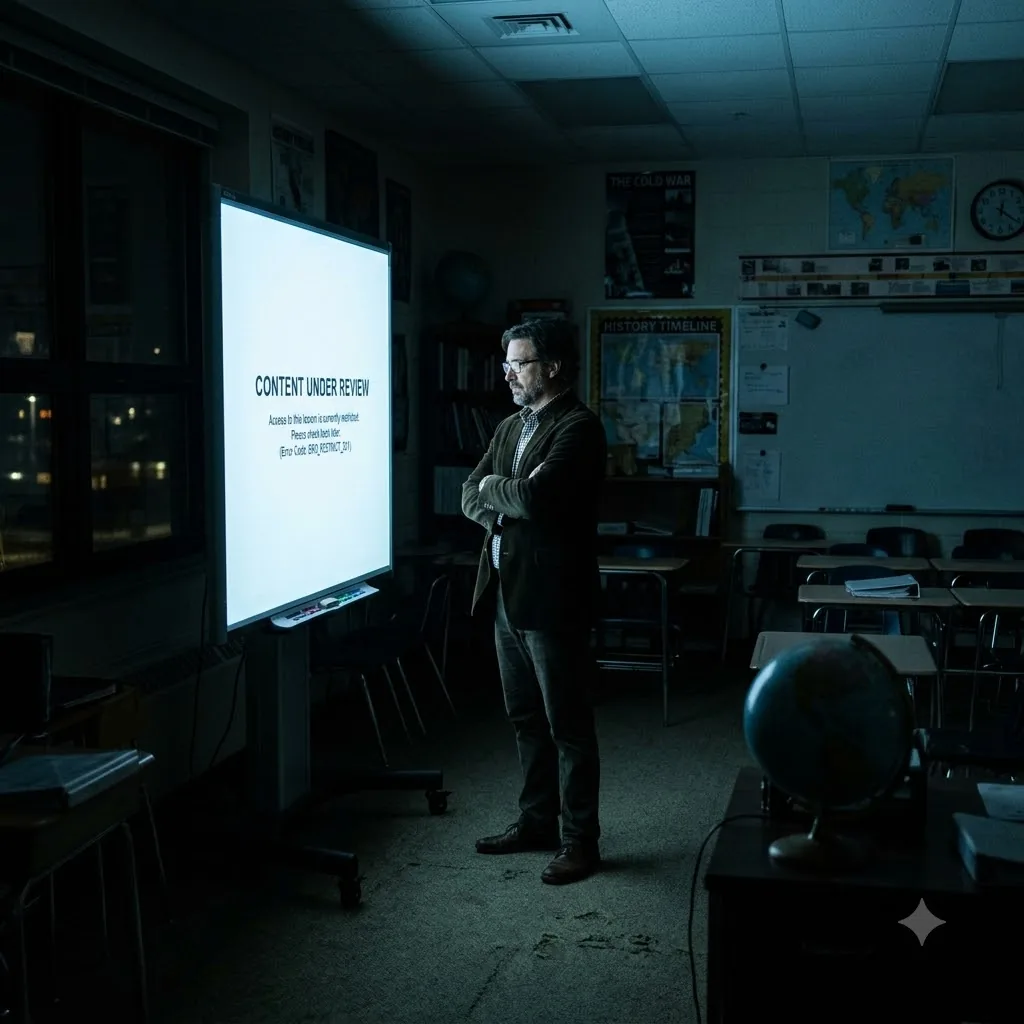
Story code: ST-001926
Part 2: The Compassion Mandate
The cylinder turned. Elias shoved a stack of standardized test prep booklets over the three neat piles of the 1924 restrictive covenants just as the heavy wooden door swung inward.
Principal Marcus Davis stepped into the room, his posture stiff, his eyes darting toward the corners of the classroom as if searching for hazards. Behind him stood Claire Sterling. She wore a tailored beige suit that matched the neutral, non-threatening tone of her district-wide emails. She clutched a sleek digital clipboard to her chest.
“Elias. Good morning,” Davis said. His voice lacked its usual booming warmth. He remained near the doorway, shifting his weight. “Apologies for the intrusion. We’re conducting mandatory compliance walkthroughs before the first bell.”
“Before the sun is fully up, you mean,” Elias said. His hands rested flat on the top of the test booklets. His pulse hammered against his ribs. The brass key to his desk drawer sat heavy in his pocket.
“We wanted to ensure a seamless transition for the faculty,” Claire said. She stepped past Davis, gliding into the room with a practiced, sympathetic smile. “Change is always difficult, Elias. We know how much pride you take in your localized curriculum. But we need to prioritize the emotional safety of our learners. Some of the material in the district repository was… deeply problematic.”
“Problematic,” Elias repeated. “They are municipal records, Claire. Public deeds.”
“They are artifacts of trauma,” Claire corrected gently, her tone identical to a therapist soothing a distressed patient. “Imagine a student sitting in this very room, reading a document that explicitly tells them they don’t belong in their own town. We are removing that burden. We are creating a harmonious environment where all students can focus on the future, rather than the ugly, divisive lines of the past.”
Elias gripped the edge of his desk. “You can’t understand the present if you erase the lines of the past. Those lines built the neighborhoods our students live in.”
“Which is exactly why the curriculum committee is streamlining the narrative,” Claire said, stopping a few feet from his desk. Her eyes swept over his workspace. “Harmony requires alignment. Speaking of which, IT flagged an administrative override attempt from this terminal at 5:42 AM. A failed attempt to access the sequestered redlining archives.”
Elias kept his face perfectly still. “I was checking my lesson plan for third period.”
“Your dedication is noted,” Principal Davis interjected, stepping forward to soften the interrogation. “But the new mandate is non-negotiable, Elias. Any circumvention of the digital firewall is a violation of the district’s new code of conduct. We need you to sign the acknowledgment.”
Davis extended the digital clipboard. The screen displayed a dense legal document masked in progressive buzzwords-*Commitment to Compassionate Pedagogy*. The penalty for violating the agreement was spelled out in bold at the bottom: Immediate unpaid administrative leave and review for termination.
“Sign it, Elias,” Davis urged softly. *Don’t throw away a twenty-year career this morning*, his exhausted expression seemed to say.
Elias looked at the stylus, then at Claire. Her compassionate smile remained fixed, but her eyes were cold, calculating. She was daring him to refuse. She wanted him out. If he refused to sign, Davis would be forced to escort him off the property before the first bell rang. He would lose his classroom, his students, and his platform.
Elias took the stylus. He scrawled his signature on the glass.
“Thank you,” Claire said, taking the clipboard from Davis. “Now, what are we covering today in third period? The approved syllabus suggests the industrial boom of the 1950s.”
“That’s the plan,” Elias lied smoothly. Beneath his palms, the sharp edges of the 1924 Oakridge covenants seemed to radiate heat through the test booklets.
Claire tilted her head, her gaze dropping to his hands. “You still use paper? How remarkably vintage. What are those?”
Elias pressed down slightly. “Practice materials. AP exam prep.”
Claire reached out. Elias’s muscles locked. If she moved the booklets, she would see the photocopies of the property deeds. She would see her own neighborhood’s founding documents, complete with the racial exclusion clauses he intended to hand out.
Instead, her manicured fingers pinched the edge of a rogue piece of paper sticking out from beneath his stapler. It was a 1934 municipal redlining map he had printed yesterday afternoon. She pulled it free.
The colorful map detailed the town’s original zoning districts, with harsh red ink slashing through the eastern neighborhoods-labeling them “hazardous” for investment.
Claire’s smile vanished for a fraction of a second before snapping back into place. “Elias. This is exactly the kind of distressing material the mandate prohibits. We discussed this.”
“It’s a map, Claire. It’s geography.”
“It’s a visual representation of systemic exclusion,” she countered smoothly, folding the map in half. “It has no place in a compassionate classroom. I’ll be taking this to the committee for secure disposal. Please stick to the approved portal.”
She turned on her heel and walked toward the door. Davis gave Elias one last, warning look before following her into the hallway. The door clicked shut.
Elias exhaled, his breath shuddering. He slid the test booklets aside, revealing the three neat piles of the 1924 covenants. They had survived, but using them now meant crossing a line he couldn’t uncross. The stakes had shifted from a mere reprimand to immediate termination.
The first bell rang, a shrill electronic tone that pierced the quiet room.
A few moments later, his early-arrival students began to trickle in. Maya, a bright, intensely focused senior who lived in the eastern district-the redlined district from the confiscated map-dropped her backpack next to her desk.
“Mr. Vance?” Maya asked, pulling out her laptop. “I tried to access the local history portal this morning, but the links are all dead. Did the district wipe the drives?”
“They’re performing a… curriculum update,” Elias said carefully.
Maya frowned, leaning forward. “That’s incredibly convenient. My mom was up all night at the community center. The town council is holding an emergency vote tonight on the Oakridge Expansion Project. They’re trying to push through a new zoning ordinance that would bulldoze our community center to build private amenities for the Oakridge subdivision.”
Elias froze. The Oakridge Expansion Project.
“The council claims Oakridge has historical precedent for autonomous zoning rights,” Maya continued, her voice thick with frustration. “Mom needed the old municipal deeds to prove at the hearing tonight that the original Oakridge zoning wasn’t based on ‘historical prestige.’ It was based on illegal racial covenants. But the digital archives went dark at two in the morning. We have no proof.”
Elias stared at the three neat piles of paper on his desk. The 1924 Oakridge covenants.
Claire Sterling wasn’t censoring the past to protect the emotional safety of the students. She was wiping the archives to destroy the legal evidence needed to stop her own neighborhood from annexing and bulldozing Maya’s community tonight.