Story code: ST-001926
Part 4: The Ink Is Dry
The silence stretching across the auditorium was heavy, broken only by the mechanical groan of the Apollo projector’s cooling fan. Up on the dais, Claire Sterling stared at the ten-foot-tall projection of the 1924 restrictive covenant overlaying her pristine architectural rendering. The therapeutic warmth she had weaponized all morning was completely gone. Her jaw tightened, the tendons in her neck standing out starkly against her beige suit.
She didn’t speak into the microphone. Instead, she abandoned the wooden lectern. Her heels clipped sharply against the stairs of the stage as she descended into the aisle. She didn’t look at the crowd. She marched straight toward the brass floor outlet.
“Claire,” Principal Davis warned, taking a half-step forward from the front row.
She ignored him. She grabbed the thick orange extension cord and yanked it upward.
The plug tore free from the socket with a sharp plastic snap. The projector’s halogen bulb died instantly, plunging the left side of the auditorium into shadow. The harsh, undeniably racist legalese vanished from the wall, leaving only the digital glow of the sun-drenched Oakridge rendering. But the afterimage seemed to burn in Elias’s retinas.
The sudden darkness did nothing to erase what the room had just read.
Elias stood up slowly, keeping his hand on the metal AV cart. The acrid smell of hot dust and melting plastic lingered in the air around him.
He watched the right side of the aisle-the Oakridge homeowners, the coalition of progressive allies who had championed Claire’s “emotional safety” mandate. Nobody was applauding her swift action. Nobody was nodding in agreement. A man in a tailored winter coat near the front row refused to meet Claire’s eye, intensely studying his leather portfolio. A woman two seats over crossed her arms, her expression hardening into quiet, profound disgust. The polite, harmonious facade had been violently shattered. The coded language had been translated, and none of them could pretend they didn’t know what they were voting for anymore.
On the left side of the aisle, Maya’s mother was already on her feet, holding up her phone. She had recorded the entire projection. Other residents of the eastern district were shouting now, demanding the council enter the 1924 deed into the official public record.
Claire stood holding the dead orange cord, her chest heaving. She glared at Elias, her mask completely slipped. There was no compassion in her eyes, only the raw, desperate fury of someone whose absolute control had just been publicly dismantled.
“You’re finished,” she whispered, her voice barely carrying over the rising uproar of the crowd.
Principal Davis stepped between them. He looked at Elias, his shoulders sagging under the weight of his own complicity. Davis didn’t yell. He didn’t call for security again. He simply extended a trembling hand, pointing toward the heavy double doors at the back of the auditorium.
“Give me your keys, Elias,” Davis said. His voice was hollow. “Your classroom. The building. Everything.”
Elias reached into his pocket. His fingers brushed against the small brass key to his desk drawer. He detached the school lanyard from his belt loop. The metal keys clinked loudly as he dropped them into Davis’s outstretched palm.
“The board will contact you regarding the termination proceedings,” Davis said, unable to look Elias in the eye. “Do not come to the campus tomorrow.”
“I understand,” Elias said.
He didn’t bother packing up the heavy AV cart. He reached onto the glass stage of the dead projector and gathered his acetate sheets, sliding them back into his manila folder. He turned his back on the dais, on Claire, and on Davis, and began the long walk up the center aisle.
As he passed the back rows, he caught Maya’s eye. She gave him a short, sharp nod. It was enough.
Elias pushed through the heavy auditorium doors and stepped out into the freezing night air. The cold hit him instantly, biting through his thin jacket, but the adrenaline still coursing through his veins kept him warm. He walked across the asphalt of the municipal parking lot, his footsteps echoing in the quiet dark. The muffled shouts of the zoning debate still vibrated through the brick walls behind him, a chaotic democracy finally working the way it was supposed to.
He reached his car, unlocking the door but not immediately getting in. He leaned against the cold roof, staring back at the distant silhouette of the high school across the street.
He had lost his job. Twenty years of teaching, of building a localized curriculum, wiped out in a single morning and finalized in a single night. He would not be there at 8:00 AM when the bell rang for first period. He would not be there to guide his third-period AP History class through the systemic construction of the local suburbs.
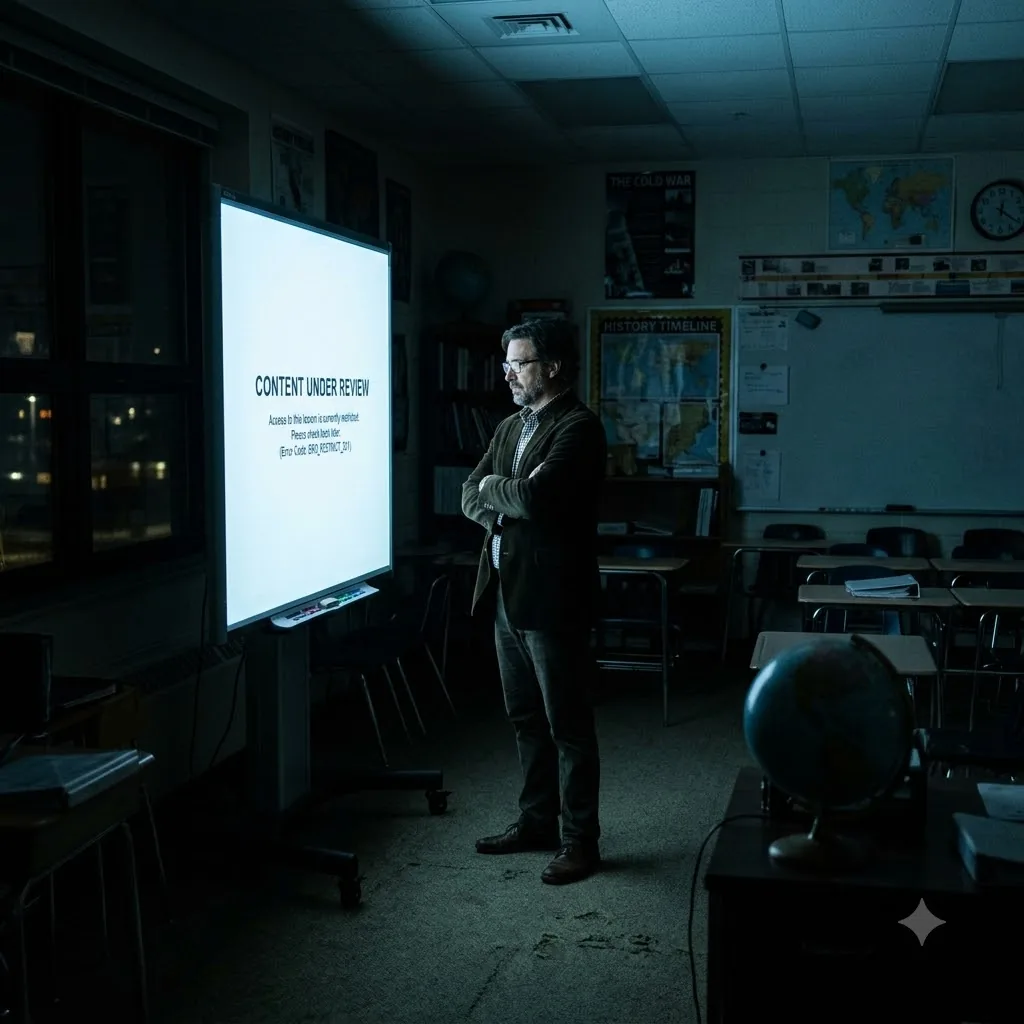
But as he stared at the dark, second-floor windows of Room 204, his mind snagged on a single image.
The three neat piles of paper resting on his desk.
The original 1924 restrictive housing covenants. The exact same text he had just projected onto the wall, photocopied thirty times for his students. He had left them sitting right on top of the standardized test booklets.
Claire Sterling could lock him out of the digital repository. Principal Davis could take his keys and ban him from the grounds. But they couldn’t undo the physical reality of what he had left behind.
Elias pulled his collar up against the biting wind, a quiet, unresolved tension settling in his chest. He wondered if Davis would think to sweep the room before the sun came up. He wondered if Claire’s mandate extended to tearing up physical paper with her bare hands.
Tomorrow morning, Maya and twenty-nine other seventeen-year-olds would walk into an empty classroom. They would find a substitute teacher who didn’t know the lesson plan. And they would find the paper.
Elias let out a slow, frosty breath, opened his car door, and slid into the driver’s seat. He didn’t know if the covenants and the maps would still be on the desks when the first bell rang. But he knew they couldn’t be unread, and out there in the dark, the ink was already dry.