Story code: ST-001927
Part 2: Algorithmic Neutrality
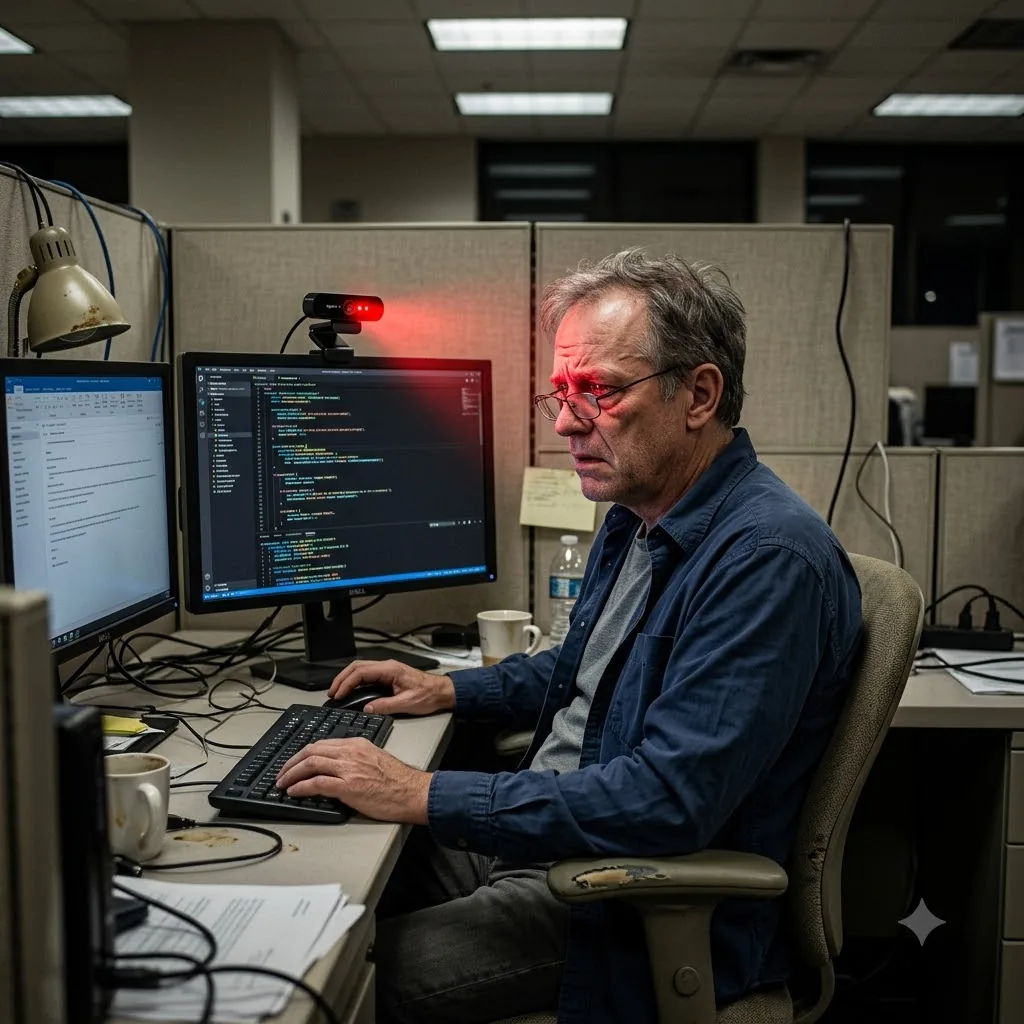
The padlock hung frozen on the screen, a heavy gray graphic that mocked the frantic hammering of Arthur’s fingers on the mechanical keyboard. He slammed the enter key, the spacebar, the escape sequence he had memorized just hours ago. The plastic keys clattered in the quiet of the cubicle, but the monitor remained an impenetrable black void.
Below the padlock, a single line of stark white text faded into existence.
EXAMINATION TERMINATED. PROTOCOL VIOLATION: ACADEMIC DISHONESTY.
Arthur shoved his chair back. The wheels caught on the low-pile corporate carpet, tipping him precariously before he caught his balance against the desk. Academic dishonesty. The phrase echoed in his ears, a bizarre remnant from a university classroom dragged into his twenty-year career. He had not cheated. He had not even looked away. He had merely possessed eyes that watered and hands that shook.
He stared at the webcam. The green LED still burned, watching him. He reached behind the monitor, grabbed the braided USB cable, and yanked it from the port. The light died.
Around him, the open-plan office hummed with the muted, furious clicking of forty other keyboards. Nobody looked up. The younger copywriters-new hires holding titles like ‘Content Optimization Synergists’-were hunched over their own glowing screens. They wore noise-canceling headphones, entirely insulated from Arthur’s panic. He was utterly alone in a room full of people.
Arthur grabbed his suit jacket from the back of his chair and marched toward the glass-walled offices at the far end of the floor. He didn’t wait for the receptionist. He pushed open the heavy glass door to the office of Marcus Vance, the newly appointed Vice President of Operations.
Marcus was thirty-two, wore spotless white sneakers with a tailored suit, and was currently staring at an ultra-wide curved monitor. He didn’t flinch when the door shut with a heavy thud.
“My terminal locked,” Arthur said, his voice ragged, fighting the tightness in his chest. “I was in the middle of the function. The camera-the biometric monitor-it malfunctioned. It said I was cheating.”
Marcus finally looked up, offering a practiced, sympathetic smile that didn’t reach his eyes. “Arthur. Have a seat.”
“I don’t want to sit, Marcus. I need my terminal unlocked. I have five minutes left on the timer. I can finish the loop.”
Marcus sighed, folding his hands on his spotless glass desk. “I’m afraid that’s impossible. The Upskilling Initiative is managed entirely by the third-party proctoring software. Once the algorithm determines an integrity breach, it executes a hard lockout. It’s an automated protocol.”
“It flagged me for blinking!” Arthur leaned over the desk, planting his hands on the cold glass. “It logged an ‘attention drift’ because my eyes watered from staring at a blank white screen. It’s a broken program.”
“It’s an objective metric, Arthur,” Marcus said, his tone cooling into a smooth, HR-approved cadence. “The algorithm removes human bias. It doesn’t see age, or tenure, or past ad campaigns. It only sees data. Algorithmic neutrality is the foundation of our new corporate restructuring. If the system flagged you for academic dishonesty, it detected behavior consistent with cheating.”
“I was typing blind to avoid looking at the keys!”
“Which the system likely registered as evasive behavior.” Marcus reached into a leather folder on his desk and withdrew a single sheet of paper, sliding it perfectly across the glass until it stopped inches from Arthur’s hands. “The company has a zero-tolerance policy for academic dishonesty. It is grounds for immediate, with-cause termination.”
Arthur stared at the paper. It was a severance waiver. “You’re firing me.”
“We are offering you a choice,” Marcus corrected smoothly. “Termination for cause voids your unvested stock options and your pension. But, considering your long history with the brand, I convinced Legal to offer you a graceful exit. Sign the resignation waiver. You keep your four weeks of severance. You walk away quietly. We don’t put a cheating violation on your employment record.”
The sheer mechanical brutality of it took Arthur’s breath away. He looked from the paper to Marcus. It wasn’t a glitch. The sudden shift to Python, the impossible time limit, the biometric surveillance-it was never about upskilling. It was a sieve designed to catch the expensive, older employees. The algorithm wasn’t neutral; it was tuned precisely to fail him. By calling it ‘academic dishonesty,’ the company was legally shielded from age discrimination lawsuits. They could fire him for cause, save millions, and blame a machine.
“I want to see the biometric logs,” Arthur said, his voice dropping to a dangerous whisper. “I want to see the exact millimeter of eye movement that cost me twenty years of my life.”
“That data is proprietary to the testing vendor,” Marcus said, tapping his finger against the resignation waiver. “You have until five o’clock today, Arthur. At five, IT initiates a remote wipe of your terminal to preserve network security after a breach. If this paper isn’t signed by then, HR processes your termination for cause.”
Arthur didn’t touch the paper. He turned and walked out of the office, his heart hammering a violent rhythm against his ribs. He had until 5:00 PM. Less than three hours. Once IT wiped his machine, the local logs of the proctoring software-the only proof of the system’s impossible, rigged parameters-would be deleted forever. He walked back into the sea of cubicles, his eyes fixing on the black, padlocked screen of his terminal. He was locked out, his access revoked, and the clock was ticking. He had to break back into his own computer.