Story code: ST-001927
Part 3: The Conversion Funnel
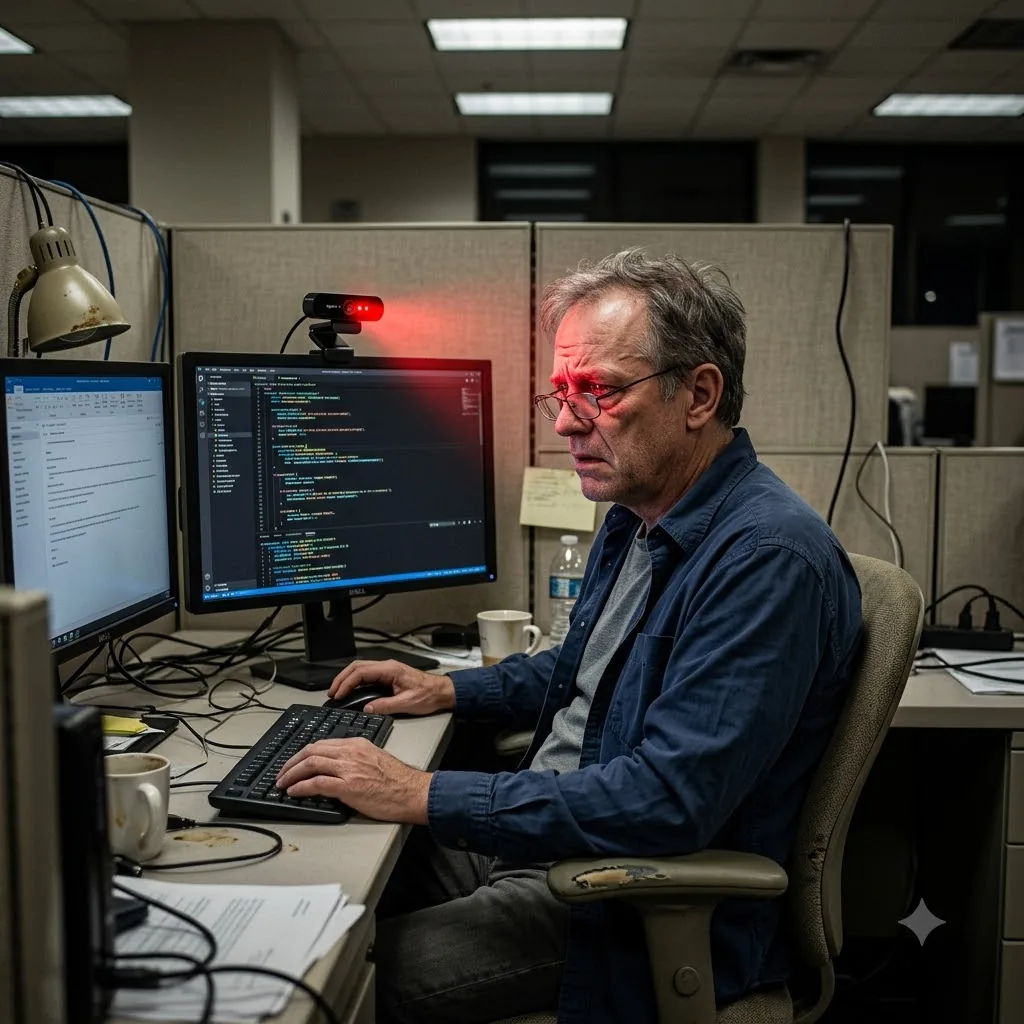
Arthur stared at the heavy gray padlock on his monitor. His reflection stared back from the glossy black bezel, pale and damp with sweat. He was locked out. He had less than three hours before IT wiped the terminal, deleting the local biometric logs and burying his twenty-year career under a robotic verdict of academic dishonesty.
He pressed the heels of his hands against his eyes, his breathing shallow and erratic. He had lost. He didn’t know Python. He didn’t understand the machine.
But as he sat in the oppressive silence of his cubicle, the sheer, polished cruelty of the interface nagged at him. He lowered his hands, looking back at the frozen screen. He remembered the specific phrasing of the error logs that had popped up just before the lockout.
*Warning: Attention Drift Detected.*
*Warning: Micro-expression anomaly.*
Arthur turned his head, looking past his low cubicle wall. The open-plan bullpen was a sea of younger employees, all wearing noise-canceling headphones, all staring intently at their own blindingly white screens.
He was a copywriter. He didn’t know how to code a loop, but he knew exactly how to build a user journey. For two decades, he had designed campaigns to bypass human logic and trigger subconscious emotional responses. He knew the precise shade of blue that made consumers trust a financial institution. He knew that adding a ticking countdown timer to a checkout page increased conversion rates by artificially spiking cortisol and creating a false sense of scarcity.
He looked at the padlock again. He thought about the test environment he had just failed out of.
A stark, blindingly bright white background. A harsh red border that flashed in the peripheral vision. A countdown timer placed in the top right corner, exactly where the human eye naturally flicked when tracking danger.
It wasn’t a neutral testing environment. It was a hostile architecture. It was a psychological pressure cooker constructed using the exact same dark patterns Arthur used to sell clearance electronics and limited-time software subscriptions.
Arthur reached into his pocket and pulled out his smartphone. He opened the web browser and searched for the vendor name Marcus had mentioned, and which he had seen on the test’s launch splash screen: *Aegis Proctoring Solutions*. He bypassed their glossy corporate homepage and navigated straight to their B2B marketing whitepapers, reading the ad copy with an expert’s clinical eye.
*”Predictive workforce filtering.”*
*”Physiological compliance tracking.”*
*”Algorithmic liability shielding.”*
Arthur felt a cold, sharp clarity wash over him. The panic evaporated, replaced entirely by the ruthless, calculating focus he usually reserved for dismantling a competitor’s advertising campaign.
He stood up, gripping his phone tight. He walked out of his cubicle and strode to the center of the bullpen. Suspended from the ceiling above the central workstations was an eighty-inch 4K monitor, used for Friday morning pitch meetings and all-hands agency addresses.
Arthur swiped down on his phone screen and tapped the screen-mirroring icon. He selected the bullpen monitor.
A loud, resonant chime echoed across the open-plan office.
Forty mechanical keyboards stopped clicking simultaneously. Forty heads popped up over the low acoustic partitions. The young ‘Content Optimization Synergists’ pulled off their headphones, blinking in confusion as the massive monitor flickered to life, displaying Arthur’s phone screen in towering proportions.
The glass door to the executive suite swung open. Marcus Vance marched out, his brow furrowed in irritation, his spotless white sneakers squeaking faintly on the carpet. “Arthur, what are you doing? Disconnect from the main display immediately.”
“I couldn’t figure out why a copywriting upskilling initiative required nested data dictionaries,” Arthur announced, his voice booming across the silent floor. He didn’t look at Marcus. He projected his voice to the bullpen, using the exact cadence and booming authority that had sold the company’s flagship product to millions. “It didn’t make sense. Until I looked at it not as a test of competence, but as a conversion funnel.”
Arthur tapped his phone, zooming in on the Aegis Proctoring API documentation page. The text blew up on the eighty-inch screen, glowing bright blue and white.
“This software isn’t evaluating Python,” Arthur said. “Look at their own supported frameworks list on the screen. It doesn’t even contain a compiler. It can’t read code.”
Marcus stopped halfway down the aisle, his face flushing. “Arthur, this is a severe violation of company policy. I am calling Security.”
“You said the algorithm was neutral, Marcus!” Arthur shouted over him, stepping into the aisle to block the Vice President’s path. “You said it removed human bias and only looked at the data. But it’s not grading code. It’s grading physiological submission.”
Arthur turned to the younger employees, sweeping his arm toward the giant display. “Look at the user interface we were just subjected to. A blinding white IDE. Flashing crimson borders. A ticking clock. In marketing, we call this a stress-induction loop. It’s designed to spike cortisol. It forces your pupils to dilate. It dries out your corneas, forcing an irregular blink rate. It induces the exact micro-expressions and physical twitches that the algorithm is specifically programmed to flag as ‘Academic Dishonesty.'”
Whispers broke out across the bullpen. Several young coders turned back to their screens, their eyes narrowing as they scrutinized the test windows they had been sweating over.
“It’s an A/B test, and older employees are the control group,” Arthur continued, his voice ringing with absolute certainty. “The system subjects us to an impossible cognitive load using foreign syntax, combines it with a hostile UI, and waits for our aging nervous systems to crack under the artificial stress. It triggers a panic response, logs the sweat and the eye twitches as cheating, and automatically locks the terminal.”
Arthur took a step closer to Marcus, forcing the younger executive to hold his ground. “It’s a flawless machine for a mass layoff. It funnels expensive, tenured employees with slightly slower reflexes into a termination-for-cause bucket, voiding our pensions without triggering a single age-discrimination lawsuit. You didn’t buy a neutral testing algorithm, Marcus. You bought a digital hitman to help you steal our severance.”
“That is unhinged paranoia,” Marcus snapped, his voice suddenly shrill, entirely devoid of its previous HR-approved smoothness. “You failed the test because you didn’t adapt. The machine caught you looking away. That’s the end of it.”
“Is it?” A voice called out from the back of the room.
Arthur turned. A young synergist three rows down-a kid who couldn’t be older than twenty-four, wearing a vintage band t-shirt-was staring intensely at his own dual monitors. His fingers were flying rapidly across his keyboard.
“He’s right,” the kid said, looking up, his face pale. “I just ran a packet sniffer on the test application. I wanted to see where my Python script was being hosted. But… it’s not.”
The kid stood up, grabbing his monitor and swiveling it around so the aisle could see. Lines of network traffic data scrolled rapidly down a black command terminal.
“The application isn’t sending our keystrokes anywhere,” the kid said, his voice echoing in the quiet room. “The only outbound payload is a continuous JSON stream from the webcam telemetry. It’s measuring heart rate via facial blood flow. It’s measuring eye moisture. It literally doesn’t know what we’re typing. It’s just watching us sweat.”
The floor went dead silent. The hum of the air conditioning suddenly sounded deafening.
Every single eye in the bullpen turned to Marcus Vance.
Marcus stood frozen in the center aisle. The practiced, sympathetic smile was completely gone, replaced by a rigid, hollow stare. His mouth opened slightly, but as he looked from the undeniable telemetry data on the young coder’s screen to the colossal vendor documentation glowing above Arthur’s head, the Vice President of Operations found himself entirely out of corporate doublespeak.