Story code: ST-001927
Part 4: The Exit Node
Marcus Vance did not apologize. He did not attempt to explain away the lines of raw JSON telemetry reflecting off the young coder’s glasses. Instead, his mouth snapped shut, his jaw tightening into a hard, bloodless line. Without a word to Arthur or the silent crowd of employees, the Vice President of Operations turned on his spotless white sneakers, marched back into his glass-walled office, and pulled the blinds.
A heavy, suffocating silence settled over the bullpen. The eighty-inch monitor above them still broadcast the Aegis Proctoring documentation, casting a harsh blue glow over the cubicles.
Then, the phones began to buzz.
It started as a singular vibration against Arthur’s thigh, quickly followed by a discordant symphony of chimes, rings, and notification alerts erupting from pockets and desks across the entire floor. Arthur pulled his phone out. A new email sat at the top of his personal inbox, dispatched from the automated HR server.
*NOTICE OF TERMINATION: WITH CAUSE.*
Arthur didn’t need to read past the subject line to know what the sterile corporate legalese contained. The algorithm had executed its final command. His unvested stock options were gone. His pension, built over two decades of loyal service, was completely voided. The machine had labeled him a cheat, and the corporate entity had happily processed the cost-saving execution.
Across the bullpen, Arthur heard a sharp gasp. A woman in her late fifties, a senior media buyer who sat three rows over, was staring at her phone with trembling hands. Beside her, her dual monitors instantly snapped to black, a heavy gray padlock appearing on both screens. Five other monitors in the room went dark in perfect synchronization. The 5:00 PM IT wipe hadn’t been canceled; it had been accelerated.
Arthur looked toward the executive corridor. Sloane, the Director of Human Resources, was speed-walking out of the main boardroom. She clutched a sleek tablet to her chest, her eyes fixed rigidly on the carpet, refusing to look at the bullpen. Arthur watched her slip into the HR suite. She shoved the heavy oak door closed, and the sharp, metallic clack of the deadbolt echoed cleanly across the silent floor. A moment later, the horizontal blinds violently snapped shut, obscuring the glass. She had barricaded herself in. The executives were letting the automated system take the fall, hiding in their offices while the algorithm stripped away livelihoods.
“I’m sorry,” a quiet voice said.
Arthur turned. The young coder in the vintage band t-shirt was standing by his desk, looking sick to his stomach. He gestured helplessly toward his own command terminal, which was still intercepting the grim biometric data. “I didn’t know. None of us knew.”
“It’s not your fault,” Arthur said, his voice remarkably steady. “They built the funnel. You just proved where it leads.”
Arthur walked slowly back to his own cubicle for the final time. The screen was dead black, perfectly mirroring the others. He stood before the desk that had anchored his entire adult life. He looked at the deep, familiar groove worn into the laminate edge by his metal watch clasp. He reached out and touched the faded acrylic trophy for the 2008 Winter Ad Blitz. It was slightly dusty. It looked absurd now, a cheap piece of plastic offered in exchange for twenty years of his youth.
He had intended to pack his things. He had an empty cardboard box folded beneath his filing cabinet for exactly this scenario. But as he looked at the trophy, the branded corporate pens, and the framed certificates pinned to the felt partition, he realized none of it belonged to him anymore. It belonged to the machine.
Arthur unclipped the plastic security badge from his belt and dropped it onto the mechanical keyboard. He left the awards right where they were.
He turned his back on the desk and walked down the center aisle. The young ‘Content Optimization Synergists’ stepped back to give him a wide berth. Nobody spoke. The only sound was the low hum of the air conditioning and the distant, muffled ringing of unanswered phones in Sloane’s barricaded HR suite. Arthur didn’t look back at Marcus’s office, nor did he look at the giant monitor still displaying the truth of the upskilling initiative. He simply stepped into the elevator and pressed the button for the lobby.
The heavy glass doors of the corporate headquarters slid open, and Arthur stepped out into the brutal late-afternoon heat. The air was thick, smelling of baking asphalt and exhaust fumes. The humidity instantly pressed against his suit jacket, drawing a fresh line of sweat down his back.
He was fifty-three years old. His pension was gone. His severance was evaporated. He was stepping into a hostile, youth-obsessed job market with a termination for cause on his permanent record. By every quantifiable metric the corporate world respected, he was facing absolute financial ruin.
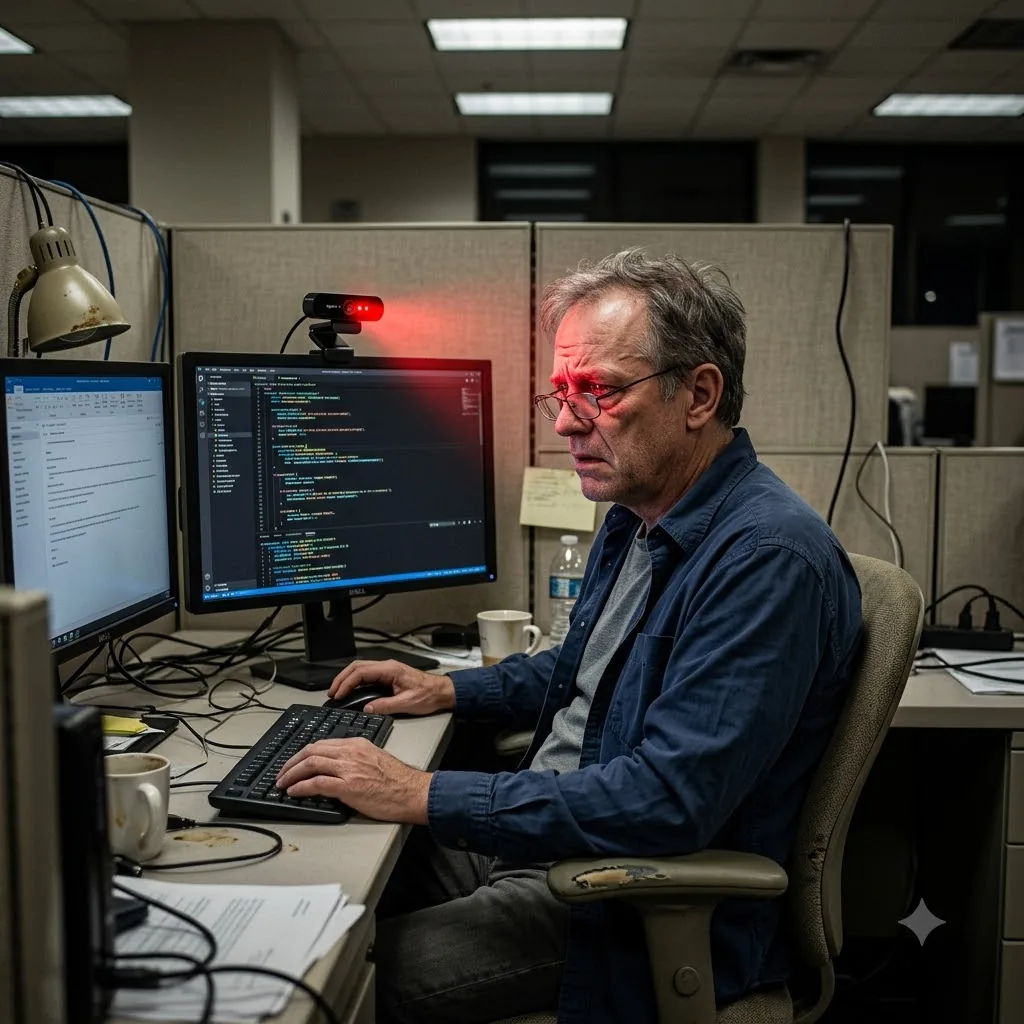
Arthur reached up, unbuttoned his collar, and loosened his tie. He took a deep, lung-expanding breath of the sweltering city air. He didn’t have to parse a JSON array tomorrow. He didn’t have to sit beneath an unblinking green LED and manage his own heart rate for the benefit of a robotic warden. The worst had happened, and he was still standing.
He looked up at the towering glass facade of the building, reflecting the blinding summer sun. For the first time in twenty years, Arthur had no idea what he was going to write next, and the sheer, terrifying emptiness of the page felt like total liberation.